A Glacier Fell 1,200 Metres Onto a River, and a Valley Full of Travellers Was Gone in Half an Hour
The ice broke away above the Lhende river in Tibet on Wednesday morning, dammed it, then let go. Nepal's tourism department has 668 visitors from 34 countries listed as missing. The mechanism has a name, and the Himalaya is producing it more often.
Friday, August 28, 2026/4 min read
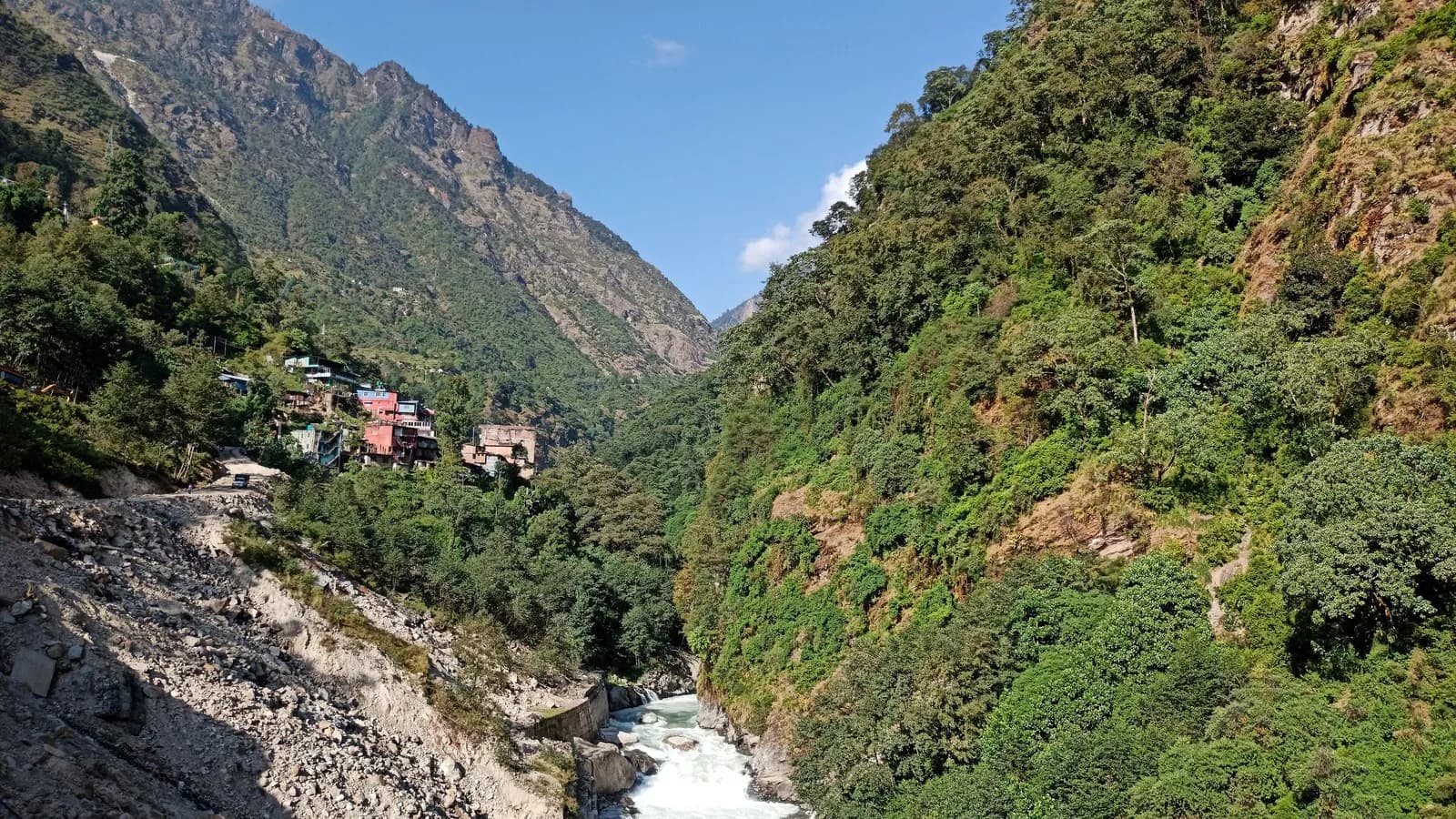
At about twenty to nine on Wednesday morning, local time, a section of glacier broke away at around 5,200 metres in the Himalaya, roughly 20 kilometres northeast of the Nepal and China border. The ice and rock fell about 1,200 metres onto the valley floor and landed on the Lhende river in Tibet, blocking it.
The blockage held for a short time. When it failed, the water went down the Lhende Khola valley into Nepal, into the Bhote Koshi, and then into the Trishuli. At one measuring point the Trishuli rose by up to nine metres in thirty minutes.
As of Thursday evening the confirmed toll stood at least 389 dead in Nepal with hundreds missing, and three dead with 558 missing in Gyirong County on the Tibetan side. Nepal's Department of Tourism listed 668 visitors from 34 countries as missing, including 177 from India, 90 from the United States and 34 from Australia. Tibet reported a further 260 foreign nationals unaccounted for. Many were pilgrims on the route to Mount Kailash and Lake Mansarovar.
What actually happened, in the correct order
It was not an earthquake, and the first reports said it was.
The United States Geological Survey initially logged a magnitude 4.4 seismic signal, which was widely reported as a quake that triggered the collapse. The USGS later corrected this. The signal was the landslide itself, and the mass of falling ice and rock was large enough to register as a magnitude 5.2 event.
That correction matters more than a technical footnote usually does. An earthquake is an external trigger and a matter of bad luck. A slope that fails on its own, on an ordinary August morning, is a different category of event, and a different question about what else on that ridge is now unstable.
The mechanism has a name
What happened on Wednesday is close to what glaciologists call a glacial lake outburst flood, usually shortened to GLOF, with the variation that the dam here was formed by the debris of the collapse rather than by a pre-existing moraine.
The pattern is the same either way. Meltwater or a river accumulates behind a barrier of ice, rock or loose glacial debris. The barrier is not engineered and was never meant to hold anything. When it fails, it does not leak. It empties, and the resulting surge moves down a steep valley carrying boulders and trees, which is why a GLOF destroys bridges that survive ordinary monsoon flooding.
At least 19 bridges and around 40 kilometres of road were destroyed on Wednesday. Roughly 350 workers at the Upper Trishuli hydropower project were initially trapped. The loss of the bridges is what has made the search so slow: the roads that rescue teams would use are in the river.
Is this climate change?
The honest answer is that nobody has established direct attribution for this specific collapse, and the honest answer also does not end there.
Satellite observation showed unusually warm conditions around the affected glacier in the period before it failed, with snow cover reduced and more bare ice exposed. Bare ice absorbs far more heat than snow does. That is a description of the conditions, not a proof of cause.
The background trend is not ambiguous. Glaciers in the Hindu Kush Himalaya lost ice 65 per cent faster between 2011 and 2020 than in the preceding decade. Nepal's glaciers have lost close to a third of their ice volume in roughly three decades. Retreating ice leaves behind meltwater ponds held back by unconsolidated debris, and it destabilises the rock walls that the ice had been buttressing for centuries. Both of those raise the frequency of exactly this kind of event.
So the correct formulation is the boring one. Warming does not schedule any particular collapse. It increases how many of them there are to schedule.
What this means if you are travelling there
The immediate risk has not finished. A new lake has formed at the site of the collapse and has been rising, which puts communities downstream in Nepal and in India's Bihar state at risk of a second flood from the same debris.
Beyond the immediate emergency, there are a few things worth understanding before booking a Himalayan trek or the Kailash pilgrimage, and they are not reasons not to go.
Trekking routes follow valleys, because valleys are where the paths are. That means the exposure is structural rather than a matter of choosing a risky operator. GLOFs arrive with almost no warning at the point of impact, which is why early warning systems in the region focus on sensors high in the catchment rather than on anything a traveller can observe. Nepal has installed such systems on some rivers and not on others, and asking an operator which category your route falls into is a reasonable question that very few people think to ask.
Late August sits at the end of the monsoon, when meltwater volumes and slope saturation are both near their peak. The autumn trekking season that begins in late September is drier and, on this particular hazard, safer.
The wider point
The Himalaya is a young, actively rising, structurally unstable mountain range, and it is now being warmed. Tourism to it has grown steadily, and the pilgrimage traffic to Kailash and Mansarovar is heavier than it has ever been.
That combination is what turned a slope failure at 5,200 metres into an event with people from 34 countries on the missing list. We have written about the way climate is quietly redrawing where people choose to travel in the rise of the coolcation, and about how quickly a region's visitor numbers can move when conditions change in this year's collapse in Middle East arrivals. This is the harder version of the same subject: not where the weather is pleasant, but where the ground is holding.
Published in The Outspoken Digest
Editorial desk
Outspoken Digest Travel DeskDestinations, airlines, borders and the practicalities of getting there.
Newsletter
The Digest, in your inbox
One edition, sent when it is ready. No noise, and your address is never passed on.
Read Next
More Travel →
British Airways Is Back in Sri Lanka: The First Gatwick to Colombo Flight Lands After 10 Years
Oct 24, 2026/2 min read

Etihad Starts Abu Dhabi to Calgary Nonstops on Sunday, Western Canada's First Gulf Link
Oct 23, 2026/2 min read
Western Sydney Airport Opens to Passengers on Sunday: First Flights, Airlines and How to Get There
Oct 22, 2026/2 min read
Alaska and Hawaiian Airlines Will Fly Nonstop From Seattle to Osaka and Tahiti From Spring 2027
Oct 20, 2026/2 min read