Your First Night Dive: What Changes When the Light Goes
The same reef becomes a different site after dark, and so does the diving. Navigation, buddy contact and the way your brain handles a narrow beam all need rethinking before you get in.
Saturday, August 8, 2026/4 min read
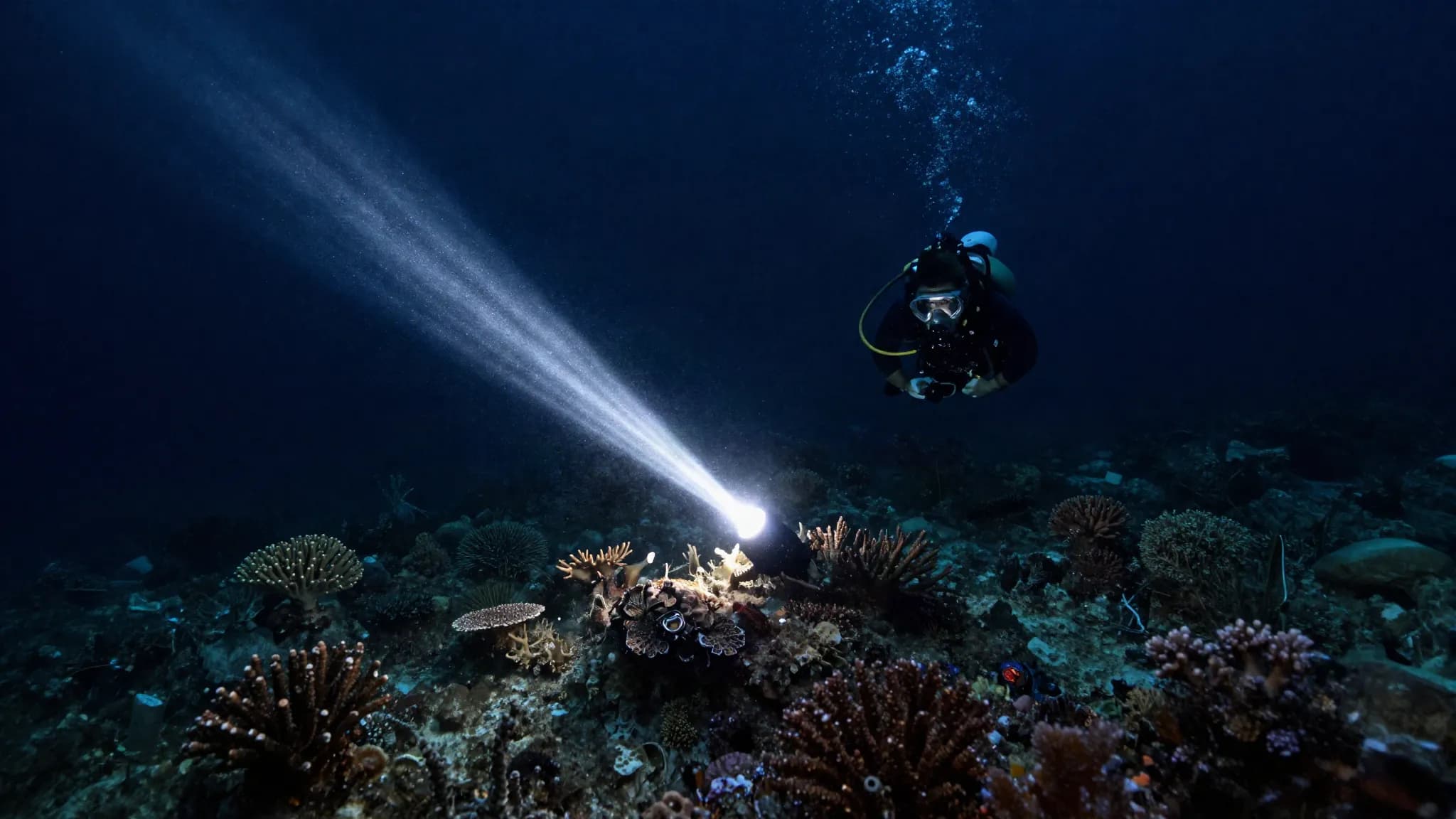
A reef you have dived twenty times in daylight is not the same site after dark. Different animals are out, the ones you know are behaving differently, and your own capacity to orient yourself has been cut to the width of a torch beam.
Night diving is not more dangerous than day diving in any inherent sense. It is a set of familiar skills performed with much less information, which means the skills need to be solid before the light goes.
What actually changes
Your field of view collapses. In daylight you take in the whole reef, the boat, the shot line and your buddy without thinking. At night you see a cone. Everything outside the cone effectively does not exist, and that includes the things you would normally navigate by.
Depth and distance perception degrade. Judging how far away something is becomes much harder without peripheral cues, which affects buoyancy control more than people expect.
Buddy contact stops being automatic. A buddy two metres away is invisible if their torch is pointed elsewhere. Separation happens fast and quietly.
Task loading rises. You are now managing a torch as well as everything else, and one hand is occupied.
And the psychology shifts. Most people feel some unease on the first night descent. This is normal, it usually passes within a few minutes, and knowing it is coming is most of the management.
Torches: bring three, and know what each is for
The single most important piece of preparation is redundancy.
A primary torch should be bright with a reasonably focused beam and enough burn time for the dive with a wide margin. Check the battery before every dive rather than trusting the last one.
A backup torch is not optional. It goes in a pocket, it is smaller, and its only job is to get you out if the primary fails. A dive where the primary dies and there is no backup becomes an ascent in the dark.
A marker light attached to your tank valve, usually a small chemical stick or LED, is how your buddy finds you when your primary is pointed elsewhere. Agree the colours in the group beforehand so people are distinguishable.
On the boat, a strobe or bright light at the exit point and on the shot line makes the return unambiguous.
How to use a torch without ruining the dive
There is technique here and beginners rarely get told it.
Do not shine it in anyone's face. Night vision takes a long time to build and about a second to destroy, and a beam across the mask leaves your buddy blind for the next few minutes.
Signal with the beam on a surface rather than at a person. Draw a slow circle on the sand or reef for attention, and a horizontal side-to-side sweep for a problem. Keep the movements deliberate; a beam waved rapidly reads as distress in most conventions.
Point the beam slightly down and ahead when swimming, not straight out. It preserves some peripheral adaptation and it stops you from lighting up the water column, which is full of particles that scatter the light straight back at you.
Turn it off once, deliberately, in a controlled position with a hand on your buddy. In clear water with a moon there is often more ambient light than expected, and the bioluminescence that appears when you wave a hand through the water is the reason many people night dive at all.
Site choice and planning
Night diving is a specialty rating for a reason, and it assumes the fundamentals are already automatic, which is worth reading alongside what an open water certification does and does not qualify you for. Do your first night dive on a site you know well in daylight, ideally the same day. Familiar topography carries a lot of the navigation load.
Choose something shallow, sheltered and simple. Depth compounds every other issue and there is nothing at thirty metres at night that is not also available at twelve.
Plan a conservative profile with generous gas reserves. Torch management, closer buddy contact and the extra alertness all raise consumption, and most people breathe more on a first night dive than they expect.
Brief thoroughly on the surface: entry and exit, the route, the turn point, light signals, lost buddy procedure and maximum depth and time. The lost buddy procedure at night is the same principle as by day, search for a minute then ascend, but the search is far less likely to succeed, so the emphasis is on not separating in the first place.
What you get for the trouble
The reason to do any of this is that the reef changes shift.
Parrotfish sleep wrapped in mucus cocoons. Octopus and cuttlefish come out to hunt in the open. Coral polyps extend to feed, so a coral head that looked like rock in daylight becomes visibly alive and furry. Crustaceans emerge everywhere, and a beam swept across the sand comes back as dozens of small reflective eyes.
Divers who have done both often say the first night dive on a familiar reef was the dive that made them realise how little they had been seeing.
Take the course, dive with someone experienced, and treat the torch as life support rather than an accessory. For the wider safety picture, our guide to diving in remote locations covers the planning that applies whenever help is not close.
Published in The Outspoken Digest
Editorial desk
Outspoken Digest Diving DeskCovers freediving, recreational and technical diving, dive medicine and the incidents the sport learns from.
Newsletter
The Digest, in your inbox
One edition, sent when it is ready. No noise, and your address is never passed on.
Read Next
More Diving →
Divers Cement Storm-Torn Corals Back Onto Hawaii's Reefs While a 45-Day Clock Runs
Oct 25, 2026/2 min read

Polish Diver Reaches 338 Metres in North Macedonia's Vrelo Cave, a Claimed Depth Record
Oct 23, 2026/3 min read
Breathless and Coughing Pink Froth After a Dive: Immersion Pulmonary Edema Explained
Oct 17, 2026/3 min read
Your Gas Consumption Is Not One Number: Why Depth, Cold and Nerves Change It
Oct 16, 2026/3 min read