Nvidia Opens Its Vera Rubin Rack Designs to the Open Compute Project and Pushes Racks Up to 250 Kilowatts
At the Open Compute Project summit in San Jose, Nvidia contributed rack and tray blueprints, new liquid-cooling specs and open software, while Meta and Cisco signed on to new networking.
Outspoken Digest Technology Desk
Tuesday, October 13, 2026/2 min read
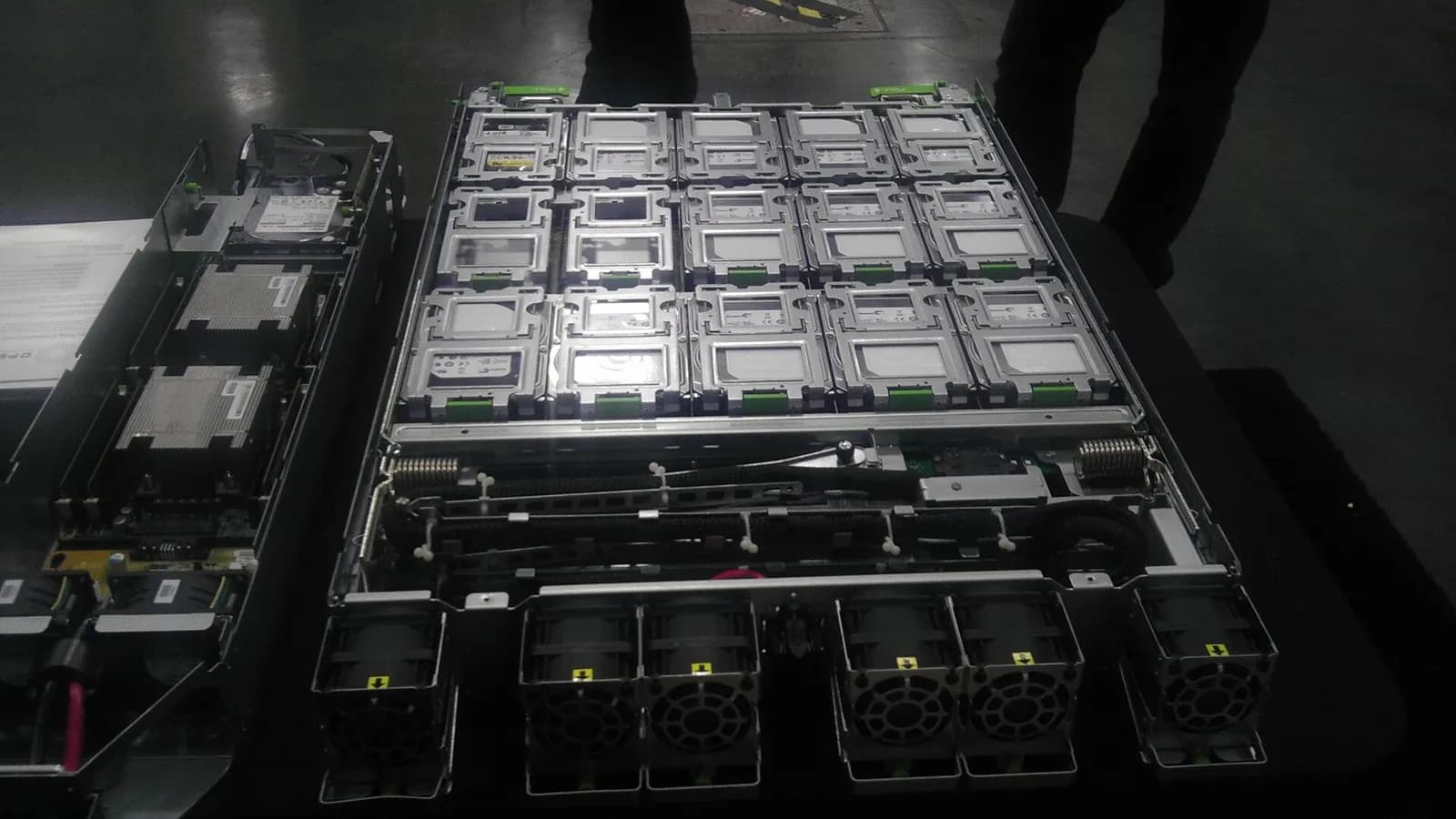
The least glamorous layer of the AI boom, the metal cabinets, cooling loops and power rails around the chips, got a public airing on 12 October. At the Open Compute Project Global Summit in San Jose, Nvidia said it was contributing the rack and compute-tray designs for its Vera Rubin generation to the open standards body, according to the company's blog post.
The designs travel through MGX, Nvidia's modular reference architecture, as part of a third-generation reference design in OCP's Open DC Initiative. In plain terms, rivals and suppliers can build compatible hardware without negotiating each interface from scratch.
What is in MGX 1.2?
The updated specification adds rack-scale blind-mate liquid cooling, so trays can slide in and connect to coolant without hand plumbing, and a liquid-cooled 5,000 amp busbar. It supports native 19-inch equipment and rack deployments up to 250 kilowatts, according to StorageReview. A separate Vera CPU rack design targets agentic workloads such as tool calling and sandboxed code execution.
Nvidia also released four open-source software components for running a GPU cluster: switch configuration, cluster stress testing, rack firmware management and bare-metal provisioning, all drawn from its DGX Cloud operations. They are named Config Manager, Cluster Readiness Engine, Rack Management Service and a Cluster API provider for infrastructure control, and each is meant to take over a chore that large operators otherwise script themselves.
Who else announced what?
Nvidia published an Open Data Center Specification, version 0.7, with AMD, Google and Meta, a blueprint for power, cooling and physical layout. Google, Meta, Microsoft and Nvidia also published a grid resilience specification that sets a target of restoring near-full load in under two seconds after a disturbance. That is a design target, not a measured result.
On networking, Meta is adopting Nvidia's Spectrum-6 Ethernet switches, which run at 102.4 terabits per second, and Nvidia says its multiplane design aims at factories of more than 100,000 GPUs. Cisco announced USFP, a pluggable optic with roughly the footprint of today's OSFP that targets 400 gigabits per lane, about four times the density of 200-gigabit optics, with 1.3 times better power efficiency. Google said its Falcon transport will be supported on future Nvidia network cards. Gilad Shainer, an Nvidia senior vice president, said building the largest AI factories starts with rethinking the smallest connections. Partner Visionbay unveiled an 800-volt DC platform built for future Vera Rubin sites.
Why does openness matter here?
For operators, the pitch is faster, cheaper builds. For Nvidia, it is also strategic: a standard that others copy keeps its platform at the centre of the supply chain. The test will be adoption. Watch which cooling vendors and server makers ship MGX 1.2 hardware, and how many sites actually run racks at the 250 kilowatt level the specification now allows.
Published in The Outspoken Digest
Editorial desk
Outspoken Digest Technology DeskSoftware, hardware, artificial intelligence and what they change for everyone else.
Newsletter
The Digest, in your inbox
One edition, sent when it is ready. No noise, and your address is never passed on.
Read Next
More Technology →
Anthropic Researchers Warn Small AI Models Could Soon Copy Themselves Onto Smart TVs and Other Home Devices
Oct 13, 2026/3 min read
Microsoft Unveils Maia 300 With 288GB of HBM4 and a 96-Chip Rack, Claiming Up to Seven Times Maia 200 Throughput
Oct 13, 2026/2 min read

Bronze Ring Engraved With the Lighthouse of Alexandria Found in the Sunken Royal Palace on Antirhodos
Oct 13, 2026/2 min read

Gannets Survive 70 mph Dives Thanks to an Extra Joint Facet in Their Neck Bones, a New Study Finds
Oct 13, 2026/2 min read