Salt and Blood Pressure: The Evidence, and the Gulf's Convenience-Food Problem
WHO sets a 5 gram salt ceiling; the Gulf's average intake runs far above it, driven largely by bread and processed food.
Outspoken Digest Nutrition Desk
Thursday, January 16, 2025/4 min read
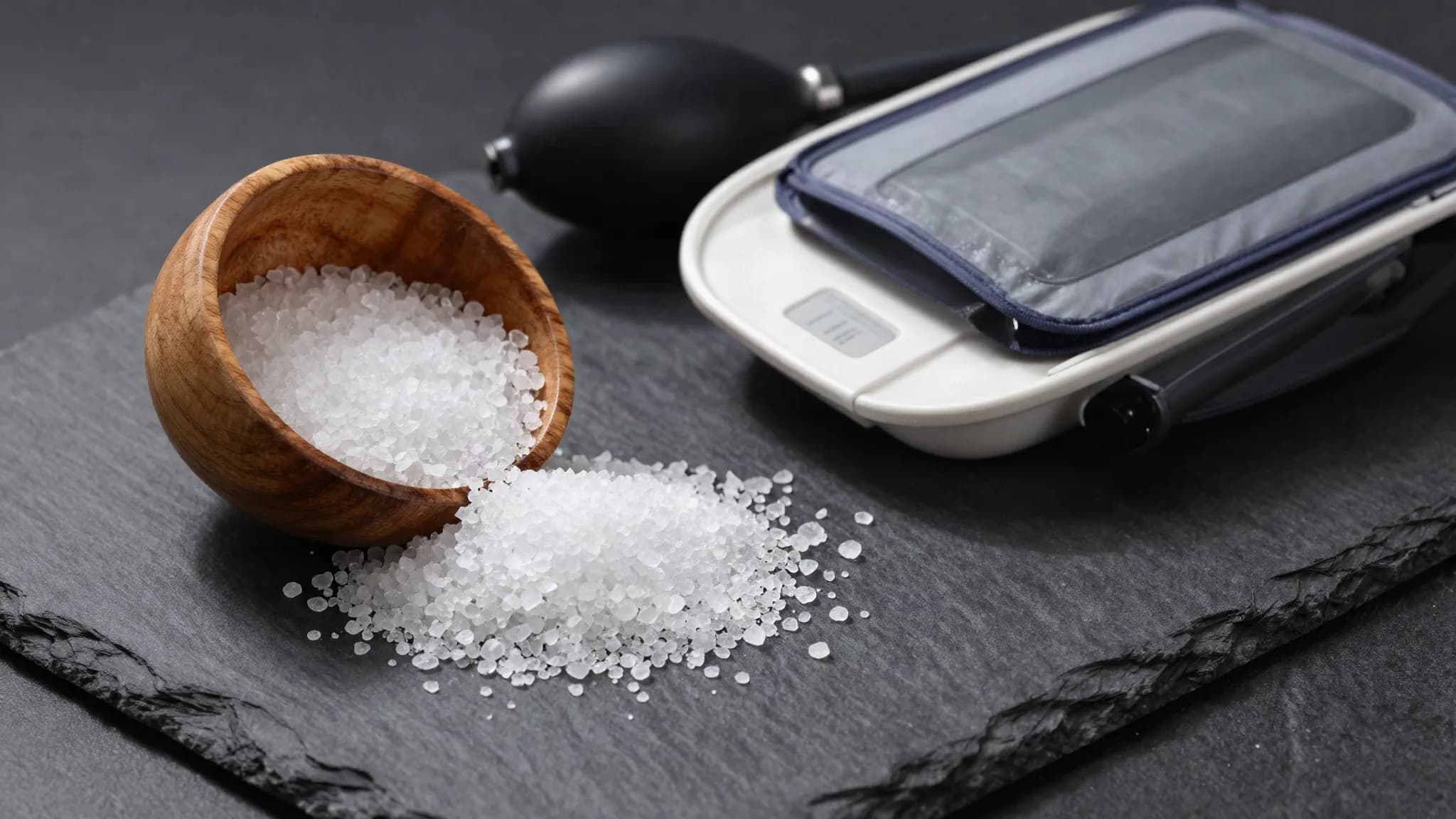
Salt is one of the few nutrients where the science, the guideline and the lived reality of an entire region line up almost too neatly to ignore. The guideline exists because the evidence on blood pressure is genuinely strong. The lived reality, in the Gulf specifically, is that most people are eating roughly double what the guideline allows, often without adding a single extra shake of salt at the table.
What the guideline actually says
The World Health Organization recommends adults consume less than 2,000 milligrams of sodium a day, equivalent to less than 5 grams of salt, or just under a teaspoon, according to WHO's sodium reduction fact sheet. That same fact sheet puts global mean intake in 2021 at 4,278 milligrams of sodium a day, the equivalent of 11 grams of salt, more than double the recommended ceiling. WHO also attributes an estimated 1.7 million deaths in 2023 to diets too high in sodium, mostly through the pathway of elevated blood pressure feeding into cardiovascular disease, stroke and kidney disease.
Why the blood pressure evidence holds up
The physiological chain is well established rather than speculative. Excess sodium intake raises blood pressure by disrupting fluid balance and vascular function, and clinical trial data summarised in the peer-reviewed literature shows that a reduction of roughly 1.75 grams of sodium a day corresponds to an average systolic and diastolic blood pressure drop of about 4.2 over 2.1 mmHg, with a larger effect, around 5.4 over 2.8 mmHg, in people who already have hypertension, according to trial evidence reviewed via the Pan American Health Organization's salt reduction resources. That is not a marginal number in population terms. Shifting average blood pressure down by even a few points across a whole country measurably reduces stroke and heart attack rates.
There is a genuine and ongoing scientific argument about the lower bound, not the upper one. Some researchers have questioned whether trial evidence clearly favours pushing intake below roughly 2 grams of sodium a day compared with a more moderate 2.3 to 4.6 gram range, since data at the very low end is thinner. That debate matters for people already near the recommended ceiling. It does not touch the much larger and much better supported finding that intakes far above the guideline, which describes most of the world including the Gulf, carry clear and consistent cardiovascular risk.
The Gulf's specific problem: convenience food and bread
Regional data makes the scale of the gap concrete. A cross-sectional study of urinary sodium excretion across the UAE found that mean sodium excretion significantly exceeded WHO recommendations, with roughly two-thirds of participants consuming above guideline levels and men roughly 2.6 times more likely than women to exceed them. Local reporting citing the UAE's own health authorities has put the figure even more starkly: 96% of residents were found to exceed daily recommended sodium levels in reporting that accompanied new regulatory action on packaged food and bread.
What is notable is where the sodium is coming from. Survey data cited in the same reporting found that 82.5% of UAE residents add salt during cooking and 66% add it again at the table, but 75% separately identified processed food as a major salt source in their diet, not home seasoning alone. Bread and bakery products, staple foods across the Gulf, have drawn specific regulatory attention because they are eaten daily in volume and are often high in sodium by default rather than by any deliberate choice on the shopper's part. Authorities in the UAE have moved to cap salt content in bread, bakery goods and processed foods directly, precisely because reformulating a staple food changes population intake more reliably than asking millions of individual households to season differently.
This pattern (rapid growth in processed and convenience food consumption alongside more sedentary daily life) is not unique to the UAE among Gulf Cooperation Council states, and it tracks with rising rates of hypertension in the region, which affects an estimated 25.9% of adults in the UAE according to health ministry figures reported alongside the sodium data.
What actually reduces sodium intake in practice
- Check bread and bakery products specifically, since they are eaten daily and often carry meaningful sodium without tasting obviously salty.
- Treat restaurant and takeaway meals as a major sodium source, not an occasional exception, given how much of regional sodium intake research traces back to food prepared outside the home.
- Use the traffic light or %DV figure on packaged food (salt at 0.3g or under per 100g is considered low, above 1.5g is considered high under UK-style labelling systems) as a quick filter when shopping.
- Season with herbs, citrus and spice blends at home rather than relying on salt as the default flavour lever, since home cooking is one of the few sodium sources an individual can control directly.
This article reports on public health evidence and regional data; it is not personal medical advice. Anyone with diagnosed hypertension, kidney disease or heart failure should follow a sodium target set by their own physician, since clinical targets for those conditions are often stricter than the general population guideline discussed here.
The Gulf's sodium problem is not really a story about the salt shaker. It is a story about what happens when convenience food becomes the default meal, and it is one of the few nutrition problems where the fix (reformulating bread and processed staples) sits mostly with regulators and manufacturers rather than with the person doing the eating.
Published in The Outspoken Digest
Editorial desk
Outspoken Digest Nutrition DeskDiet, food science and the evidence behind claims about what we eat.
Newsletter
The Digest, in your inbox
One edition, sent when it is ready. No noise, and your address is never passed on.
Read Next
More Nutrition →
Potassium-Rich DASH Diet Did Not Raise Blood Potassium to Unsafe Levels in Adults on Blood Pressure Drugs
Oct 13, 2026/2 min read
Matched for Calories and Macronutrients, an Ultra-Processed Meal Still Drew a Bigger Insulin Response in a Small Trial
Oct 9, 2026/3 min read
A Study of 371,000 Americans Found Whole Fruit, Not Juice, Is Linked to Better Heart Health
Oct 1, 2026/2 min read

Tirzepatide Switched On Calorie-Burning Brown Fat in Obese Mice, Independent of Its Appetite-Suppressing Effect
Sep 29, 2026/2 min read