Saturn Reached Opposition on Sunday, and Its Rings Are Open Again for the Best View of the Year
Earth passed between the Sun and Saturn on 4 October, putting the ringed planet at its brightest and closest of 2026. A small telescope shows the rings clearly, which was not true a year ago when they were edge-on.
Monday, October 5, 2026/2 min read
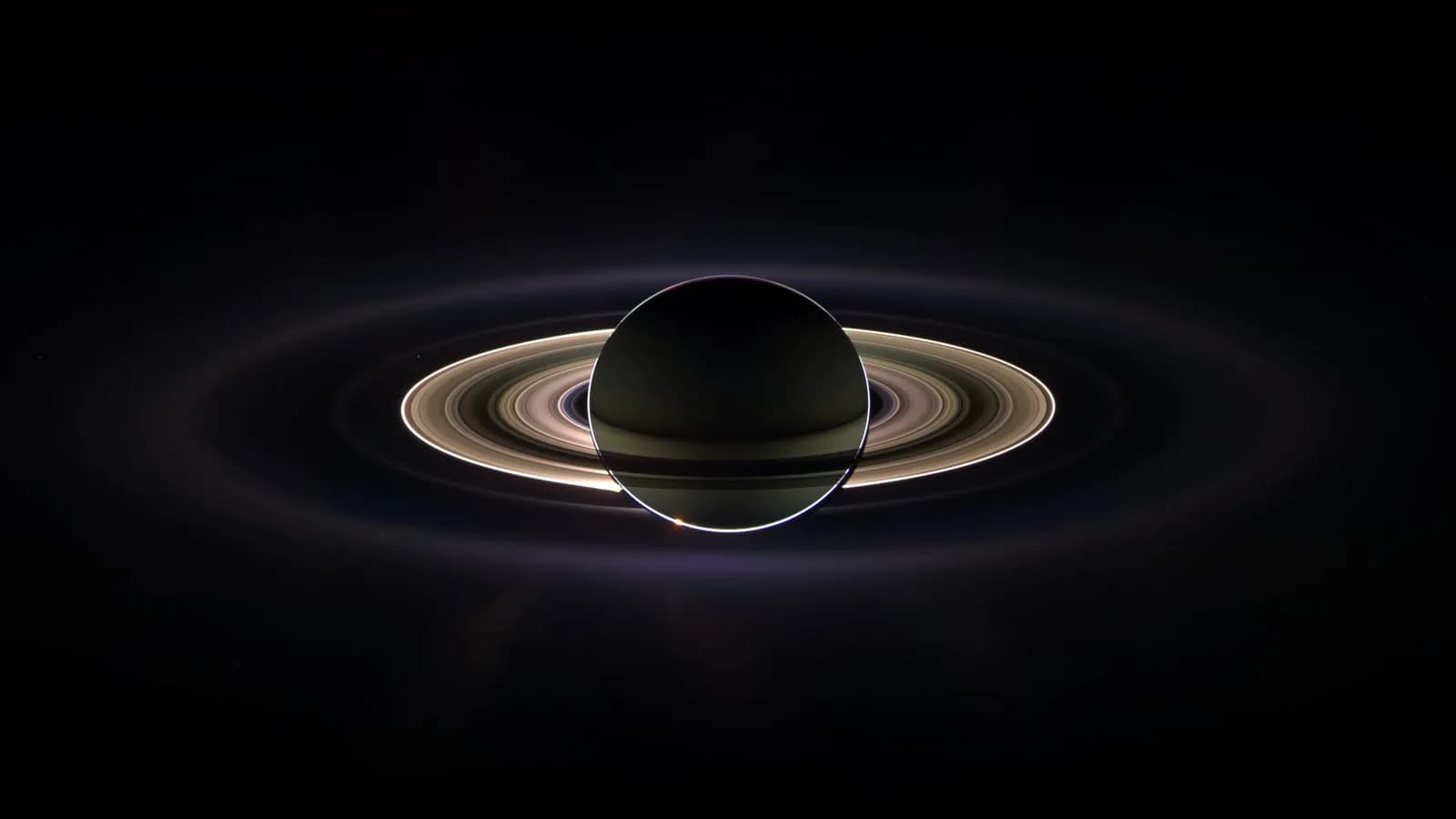
Saturn is at its best this week. EarthSky's guide says Earth flew between the Sun and Saturn at around 12:00 UTC on Sunday 4 October, an alignment astronomers call opposition. It puts the planet opposite the Sun in our sky, which is why it rises at sunset, stays up all night and sets around sunrise.
Brightest and closest of the year
Opposition is when an outer planet is nearest to Earth, so it looks brightest and largest. At this one Saturn shines at magnitude 0.3 and is about 784 million miles away, roughly 1.26 billion kilometres, or about 70 light-minutes. Astronomy magazine's observing note says it sits in the constellation Cetus, the whale, near its border with Pisces, and is the brightest point of light in that patch of sky. It rises in the east beneath the Great Square of Pegasus and is highest around midnight. Saturn is still the faintest of the bright planets, so its opposition month is the easiest time to find it.
The rings are back
The real news for telescope owners is the rings. Earth crossed the plane of Saturn's rings in March 2025, something that happens every 13 to 15 years, and for a few weeks around then the rings were too thin to see in small instruments. They have been opening since. This month they are tilted about 7 degrees towards us, showing their southern face and the planet's south pole, according to both EarthSky and Astronomy. In a telescope the disc spans about 20 arcseconds and the rings nearly 45 arcseconds from end to end.
How to look
- Binoculars will show Saturn as a bright oval, but they will not separate the rings from the planet. Hold them steady or mount them on a tripod.
- Any small backyard telescope will show the rings as a distinct band around the planet.
- Look for moons too. Titan, the brightest, is mid-eighth magnitude and lies east of the planet, and Tethys, Rhea and Dione are closer in at about tenth magnitude.
On the evening of 4 October, Astronomy reported, Tethys passes behind the disc and reappears around 8:20 pm EDT, while Dione disappears behind Saturn around dawn in the western United States.
No rush, but do not wait for the weekend
Opposition marks the middle of the best viewing season rather than a single night, and EarthSky says Saturn is well placed from late August through October. Oppositions arrive about 378 days apart, so next year's falls on 18 October 2027. If you want one more thing in the same sky, the waning crescent Moon passes 1.2 degrees north of Mars at 2 am EDT on 5 October, and edges through the Beehive Cluster that morning.
Saturn also featured in science news earlier this week, when a reanalysis of old Cassini data showed how Enceladus sorts its ocean chemistry into different ice grains. Saturn's rings are the easier thing to see, and this week they are as good as they will get until next autumn.
Published in The Outspoken Digest
Editorial desk
Outspoken Digest Science DeskReports for The Outspoken Digest across Technology, Latest Trends, Health.
Newsletter
The Digest, in your inbox
One edition, sent when it is ready. No noise, and your address is never passed on.
Read Next
More Technology →
What PHP2Shell Reveals About Maintaining the Code Behind Most of the Web
Oct 22, 2026/3 min read

PHP2Shell for Hosts, Developers and Security Teams: Backports, WAF Rules and Incident Response
Oct 22, 2026/3 min read
PHP2Shell: What Website Owners and Small Businesses Should Do Right Now
Oct 22, 2026/3 min read

PHP2Shell Timeline: From a Quiet August Report to a Leak, Early Attacks and a Day-Early Patch
Oct 22, 2026/3 min read