Saturn Has Grown a Ten-Sided Storm at Its South Pole, and Nobody Saw It Start
Hubble has confirmed a decagon riding a jet stream around Saturn's south pole, each side longer than Earth is wide. The northern hexagon has been there for forty years. This one was not there in 2022.
Outspoken Digest Technology Desk
Sunday, September 6, 2026/3 min read
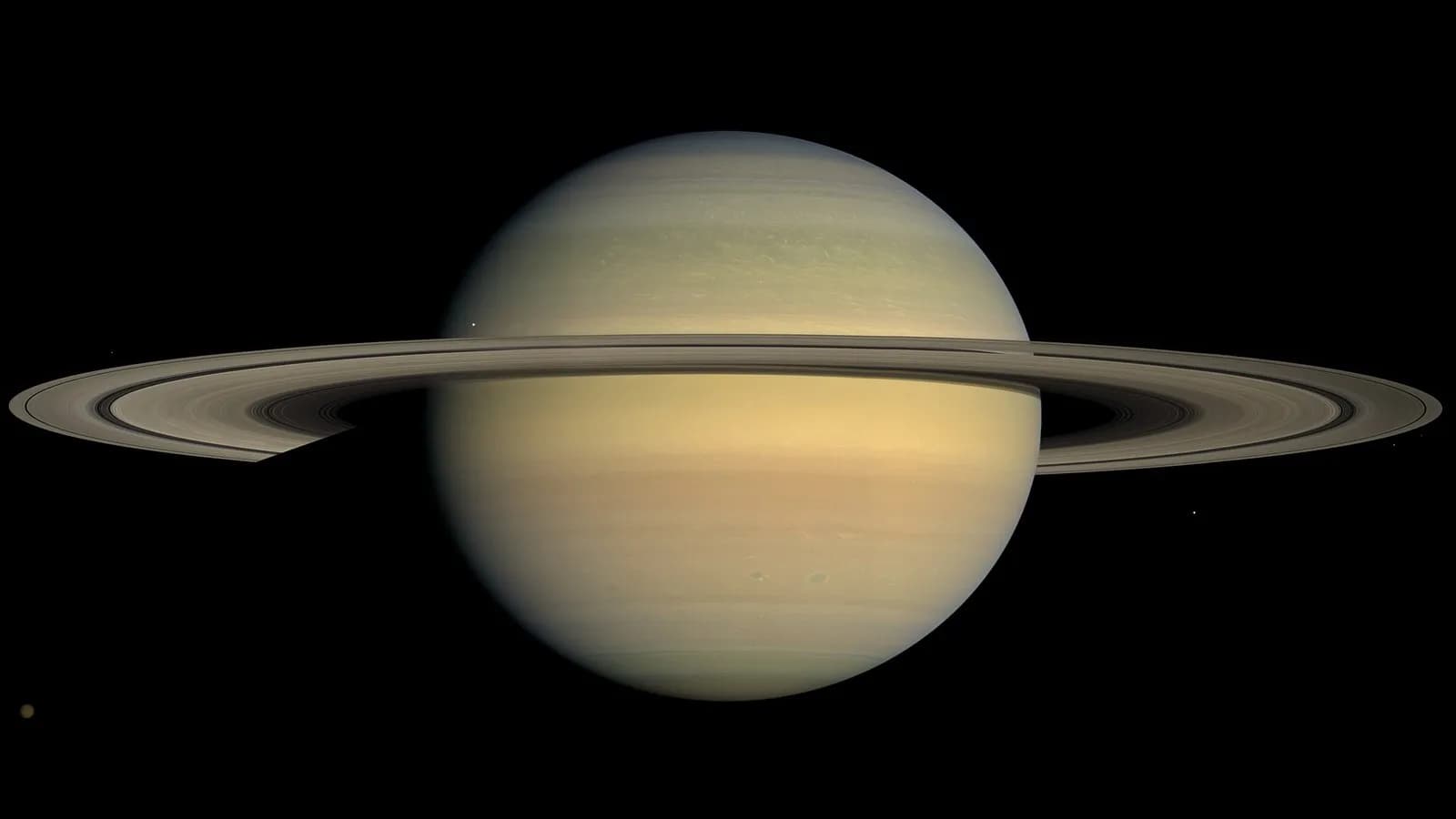
Saturn's north pole has a hexagon. It was spotted by the Voyager probes in the early 1980s, photographed in extraordinary detail by Cassini, and it has sat there, six-sided and roughly the width of two Earths, for as long as anyone has been able to look.
It now has company. A paper published on 2 September in Science Advances, led by Agustin Sanchez-Lavega of the University of the Basque Country, confirms a ten-sided figure encircling the south pole. Hubble found it, and the remarkable thing is not that it exists but that it did not use to.
How it appeared
The timeline is short and it is the whole story.
Hubble data from 2023 showed faint hints of a polygonal shape at high southern latitudes. In 2024 ground-based observers, including amateur astronomers feeding the Planetary Virtual Observatory Laboratory, picked up an undulating band. In Hubble images from August and September 2025 it had sharpened into a fully defined decagon, and the most recent observations in the paper are from 29 August 2025.
NASA's own summary uses the word strengthening. That is a different situation from the hexagon, which appears to be stable and old. Here the planet is being watched while a giant atmospheric pattern develops, which does not happen often.
What it actually is
A wave, not a wall.
The decagon is a pattern in one of Saturn's eastward jet streams, centred around sixty degrees south. The ten straight-looking sides are the crests and troughs of a wave travelling around the planet, locked into a shape that closes on itself after ten cycles. The northern hexagon is understood the same way, with six.
Each side of the southern figure is longer than the diameter of Earth. The whole structure extends through several layers of the atmosphere rather than sitting at one altitude.
Why it matters beyond being strange
Because a polygon that forms while you are watching is an experiment you did not have to run.
The hexagon has been a puzzle for forty years precisely because it was already there. Laboratory work with rotating tanks of fluid has reproduced polygonal jets, and the physics is broadly understood, but a stable feature tells you little about how such things begin, how long they take, and what decides whether the answer is six sides or ten.
A decagon that emerged over two or three years gives planetary scientists the beginning of the process for the first time. Amy Simon of NASA put the question plainly: why did it suddenly form now, when nothing like it had been seen before.
Saturn's south pole has just come out of a long winter and into spring, and the seasonal change in sunlight is the obvious candidate for what changed. Whether that is the cause, and whether the decagon will persist for decades like its northern counterpart or fade, is exactly what the team says it does not yet know. The James Webb Space Telescope is scheduled to look.
The amateur contribution
It is worth noticing who saw it in 2024.
Hubble time is scarce and Saturn is a large, bright, frequently photographed target for amateurs with good telescopes. The undulating band that bridged the gap between Hubble's first hints and its confirmation was recorded by people observing from back gardens and sending images to a shared archive. Planetary astronomy is one of the few fields where that still matters, and this discovery is a clean example of it.
Our earlier reporting on the largest map of a nervous system ever produced, another case of patient observation paying off on a timescale longer than a career, is in the connectome piece. The full description of the decagon is on NASA's Hubble mission site.
Published in The Outspoken Digest
Editorial desk
Outspoken Digest Technology DeskSoftware, hardware, artificial intelligence and what they change for everyone else.
Newsletter
The Digest, in your inbox
One edition, sent when it is ready. No noise, and your address is never passed on.
Read Next
More Technology →
Some White Dwarfs Would Look Green, Pink or Purple, Warwick Astronomers Calculate
Oct 15, 2026/2 min read
Oxford Physicists Reproduce the Aharonov-Bohm Effect on a Hybrid Quantum Computer
Oct 15, 2026/2 min read

Japan Will Fund Up to $21 Billion for Two GlobalFoundries Chip Plants in New York
Oct 15, 2026/2 min read

Apple's $299 HomeView Smart Display Takes Preorders, but Not in the European Union
Oct 15, 2026/2 min read