Shawarma, Gyro, Doner and Al Pastor Are the Same Machine in Four Languages
Three of those words literally mean turning. The fourth means shepherd, and it exists because a hundred thousand Lebanese migrants arrived in Mexico and their children swapped the lamb for pork and added pineapple.
Friday, August 21, 2026/4 min read
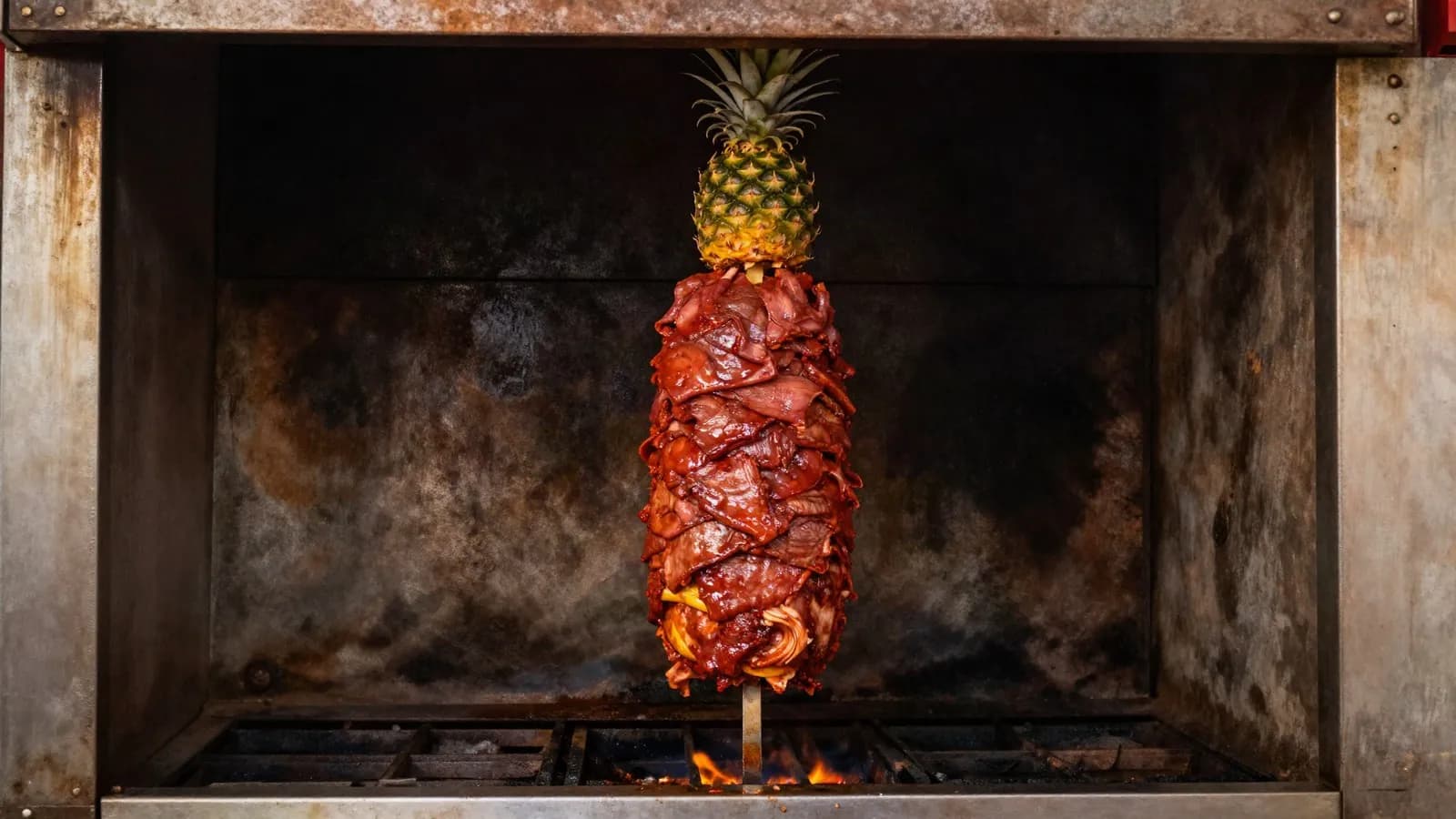
Put a shawarma shop, a Greek gyro counter, a Berlin doner stand and a Mexico City taqueria next to each other and you will see the same object four times: a column of meat, standing upright, turning slowly, being shaved from the outside in.
They are not similar by coincidence. They are the same nineteenth century Ottoman invention, carried outward by migration, renamed in each language it landed in.
What do the names actually mean?
Three of the four are the same word.
- Doner comes from the Turkish donmek, to turn.
- Shawarma is Arabic, borrowed from the Turkish cevirme, which means turning.
- Gyros is Greek, from the root meaning turn or revolution, the same root behind gyroscope.
- Al pastor is the outlier. It is Spanish for shepherd, a reference to the lamb the dish was originally made with.
When four cuisines independently name a dish after rotation, they are telling you what they considered new about it. Not the meat. The motion. That is the same conclusion you reach from the origin of shawarma itself.
How are they actually different?
The spit is shared. Everything hung on it is local.
Doner is typically lamb, beef or a beef and lamb mix, seasoned relatively lightly. The German version, which is the one most of Europe eats, is a distinct dish in its own right: it developed in Berlin among Turkish workers in the 1970s and added salad, cabbage and sauces to a bread pocket in a way that Turkish doner traditionally does not.
Gyros in Greece is usually pork or chicken, seasoned with oregano and thyme, served in pita with tomato, onion, tzatziki and very often chips inside the wrap.
Shawarma across the Levant and the Gulf is chicken, lamb or beef with a warm spice profile of allspice, cinnamon and cardamom, finished with garlic sauce, tahini and pickles.
Al pastor is pork, marinated in dried chillies and achiote, which is what gives it the red colour, served in small corn tortillas with onion, coriander and, traditionally, a slice of pineapple cut from the top of the spit.
How did the spit get to Mexico?
With people, which is the most interesting part of the whole story.
Between roughly 1880 and 1950, more than a hundred thousand Arabic speakers, predominantly Lebanese, migrated to Mexico, leaving economic hardship and political instability. They brought the vertical spit with them, cooking lamb the way it was cooked at home.
In Puebla in the 1960s, the Mexican-born children of those migrants opened their own restaurants and rebuilt the dish around what was around them. Lamb became pork. The Levantine spice mix became a marinade of Mexican chillies. The flatbread became a corn tortilla.
The result is now one of the most recognisable Mexican foods in the world, and it is, structurally, a Lebanese shawarma. Al pastor is what happens when a technique is inherited by a second generation who are cooking for their own country rather than remembering another one.
What about the pineapple?
The pineapple is the part purists argue about, and the argument is worth understanding.
It sits at the top of the trompo, the spinning cone, and its juice runs down through the pork as it cooks. There is a functional case for it: pineapple contains bromelain, an enzyme that breaks down protein, so it tenderises the surface of the meat it drips onto. There is also a straightforward flavour case, since acidity and sweetness cut through rich pork.
Whether it is traditional depends on which decade you call tradition, which is true of nearly every food argument.
Which one is the original?
None of the four, and that is the honest answer rather than a diplomatic one.
The original is the vertical spit itself, developed in the nineteenth century Ottoman Empire and generally credited to a butcher in Bursa. Every dish named here is a descendant. Doner is the closest to the source geographically, but the Berlin version most Europeans eat is itself a 1970s reinvention, so even proximity does not settle it.
The useful way to think about it is that this is a family, not a hierarchy. What spread was a piece of equipment and a way of using it, and each place that received it made something its own, which is exactly what happened to falafel as it moved out of Egypt.
Which should you order?
Judge the shop, not the category.
The signals are the same everywhere. The stack should look like layered whole muscle rather than a uniform processed cone. It should be busy, because turnover means the outer surface is being carved constantly rather than drying out. And the meat should be shaved to order in front of you, never scooped from a holding tray, which is the single reliable difference between a good one and a bad one in any of the four cuisines.
Published in The Outspoken Digest
Editorial desk
Outspoken Digest Food DeskCooking, ingredients, restaurants and the economics of what ends up on the table.
Newsletter
The Digest, in your inbox
One edition, sent when it is ready. No noise, and your address is never passed on.
Read Next
More Recipes →
Cheesy Ramen on the Stove: Instant Noodles in a Real Cheese Sauce in Ten Minutes
Oct 18, 2026/3 min read
Beer-Battered Jalapeno Cheese Curds: The Wisconsin Bar Snack, Fried Properly at Home
Oct 18, 2026/3 min read
A Thanksgiving Turkey Sub With Hot Stuffing, Cranberry and Gravy to Dip
Oct 17, 2026/3 min read

Pecan Pie Bars With a Shortbread Base and a Caramel Filling That Slices Cleanly
Oct 17, 2026/3 min read