Falafel Was Almost Certainly Egyptian, Made With Fava Beans, and the Chickpea Came Later
The version most of the world eats is the Levantine one, and it is a revision. Egypt still makes it the older way, with fava beans, under a different name. The argument about who owns it is genuinely political.
Friday, August 21, 2026/3 min read
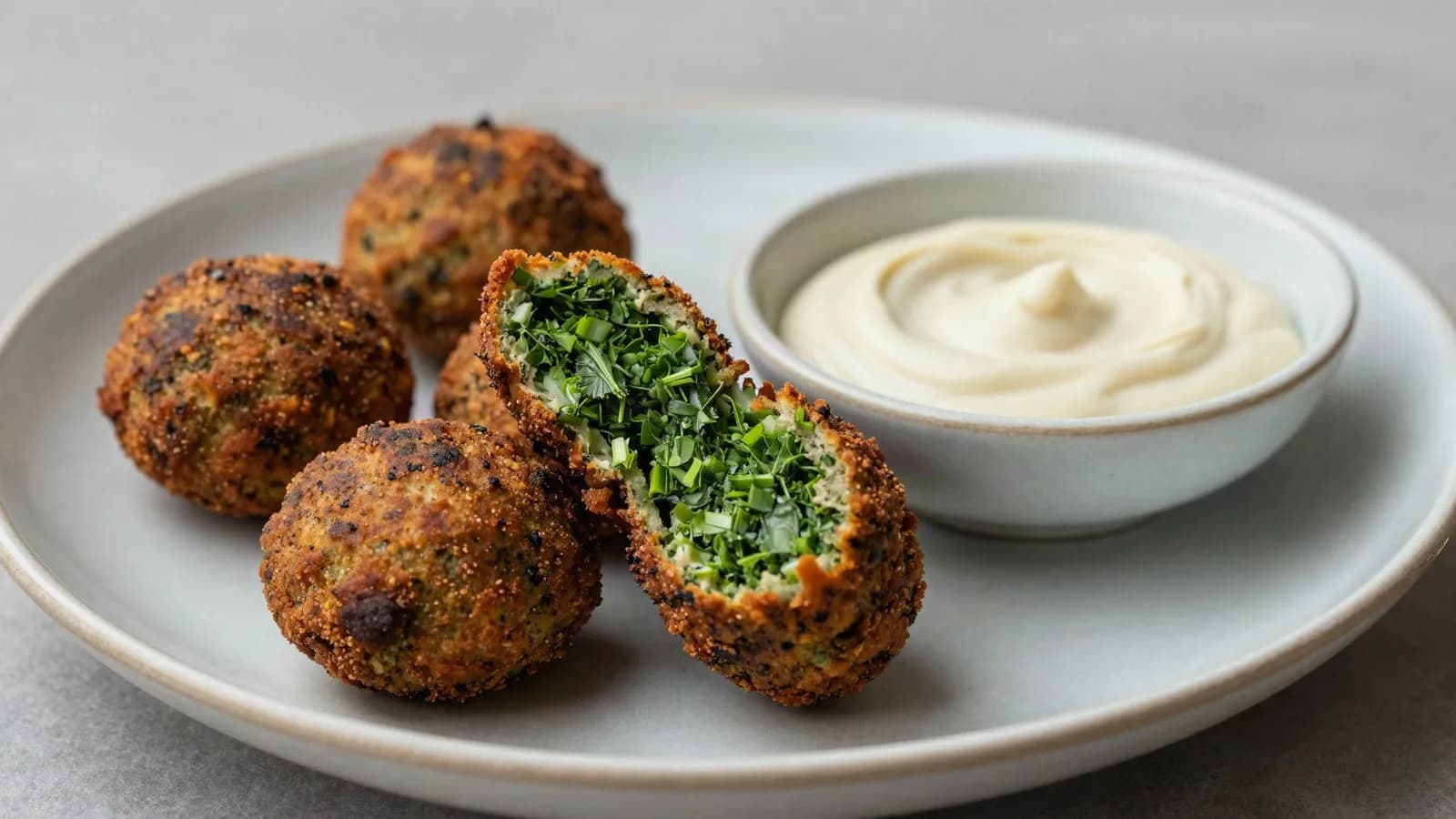
Falafel is one of the few foods that is simultaneously everywhere and constantly misunderstood. It is sold in Cairo, Beirut, Berlin, London and New York, it is the default answer to what a vegetarian eats in a Middle Eastern restaurant, and almost nobody outside the region can say what is actually in it.
The short answer is a ground pulse, herbs and spices, shaped and deep fried. The longer answer involves two different pulses, two different countries, and a dispute that is not really about food.
What is falafel made of?
Ground pulses, never cooked ones, which is the detail that decides whether it works.
Dried chickpeas or fava beans are soaked overnight until they swell, then ground raw with onion, garlic, parsley, coriander leaf and spices, typically cumin and coriander seed. The mixture is shaped into balls or patties and deep fried.
The soaked-but-uncooked part is not a stylistic choice. It is the whole technique. Raw soaked pulses hold together through the starch and protein released by grinding, and they dry out into a light, crumbly interior. Tinned chickpeas, which are already cooked, carry far too much water: they will not bind, and they turn to paste in the fryer. Nearly every failed home attempt traces to that single substitution, which is why our falafel recipe starts from dried.
Where does falafel come from?
Egypt, on the most widely accepted account, though the dating is genuinely uncertain.
The common claim is that it emerged in Egypt roughly a thousand years ago, often associated with Egyptian Copts. Competing accounts push it considerably earlier, and one theory traces the idea to the Indian subcontinent, which has its own long history of fried chickpea preparations. Anyone stating a precise date and inventor is going beyond the evidence.
What is better established is the direction of travel. From Egypt the dish moved into the Levant, and it is there that the pulse changed.
Fava beans or chickpeas?
Both, geographically split, and the split is the clearest fingerprint of the dish's route.
Egypt makes it with fava beans and calls it ta'ameya. It is typically a deeper green inside, softer, and heavier on herbs. That is the older form.
The Levant, Lebanon, Syria, Palestine and Jordan, makes it with chickpeas, or sometimes a mix of the two. That is the version that spread globally and the one most people picture when they hear the word.
So the world's default falafel is a regional revision of the original, which is not a criticism. It is simply what happened.
When did it become global?
The twentieth century, and rather more recently than most assume.
Shortly after the First World War it had reached what is now Lebanon, and in 1933 Mustafa Sahyoun opened a falafel shop in Beirut that is still a reference point. Around the same period it travelled down the Red Sea coast towards Yemen, north to Turkey and west towards Libya. Its arrival in Europe and North America came later still, largely with migration in the second half of the century.
Why is the origin argued about so fiercely?
Because ownership of the dish has been bound up with national identity, and the argument is refracted through political rivalry.
This is most visible between Israelis and Palestinians, where claims over a distinctively Levantine food carry questions of legitimacy and belonging that have nothing to do with cooking. Lebanon and Egypt have their own versions of the claim.
The position worth holding is that the historical record supports an Egyptian origin and a Levantine transformation, that both facts are real, and that a food eaten daily by tens of millions of people across many countries is not diminished by having a complicated parentage. The same argument surrounds hummus, for the same reasons and with the same heat.
How do you tell a good one?
Four signals, none of which require expertise.
It should be fried to order. Falafel has a life of about ten minutes. A tray of them sitting under a lamp has already lost the contrast between crust and interior that is the entire point.
The inside should be green, not beige. Green means a serious quantity of fresh herbs. Beige means flour, filler or a mix that leaned on the pulse alone.
It should crumble, not squash. A dense, wet, pasty interior means cooked pulses were used, or the mixture was over-processed.
It should not taste of old oil. This is the most common failure in high-turnover shops and the easiest to detect.
Served properly it comes with tahini sauce, pickles and bread, and the tahini is doing more work than people credit, which is its own subject in what tahini actually is.
Published in The Outspoken Digest
Editorial desk
Outspoken Digest Food DeskCooking, ingredients, restaurants and the economics of what ends up on the table.
Newsletter
The Digest, in your inbox
One edition, sent when it is ready. No noise, and your address is never passed on.
Read Next
More Recipes →
Cheesy Ramen on the Stove: Instant Noodles in a Real Cheese Sauce in Ten Minutes
Oct 18, 2026/3 min read
Beer-Battered Jalapeno Cheese Curds: The Wisconsin Bar Snack, Fried Properly at Home
Oct 18, 2026/3 min read
A Thanksgiving Turkey Sub With Hot Stuffing, Cranberry and Gravy to Dip
Oct 17, 2026/3 min read

Pecan Pie Bars With a Shortbread Base and a Caramel Filling That Slices Cleanly
Oct 17, 2026/3 min read