The Shish Tawook Marinade, and Why Yogurt Does the Work
The marinade is the entire dish. Here is what each ingredient is actually for, the ratio that works, and the timing window outside which you make the chicken worse rather than better.
Friday, August 14, 2026/4 min read
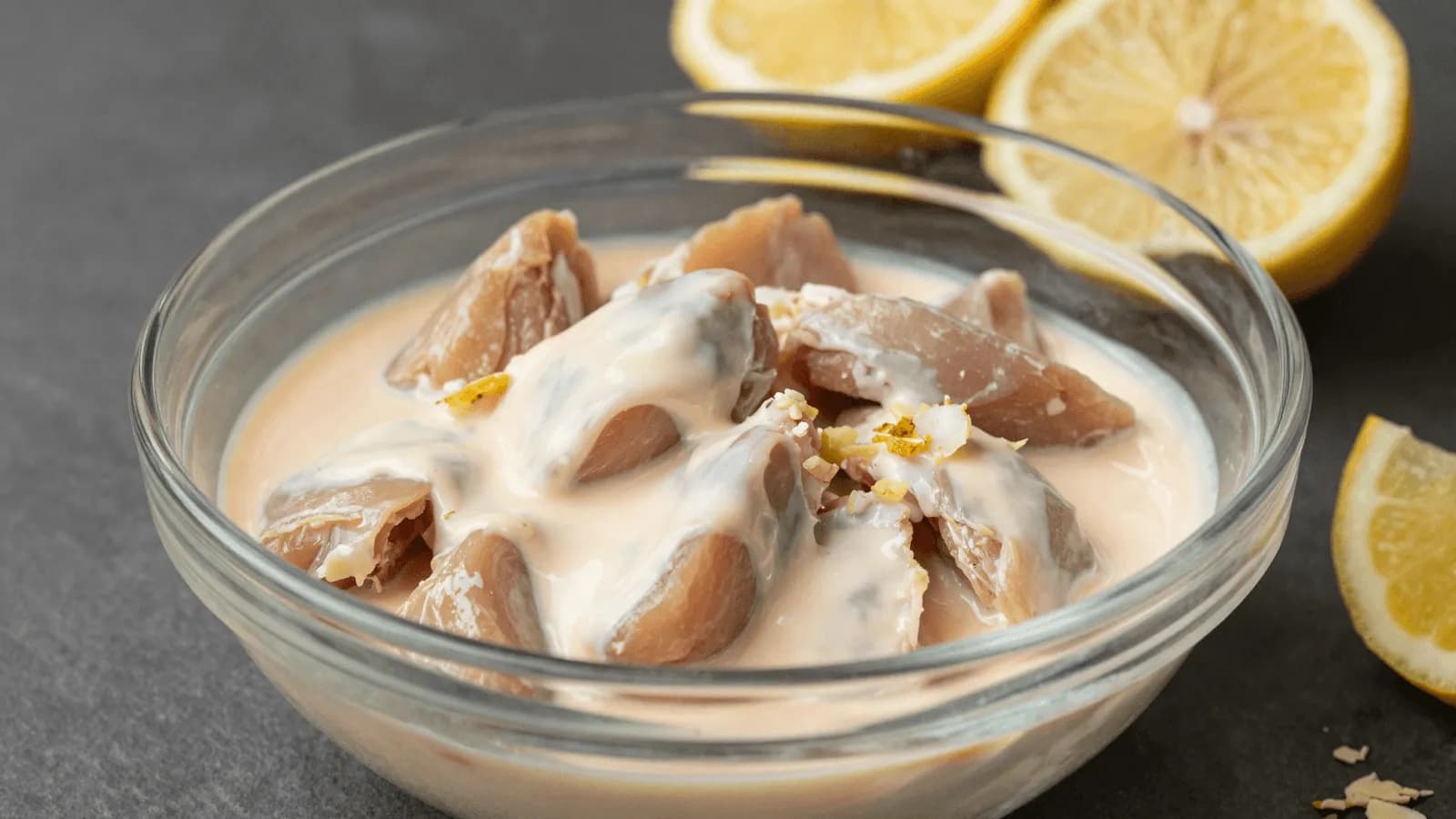
The shish tawook marinade is yogurt, lemon juice, garlic, oil and warm spices, and it does two separate jobs: it tenderises the chicken and it creates the surface that chars on the grill. Get the balance wrong in either direction and you get either bland chicken or chicken with a chalky, broken texture.
Almost everything written about this marinade is a list. What follows is what each part is actually doing, because once you know that you can fix your own version rather than following someone else's.
Why yogurt and not just lemon?
Because acid alone toughens meat past a certain point, and yogurt is a much gentler acid than lemon juice.
Lemon juice sits around pH 2. Yogurt sits around pH 4.5, which is acidic enough to loosen the protein structure but far from strong enough to seize it. Yogurt also contains calcium, which activates enzymes in the meat that break down protein, and that is a different mechanism from acid denaturation entirely.
The practical consequence: a yogurt marinade can be left on for twelve hours. A straight lemon marinade at the same strength would leave you with the texture of cooked ceviche in about three.
The second job is the coating. Yogurt clings where a thin liquid runs off, and the milk solids and lactose in it brown on the grill. That is where the golden, patchy, slightly blistered surface of good shish tawook comes from.
Use full-fat, and do not use Greek
Full-fat plain yogurt is the right choice. The fat carries the fat-soluble spice compounds, which is the difference between the cinnamon and allspice being tasted and merely being present.
Greek yogurt is strained, so it is thicker and lower in whey. It makes a paste that sits on the chicken in clumps rather than a coating that flows around it, and the clumps burn before the meat cooks. If Greek is all you have, thin it with a tablespoon or two of water or milk until it drops from the spoon.
What each ingredient is for
- Yogurt. Tenderiser, coating, browning agent. The base.
- Lemon juice. Brightness and a second acid. Enough to taste, not enough to dominate.
- Garlic. The dominant savoury note. Crush it to a paste with salt rather than chopping it, because chopped pieces stay raw and harsh in a twelve minute cook.
- Oil. Carries fat-soluble aromatics and stops the meat welding to the grill bars.
- Tomato paste. Colour and a little umami. This is why authentic shish tawook is faintly orange rather than white.
- Mustard. An emulsifier more than a flavour. It stops the marinade splitting into a watery layer and an oily one.
- Paprika. Colour first, sweetness second.
- Cinnamon and allspice. The warmth that makes it read as Levantine rather than generic grilled chicken. Small quantities.
- Salt. Seasons, and helps the marinade penetrate rather than only coat.
The ratio
For 900 g of chicken:
- 240 ml full-fat plain yogurt
- 80 ml lemon juice
- 60 ml neutral oil
- 2 tablespoons tomato paste
- 1 tablespoon Dijon mustard
- 6 cloves garlic, crushed with the salt
- 1.5 teaspoons paprika
- 1 teaspoon garlic powder
- 0.75 teaspoon onion powder
- 0.5 teaspoon each ground cinnamon and allspice
- 0.5 teaspoon dried oregano
- 0.25 teaspoon cayenne
- 1 teaspoon salt, 0.25 teaspoon black pepper
The full method, including grilling times and the oven version, is in our shish tawook recipe.
How long should you marinate shish tawook?
Eight to twelve hours. Four is the workable minimum. Eighteen is the hard ceiling.
Under four hours the acid has barely started and you have seasoned the surface only. Between eight and twelve the texture genuinely changes: the meat holds more moisture and the fibres give more easily.
Past eighteen hours the process goes into reverse. Enough of the protein structure has broken down that the outer few millimetres turn mushy and, once cooked, chalky. This is the single most common way people ruin it while believing they are being thorough. Longer is not better, and there is no recovering it.
Can you freeze chicken in the marinade?
Yes, and it is the most useful thing you can do with this recipe.
Put the cubed raw chicken and the marinade into a bag, press it flat, and freeze. It marinates as it thaws in the fridge, so a bag moved across on Monday night is ready to grill on Tuesday. Freeze it flat and it thaws in a few hours rather than overnight.
Do not refreeze after thawing, and do not reuse marinade that has held raw chicken. Discard it. If you want a sauce, set some aside before the chicken goes in.
What else can you use it on?
Chicken thighs, obviously, which many Lebanese grill houses prefer to breast for the extra fat. Beyond that it works on lamb, on firm white fish for a much shorter time of about 30 minutes, on prawns for 20 minutes, and very well on cauliflower steaks and thick halloumi slices.
For vegetables the timing collapses, since there is no protein structure to break down. Half an hour is plenty, and the marinade is behaving purely as a coating. The same principle applies to the yogurt-based marinades used across the region, including the one on our chicken shawarma, which reaches a similar destination by a different route.
Published in The Outspoken Digest
Editorial desk
Outspoken Digest Food DeskCooking, ingredients, restaurants and the economics of what ends up on the table.
Newsletter
The Digest, in your inbox
One edition, sent when it is ready. No noise, and your address is never passed on.
Read Next
More Recipes →
Swangy Tamarind Glazed Chicken Wings for the Flavour Replacing Swicy on Fast Food Menus
Sep 29, 2026/3 min read

Baked Apple Cider Doughnuts for a Cider Season That Peaked Earlier Than the Calendar Says
Sep 29, 2026/3 min read
An Obatzda Bavarian Beer Cheese Dip for the Final Stretch of Oktoberfest 2026
Sep 29, 2026/3 min read