Falcon's 700th Flight, Europe's Plant-Fluorescence Satellite, and Djibouti Signs the Artemis Accords: A Weekend in Orbit
SpaceX completed SES's medium-orbit constellation on a booster flying for the twenty-ninth time. Vega-C put FLEX, the first satellite built to watch photosynthesis, into orbit with Sentinel-3C. And a Red Sea state became the seventy-second signatory.
Outspoken Digest Technology Desk
Tuesday, September 15, 2026/3 min read
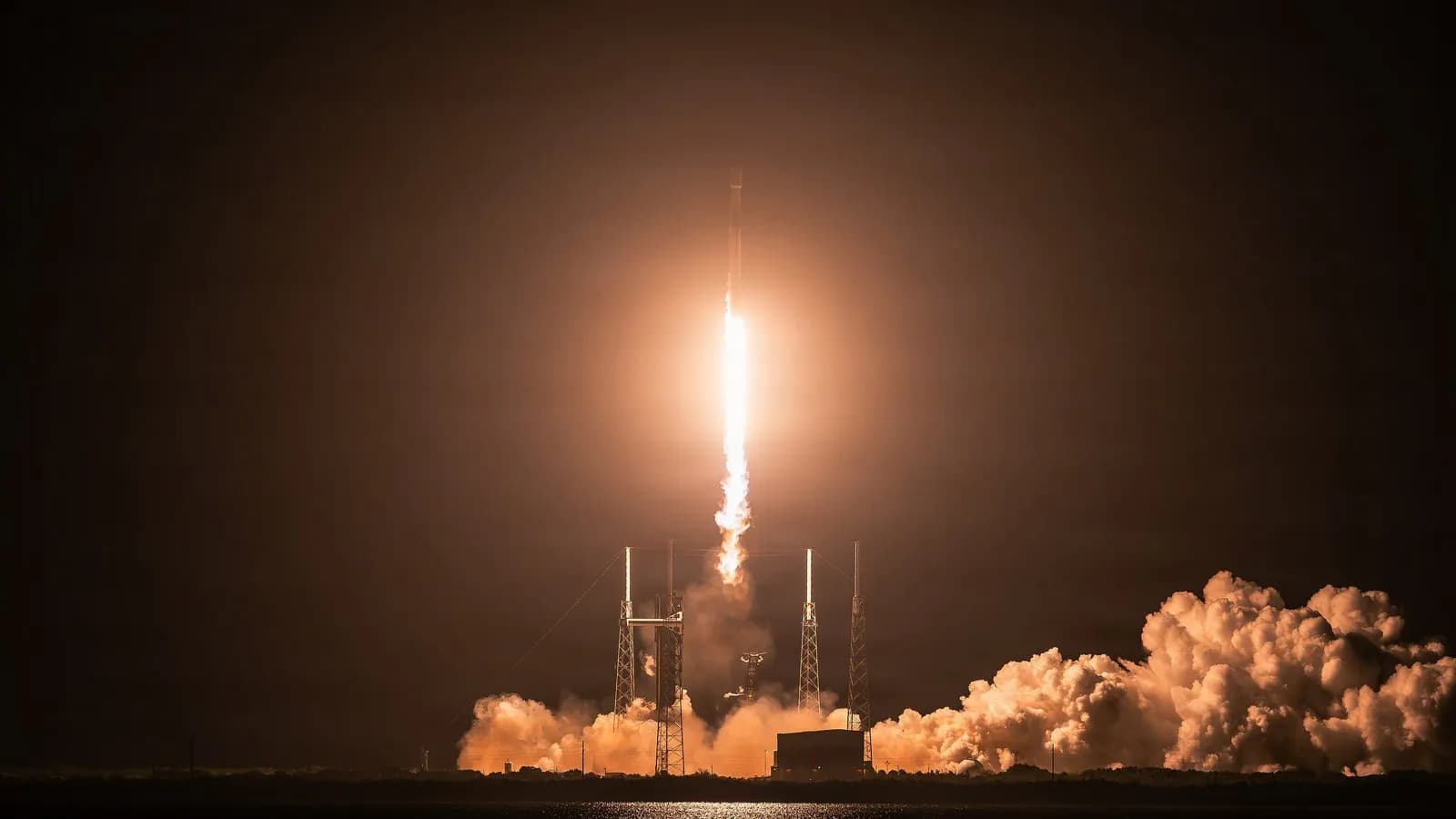
Three things happened above the atmosphere between Saturday afternoon and Monday morning, none of them a first landing on anything, all of them the kind of routine that would have been science fiction ten years ago.
Seven hundred
At 2.49 in the afternoon Florida time on Saturday, a Falcon 9 left Space Launch Complex 40 at Cape Canaveral carrying the last three satellites of SES's O3b mPOWER constellation. It was the 700th flight of the Falcon family, Spaceflight Now counts: 687 Falcon 9s and 13 Falcon Heavies since the first Falcon 1 in March 2006. The booster, B1080, was on its twenty-ninth flight, having previously carried four cargo missions to the space station, the European Euclid observatory, an earlier SES satellite and twenty-two batches of Starlinks, and it landed on the drone ship A Shortfall of Gravitas eight and a half minutes after lift-off, the 661st recovery of a Falcon first stage. The three Boeing-built satellites, F11 to F13, complete a thirteen-spacecraft broadband system in medium Earth orbit about 8,000 kilometres up, and should enter service by mid-2027 after raising their orbits. The constellation has had a hard road: electrical faults on satellites five and six cut their capacity and lifespan, forced design changes on the rest and added two spacecraft to the order. "The completion of the O3b mPOWER system reinforces our proven leadership in MEO," said Xavier Bertran, SES's chief product officer, which is what you say when the alternative was not completing it.
Watching plants breathe
At 22.21 local time on Monday night in French Guiana, 03.21 in Central European time on Tuesday morning, Avio's Vega-C flew its eighth mission, VV30, and put two European satellites into a sun-synchronous orbit at about 820 kilometres after a 116-minute flight. Copernicus Sentinel-3C, 1,143 kilograms, replaces Sentinel-3A, which is past its design life, and carries the instruments that measure sea-surface temperature, ocean colour, aerosols, cloud and wildfire for the EU's Earth observation programme. FLEX, at 397 kilograms, is the more original of the two. Its single instrument, FLORIS, is a spectrometer tuned to the faint red and far-red glow that chlorophyll emits during photosynthesis, which Spaceflight Now explains is a direct measure of how hard plants are working rather than merely how green they look. The two satellites will fly about a kilometre apart so FLEX can borrow Sentinel-3C's atmospheric data, revisiting every point on Earth every 27 days for a planned three and a half years. Nobody has measured global photosynthesis from orbit before, and for anyone trying to work out how much carbon the world's vegetation actually absorbs, it is the missing instrument. "The launcher performed flawlessly, putting in orbit two strategic satellites for Europe," said Avio's chief executive Giulio Ranzo, who has had launches that did not.
Seventy-two
On Monday morning at NASA headquarters in Washington, Djibouti's ambassador to the United States, Mohamed Siad Douale, signed the Artemis Accords, making the country the seventy-second signatory and the eighth in Africa. The Accords are a set of principles on transparency, safety and coordination for exploration of the Moon and beyond rather than a treaty, and the signature is as much diplomatic as astronautical. But Djibouti is not a token signatory: it already has small satellites in orbit and a spaceport agreement with Hong Kong investors on its Red Sea coast. It sits at the mouth of Bab al-Mandeb, which this week's news has made the most watched stretch of water on Earth, and it hosts American, French, Chinese and Japanese military bases within sight of each other. A country in that position choosing to sign an American-led space framework, in this week of all weeks, is not an accident of the diplomatic calendar.
Next up: Starship's fourteenth flight is scheduled from Texas on Friday 18 September at 12.15 UTC, following static fires of Ship 41 and Booster 21 last week. We will cover it if it flies.
Published in The Outspoken Digest
Editorial desk
Outspoken Digest Technology DeskSoftware, hardware, artificial intelligence and what they change for everyone else.
Newsletter
The Digest, in your inbox
One edition, sent when it is ready. No noise, and your address is never passed on.
Read Next
More Technology →
What PHP2Shell Reveals About Maintaining the Code Behind Most of the Web
Oct 22, 2026/3 min read
PHP2Shell for Hosts, Developers and Security Teams: Backports, WAF Rules and Incident Response
Oct 22, 2026/3 min read
PHP2Shell: What Website Owners and Small Businesses Should Do Right Now
Oct 22, 2026/3 min read

PHP2Shell Timeline: From a Quiet August Report to a Leak, Early Attacks and a Day-Early Patch
Oct 22, 2026/3 min read