A Sahara Meteorite Is at Least 4.1 Billion Years Old and May Be the Oldest Known Piece of Mars
A study in Science dates the Sahara meteorite Teghaza 001 to more than 4.1 billion years, a rare sample of early Martian crust that also shows signs of ancient water.
Friday, October 30, 2026/2 min read
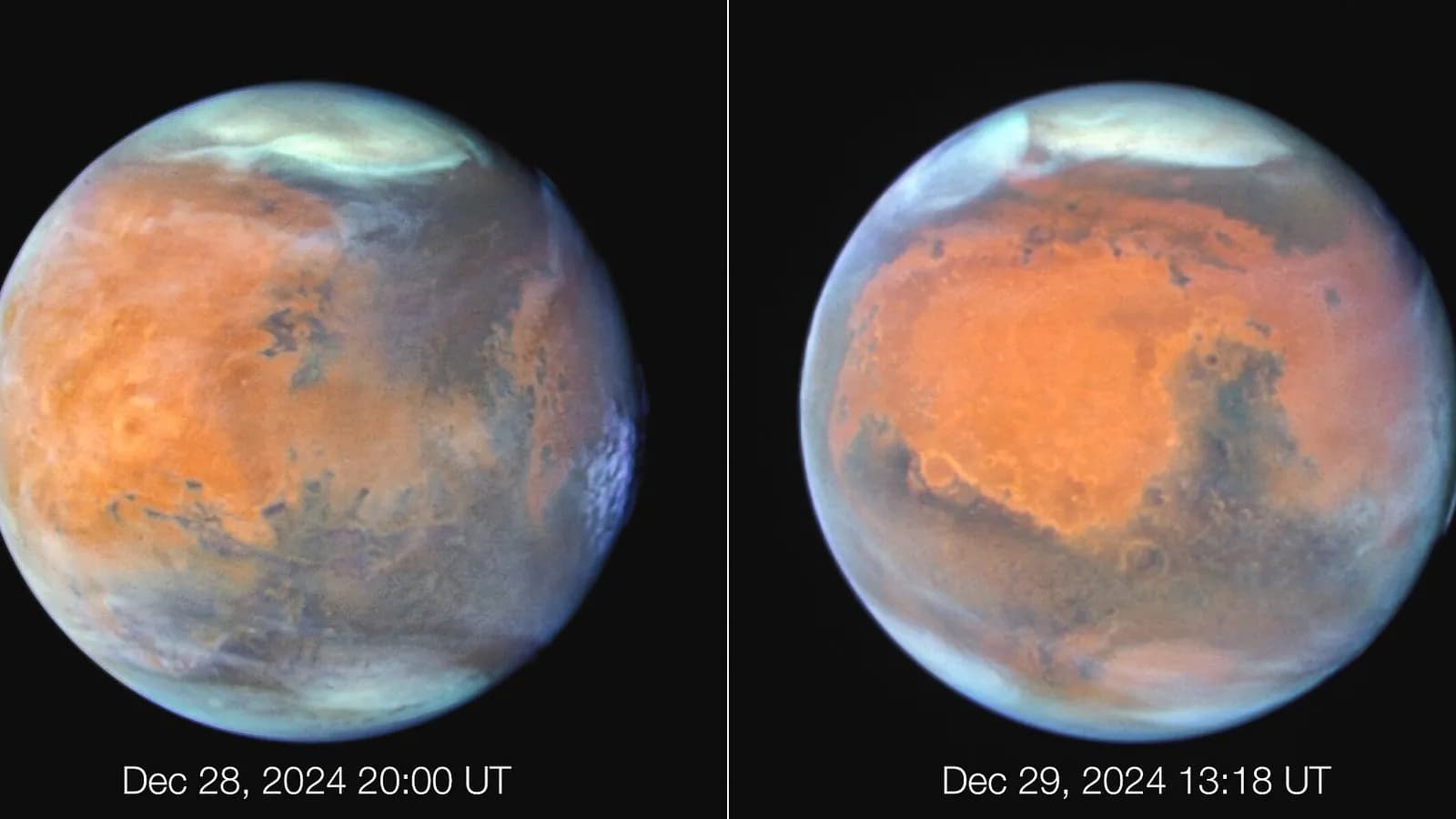
An 800-gram stone found by nomadic meteorite hunters in the Sahara in 2022 may be the oldest piece of Mars anyone has held. A study published on Thursday in the journal Science puts the age of the meteorite, Teghaza 001, at more than 4.1 billion years, NASA said. For comparison, most of the several hundred known Martian meteorites crystallised within roughly the last 600 million years of the planet's 4.5-billion-year history, according to Scientific American.
That makes this a rare view of Mars as it was forming a crust, when the planet may have had liquid water and a thicker atmosphere.
What is the Teghaza 001 meteorite?
Teghaza 001 weighs about 800 grams, nearly two pounds, and was found in the salt plain at Teghaza in Mali. It is one of roughly 435 known Martian meteorites, NASA says. University of New Mexico researchers identified it as Martian using oxygen isotopes. It is an igneous rock, formed from slowly cooled magma, that was once part of the planet's crust.
The team, led by Yang Liu of NASA's Jet Propulsion Laboratory, reports an age of at least 4.1 billion years. Phys.org, which carried the University of New Mexico account, describes uranium-lead dating of tiny zircon crystals, while NASA's release describes in-situ rubidium-strontium dating on single mineral grains from a piece smaller than a fingernail.
Why does a 4.1-billion-year-old Mars rock matter?
The only other known intact sample from that early period is the Antarctic meteorite ALH84001, about 10 million years younger, Scientific American reports. Minerals in Teghaza 001 were altered by water around 4.1 billion years ago, which suggests the rock itself formed even earlier. An earlier paper by the same group, in Science Advances, described that water signature, and hydrogen trapped in the rock hints that Mars was already losing its atmosphere and cooling.
Lee Saper, now at NASA Ames and a co-author, said the rock records interactions between water and rock and may even carry an imprint of the Martian atmosphere as it was lost. Liu said the team has only scratched the surface of what it can reveal.
Where on Mars did it come from?
Nobody knows exactly. Using orbital data from NASA's Mars Reconnaissance Orbiter, the researchers matched the rock's mineralogy and chemistry to 13 possible origin sites in the cratered southern highlands, NASA says. Scientific American notes the match is only a closest fit based on element ratios.
Anya Udry of the University of Nevada, Las Vegas, who was not involved, told the magazine that much remains unknown and argued that sample-return missions are needed. That is the real limit here: a meteorite comes with no field notes. A rover that drilled and cached rock from the ancient highlands would give scientists context this stone cannot.
For now, the claim to watch is the dating. Other laboratories will want to test the age and the water signature, and the map of 13 candidate sites will be refined as orbital data improve. The rock itself has waited a very long time to be read.
Published in The Outspoken Digest
Editorial desk
Outspoken Digest Science DeskReports for The Outspoken Digest across Technology, Latest Trends, Health.
Newsletter
The Digest, in your inbox
One edition, sent when it is ready. No noise, and your address is never passed on.
Read Next
More Technology →
GM Will Pay $220 Million to 36 States Over Selling Drivers' Location and Driving Data
Oct 30, 2026/3 min read

DoorDash Agrees to Buy Instacart for About $17 Billion, Paying $65 a Share
Oct 29, 2026/2 min read

Mars's Strangest Cloud May Freeze Straight From Vapour With No Dust Seed, a New Study Suggests
Oct 29, 2026/2 min read

Apple Unveils Its First Touchscreen MacBook Pro, From $2,899, on Sale 6 November
Oct 29, 2026/2 min read