Toum: Four Ingredients, One Emulsion, No Room for Impatience
Garlic, oil, lemon and salt whipped into a white sauce stiff enough to stand a spoon in. There is no egg holding it together, which is exactly why it breaks when you rush the oil.
Saturday, August 15, 2026/5 min read
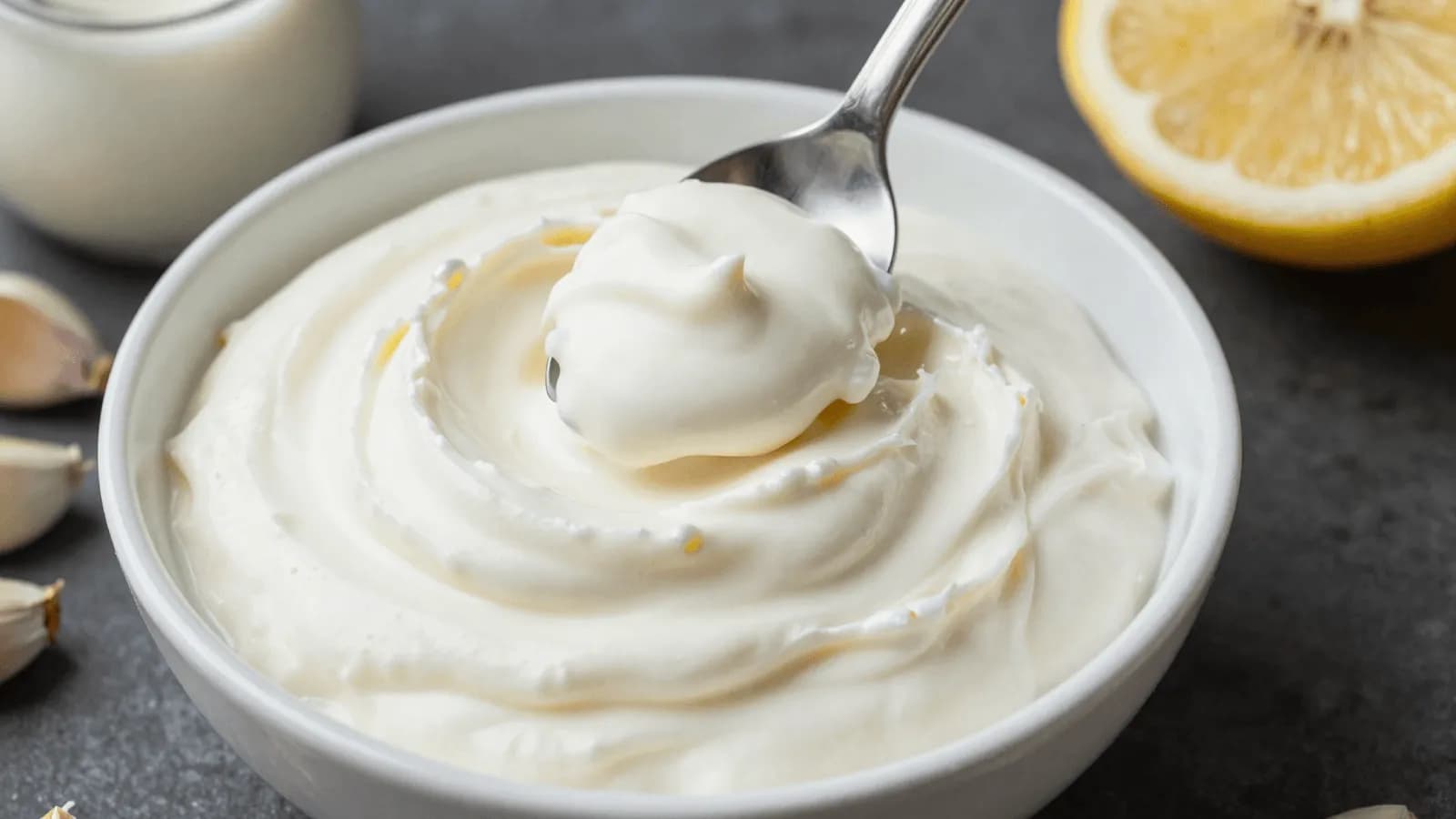
Toum is the white sauce served with grilled chicken across Lebanon, Syria, Jordan and every shawarma counter that descends from them. It looks like mayonnaise, behaves like mayonnaise, and contains no egg whatsoever.
It is garlic, neutral oil, lemon juice and salt, beaten into a stable emulsion by force. Properly made it is stiff enough to hold a peak, pure white, and so intensely garlicky that a teaspoon is a serving.
It is also the thing most home cooks have failed at least once, usually spectacularly, ending with a curdled slick of oil and garlic fragments. That failure has one dominant cause.
What is actually holding it together
An emulsion is oil suspended in water in droplets small enough to stay put, and something has to sit at the boundary keeping them apart. In mayonnaise, egg yolk lecithin does that job. In toum there is no egg, so the garlic does it.
Garlic contains water, plus proteins and mucilage that function as emulsifiers. It is a far weaker system than egg yolk, which is precisely why toum is less forgiving. There is enough emulsifying capacity in the garlic to hold a lot of oil, but only if every droplet gets broken down small before the next arrives.
So the oil goes in slowly. Not slowly as a general principle, but genuinely, tediously slowly: a thin thread at the start, never a pour. Adding the oil too fast is the single most common reason the emulsion breaks, and no amount of extra processing afterwards will fix a batch that got ahead of itself.
The other three things that go wrong
Lemon juice added at the end. It needs to go in from the beginning, alternating with the oil. Water content is what the emulsion is built on, and dumping acid into a finished sauce thins and destabilises it.
Heat. A food processor running for ten minutes warms its bowl, and a warm emulsion breaks. Some cooks freeze the peeled garlic for twenty minutes first, which keeps things cool and has the side effect of taking the harshest edge off the raw garlic.
The wrong oil. Use a neutral oil: sunflower, canola, grapeseed or a light vegetable oil. Olive oil is the intuitive choice and it is wrong twice over. Its flavour fights the garlic, and extra virgin olive oil in particular turns bitter and metallic when whipped hard, because the processing ruptures cells and releases bitter polyphenols.
Ingredients
Makes about 500 ml. 20 minutes.
- 1 whole head of garlic, about 60 g peeled cloves
- 1 teaspoon fine salt
- 500 ml neutral oil (sunflower, canola or grapeseed)
- 4 tablespoons lemon juice, fresh
- 2 tablespoons ice water
Use fresh, firm garlic. Old cloves with a green germ sprouting through the centre are bitter and slightly acrid, and in a sauce that is essentially concentrated garlic that is not a small problem. Split each clove and pull the germ out if you see one.
Method
1. Prepare the garlic properly
Peel the cloves, halve them lengthways, and remove any green shoots. Put them in a food processor with the salt.
Process for about a minute, stopping to scrape the sides down twice, until you have a fine, uniform paste with no visible chunks. Do not move on while pieces remain. Whole fragments cannot emulsify, and they will sit in the finished sauce as hot little nodes.
2. Start the oil at a thread
With the processor running, begin adding the oil in the thinnest stream you can manage. For the first 100 ml this should feel absurdly slow, close to a drip.
This opening phase is where the emulsion is established. Once it has taken, it becomes much more robust; before it has, it is fragile. Watch the mixture: it should turn opaque white and start to thicken. If it looks like oily garlic soup, stop and read the rescue section below.
3. Alternate with the lemon
Once you have added about a third of the oil and the mixture is visibly thick and pale, add a tablespoon of lemon juice.
Then continue with oil, adding a tablespoon of lemon every 100 ml or so. Alternating keeps the water phase topped up so the emulsion can accept more oil, and stops it becoming so stiff the blade cannot move it.
4. Finish with ice water
After the last of the oil, add the ice water and run the machine for another thirty seconds.
This lightens the texture, brings the colour to a brighter white, and cools the sauce down after a long run. It should now be thick, glossy and firm enough to hold its shape on a spoon.
5. Rest it before judging
Transfer to a jar and refrigerate for at least a few hours. Freshly made toum is ferociously sharp; it mellows and rounds out considerably overnight.
It keeps for about a month in the fridge in a sealed jar, and improves for the first week.
How do you fix broken toum?
Do not throw it away. Pour the broken mixture into a jug. Clean the processor bowl, add one fresh clove of garlic and a tablespoon of lemon juice, and process to a paste. Then drizzle the broken mixture back in exactly as slowly as you should have added the oil the first time. It will re-emulsify. You can also start the rescue with a tablespoon of already-made toum, or with an egg white if you are willing to abandon the traditional recipe, which will hold almost anything together.
Why is my toum bitter?
Three likely causes. Old garlic with green germs in the cloves, which should be removed. Olive oil, especially extra virgin, which turns bitter under high-shear processing. Or over-processing generally, which heats the garlic and develops harsher sulphur compounds. Freezing the garlic briefly before you start helps with the last of these, and using fresh garlic and a neutral oil eliminates the first two.
Can you make toum without a food processor?
Yes, and it predates the machine. The traditional method is a mortar and pestle: pound the garlic and salt to a completely smooth paste, then work the oil in drop by drop with the pestle, alternating with lemon. It takes twenty to thirty minutes of continuous effort and produces a slightly denser, more rustic sauce that many people prefer. An immersion blender in a tall narrow jar also works well and is more forgiving than a full-size processor, because the small blade area concentrates the shear.
What to eat it with
Grilled chicken above all, which is where it belongs and why it appears alongside shish tawook on every mixed grill. Also with shawarma, with roast potatoes, with batata harra, stirred into rice, or spread thinly inside a wrap.
Use less than you think for the first few days. It is considerably stronger than commercial versions, which are usually cut with potato or thickened with starch, and a tablespoon of real toum will announce itself for some hours afterwards.
Published in The Outspoken Digest
Editorial desk
Outspoken Digest Food DeskCooking, ingredients, restaurants and the economics of what ends up on the table.
Newsletter
The Digest, in your inbox
One edition, sent when it is ready. No noise, and your address is never passed on.
Read Next
More Recipes →
Swangy Tamarind Glazed Chicken Wings for the Flavour Replacing Swicy on Fast Food Menus
Sep 29, 2026/3 min read

Baked Apple Cider Doughnuts for a Cider Season That Peaked Earlier Than the Calendar Says
Sep 29, 2026/3 min read
An Obatzda Bavarian Beer Cheese Dip for the Final Stretch of Oktoberfest 2026
Sep 29, 2026/3 min read