Tempeh Is Not a Meat Substitute, It Is a Four Hundred Year Old Food That Never Needed One
Tempeh was documented in Java in the 1600s as an affordable protein in its own right, not as an imitation of anything. Braised in turmeric and lemongrass then fried, it is the dish that shows why.
Friday, September 4, 2026/3 min read
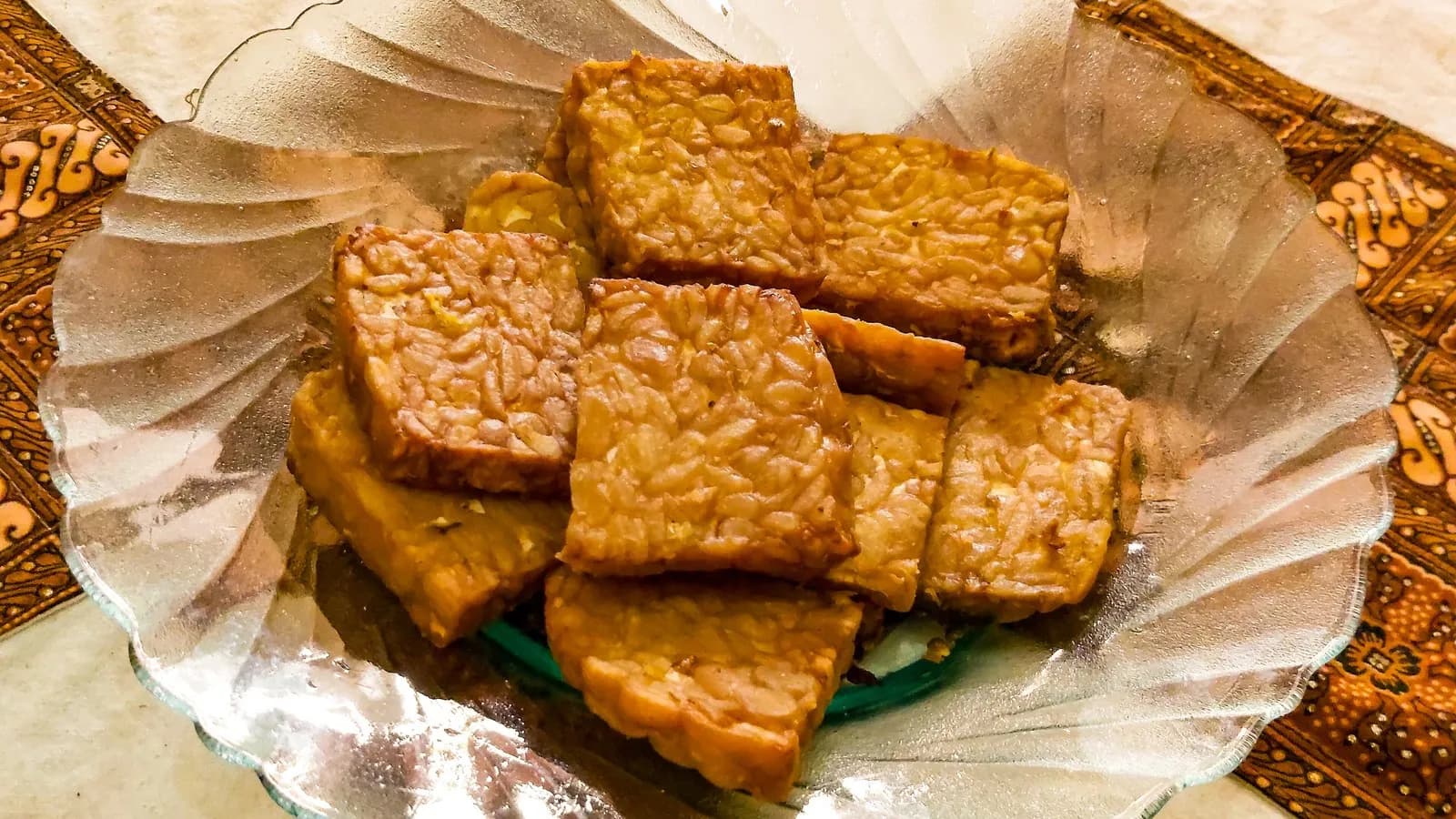
Almost everything written about tempeh in English frames it as a substitute. High protein alternative to meat, plant based swap, the vegan option. This is a strange way to describe a food that has been eaten in Java for roughly four hundred years by people who were not substituting it for anything.
Tempeh was documented in Bayat, in Klaten, Central Java, in the 1600s, and it has been an ordinary staple ever since. It is made by inoculating cooked soybeans with a mould, usually Rhizopus oligosporus, packing them tight and holding them at around 30C for a couple of days until the mycelium knits the beans into a firm white cake. That is the whole technology, and it is old.
What the fermentation actually does
Three things, and they are the reason tempeh behaves differently from tofu.
It binds. The mould's mycelium is what turns loose beans into a sliceable block, which is why tempeh has structure and bite where tofu has none. It predigests, breaking proteins into free amino acids and increasing digestibility. And it strips out antinutrients: fermentation with Rhizopus oligosporus has been measured cutting trypsin inhibitors by around two thirds and phytates by up to 65 percent, which improves the availability of the minerals already in the beans.
Uncooked soy tempeh runs to roughly 19 to 20 percent protein by weight, which is in the same region as minced beef or chicken. That is a fact about the food, not an argument for it.
The recipe: tempeh braised in turmeric and lemongrass, then fried
This is the technique behind tempeh bacem and its relatives: simmer first in aromatics, then fry. It is much better than frying raw tempeh, which stays dry and can be faintly bitter.
For two to three.
- 250g tempeh, cut into 1cm slabs
- 2 stalks lemongrass, bruised hard with the back of a knife
- 4cm fresh turmeric, sliced, or 1.5 tsp ground
- 3cm ginger or galangal, sliced
- 3 cloves garlic, crushed
- 3 kaffir lime leaves, or a strip of lime zest
- 1 tbsp tamarind paste, or the juice of half a lime
- 1 tbsp soy sauce or kecap manis
- 1 tsp coconut sugar or brown sugar
- 1 tsp salt
- 300ml water or thin coconut milk
- Neutral oil for frying
Put everything except the tempeh and the frying oil into a wide pan and bring to a simmer. Lay the tempeh in a single layer, top up with water so it is just covered, and simmer gently, uncovered, for 20 to 25 minutes until the liquid has reduced to a syrupy glaze clinging to the slabs. Do not boil hard. Tempeh will break up.
Lift the pieces out and let them dry on a rack for ten minutes. This matters. Wet tempeh in hot oil spits and steams instead of browning.
Fry in 1cm of hot oil, two or three minutes a side, until deep brown and crisp at the edges. Drain, salt lightly, and eat with rice, sambal and something sharp and raw.
The B12 claim you should ignore
Tempeh is regularly listed as a plant source of vitamin B12. It is not a reliable one, and treating it as one is genuinely risky for anyone eating no animal foods at all.
Where B12 has been detected in tempeh, it has generally been traced to contaminating bacteria such as Klebsiella and Citrobacter that happen to be present during fermentation, rather than to the Rhizopus mould itself. Measured levels are erratic, commonly between zero and a fraction of a microgram per 100g, and frequently zero outright. Tempeh made under modern hygienic conditions in Europe or North America should not be counted on for any B12 at all.
The practical consequence is simple. If you eat a fully plant based diet, take a B12 supplement or eat reliably fortified foods, and do not let tempeh, or any other fermented food, stand in for that. B12 deficiency develops slowly and quietly and causes neurological damage that is not always reversible. The NHS overview of B12 deficiency is a sober summary, and the evidence on B12 in plant foods covers the fermentation research directly.
Buying and storing
Good tempeh is firm, dense and covered in a dry white bloom. Grey or black patches of sporulation are harmless and are a sign of a mature ferment, though they taste stronger. Slimy texture, ammonia smell or pink and yellow colouring mean it has gone over: throw it away.
It freezes well in slabs. Our other soy technique is in the baked tofu recipe, and the argument for cooking plants as themselves rather than as replacements is made at length in this piece.
Published in The Outspoken Digest
Editorial desk
Outspoken Digest Food DeskCooking, ingredients, restaurants and the economics of what ends up on the table.
Newsletter
The Digest, in your inbox
One edition, sent when it is ready. No noise, and your address is never passed on.
Read Next
More Recipes →
Swangy Tamarind Glazed Chicken Wings for the Flavour Replacing Swicy on Fast Food Menus
Sep 29, 2026/3 min read

Baked Apple Cider Doughnuts for a Cider Season That Peaked Earlier Than the Calendar Says
Sep 29, 2026/3 min read
An Obatzda Bavarian Beer Cheese Dip for the Final Stretch of Oktoberfest 2026
Sep 29, 2026/3 min read