Webb and MeerKAT Find the Most Distant Fast Radio Burst Yet, From a Small Galaxy About 11 Billion Years Back
FRB 20240304B was caught by South Africa's MeerKAT and its host found by Webb. The galaxy is a surprise, a young dwarf far lighter than expected, and it favours magnetars over mergers.
Friday, October 9, 2026/2 min read
A flash that lasted a few thousandths of a second has become the most distant fast radio burst yet found. The burst, catalogued as FRB 20240304B, was detected by South Africa's MeerKAT telescope on 4 March 2024. A team led by Manisha Caleb of the University of Sydney reports in Science that its light travelled for roughly 11 billion years to reach us, according to Sky and Telescope.
In those few milliseconds the burst released more energy than the Sun does in a year. It left its source when the universe was about 3 billion years old, at a redshift of 2.15, and the finding was published on 8 October.
How far is it, and how does that compare with the 2023 record?
In 2023 ESO announced FRB 20220610A, which Australia's ASKAP telescope had detected in June 2022, as the most distant burst then known, with light from its source galaxy that had taken about eight billion years to arrive. The new burst's light-travel time is roughly 11 billion years, which puts it well beyond that mark.
Why did it take the Webb telescope?
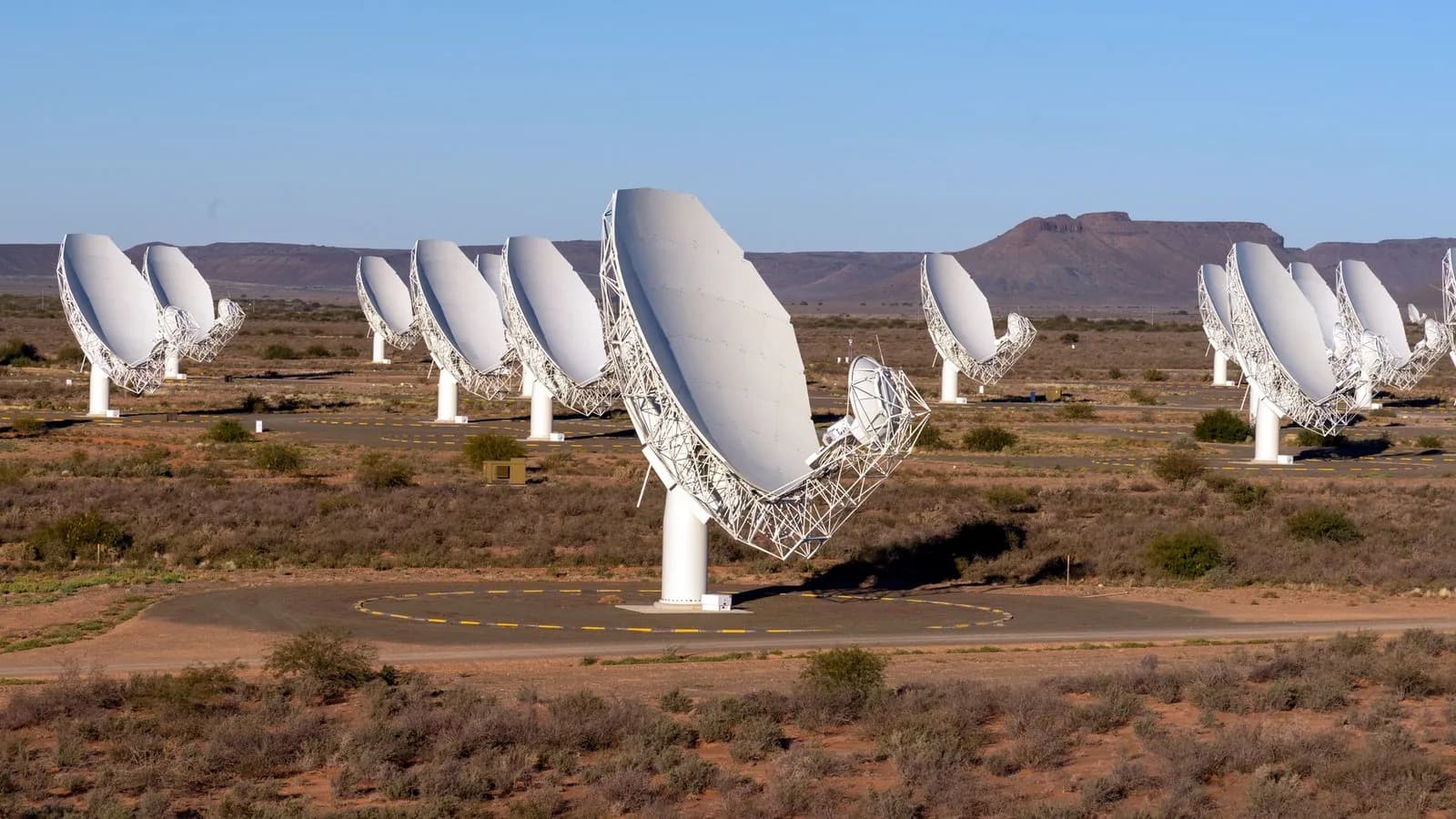
MeerKAT, an array of 64 radio dishes in South Africa, detected the burst and pinned it to a patch of sky near the star Denebola in Leo. Archival images and ground-based telescopes, including Keck in Hawaii and the MMT in Arizona, found no galaxy at that position. The James Webb Space Telescope did. Its Near-Infrared Camera picked up a very faint host, and its Near-Infrared Spectrograph measured the redshift, according to Sky and Telescope and to OzGrav.
A small galaxy, and a clue about where bursts come from
The host surprised the team. It is a dwarf galaxy that is still forming stars, about a thousand times less massive than expected for a typical burst host, and OzGrav says most of its stars may have formed within about 30 million years. Caleb said the team had expected a big, well-formed galaxy, and "instead it was a little dwarf galaxy".
That points towards magnetars, the young and intensely magnetised neutron stars left behind by supernovae, as the source, and away from mergers of neutron stars, which would take billions of years to occur and would be expected in older galaxies. Caleb says the work makes a merger origin very unlikely for this burst.
The burst doubled as a probe. Its signal passed through a previously unknown galaxy cluster at redshift 0.3, about 3.5 billion light-years away, and through the nearby Virgo Cluster, OzGrav reports. Sky and Telescope says it samples ionised gas over about 80 per cent of cosmic history. J. Xavier Prochaska of the University of California, Santa Cruz, a co-author, likens a burst to a cosmic flashlight.
What comes next?
The team estimates MeerKAT could find several bursts a year at redshift above 1. Space in Africa adds that the SKA-Mid telescope, under construction in South Africa and incorporating MeerKAT, is expected to detect more distant ones, with Webb following up on their hosts. Joeri van Leeuwen of ASTRON, who was not involved in the study, said that every large collection begins with a single specimen. One burst from 11 billion years ago is that first specimen, and the next few will show whether young dwarf galaxies are the norm.
Published in The Outspoken Digest
Editorial desk
Outspoken Digest Science DeskReports for The Outspoken Digest across Technology, Latest Trends, Health.
Newsletter
The Digest, in your inbox
One edition, sent when it is ready. No noise, and your address is never passed on.
Read Next
More Technology →
SpaceX Agrees to Buy a Nationwide Block of 800 MHz Spectrum, Reportedly for $8 Billion, to Back Starlink Mobile
Oct 9, 2026/3 min read
Finland Orders Google to Stop Forest Clearing at Two Data Centre Sites Until Environmental Reviews Finish
Oct 9, 2026/3 min read
Manus Raised More Than $500 Million Six Months After China Forced Meta to Unwind Its $2 Billion Takeover
Oct 9, 2026/2 min read