Za'atar Is a Herb, a Blend and an Argument About Land
The same word means a wild hillside herb and the sesame-and-sumac mixture made from it. Knowing which one a recipe means is the difference between a good jar and a disappointing one.
Thursday, August 13, 2026/5 min read
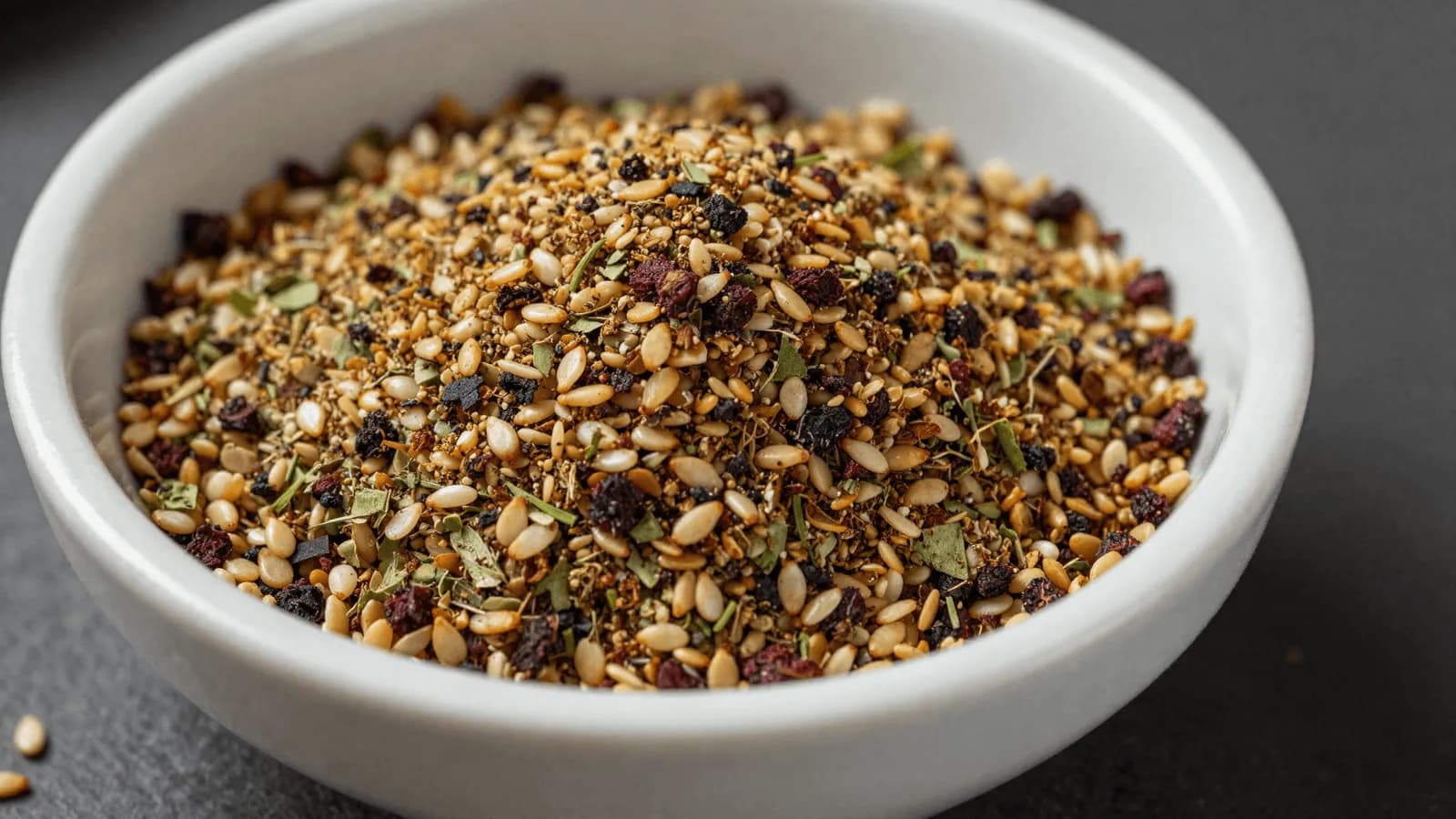
Ask for za'atar in a Levantine market and the answer depends on which shelf the seller reaches for. One holds a bundle of dried grey-green leaves. The other holds a coarse, brick-flecked mixture with sesame seeds through it. Both are za'atar, correctly, and this is the source of nearly every confusion in English-language recipes.
The word is Arabic for a family of wild hillside herbs, the most important of which is Origanum syriacum, sometimes called Syrian oregano or biblical hyssop. It is also the name of the blend built on that herb.
A recipe calling for a teaspoon of za'atar means the blend. A recipe calling for a handful of fresh za'atar means the plant. If a jar you bought tastes of very little, the odds are it contains neither in useful quantity.
What is actually in the blend
Three things define it, as the standard description sets out: the dried herb, sesame seeds and sumac, usually with salt.
The herb carries the savoury, faintly medicinal backbone. Toasted sesame gives fat, nuttiness and body. Sumac, the ground dried berry of a Mediterranean shrub, provides a sharp fruity sourness that does the job lemon would do if you could put lemon in a jar.
Beyond that it opens up. Some blends carry cumin, coriander seed, aniseed, caraway or dried oregano and marjoram. Household proportions vary as much as household bread recipes do.
The catch is that Origanum syriacum is not widely exported, so most commercial za'atar sold outside the region substitutes ordinary dried thyme, oregano or a mix of both. That is a legitimate adaptation rather than a fake, but it does taste different, and it is why a jar bought in the Levant rarely tastes like a jar bought in a European supermarket.
How the regions differ
The proportions are a regional signature and people are not casual about them.
Lebanese blends lean sour and dark, heavy on sumac, often with a deep red-brown cast. Palestinian blends tend to be greener and more herb-forward, frequently with caraway. Syrian versions are commonly the most sesame-rich. Jordanian blends often sit closest to plain herb and sumac with little else.
None of these is the correct one. They are different answers to the same question and every family will tell you theirs is standard.
The thing that is actually wrong with your jar
Za'atar goes stale faster than almost any other spice mixture in the cupboard, and the sesame is why. Sesame seeds are around half fat, and that fat oxidises. A blend more than six months old does not merely fade, it turns faintly rancid, with a flat cardboard note underneath.
Buy small quantities. Keep it sealed, dark and cool. If it smells of nothing when you open the jar, it will taste of nothing on the bread, and no amount of good olive oil will bring it back.
Ingredients
Makes about 150 g, roughly a medium jar. 10 minutes.
- 6 tablespoons dried thyme, or Origanum syriacum if you can get it
- 2 tablespoons dried oregano
- 4 tablespoons sesame seeds
- 3 tablespoons ground sumac
- 1 teaspoon fine sea salt
- 1 teaspoon ground cumin (optional)
- 1 teaspoon caraway seeds, lightly crushed (optional, Palestinian style)
Buy whole dried herb rather than the powdered kind if you have the choice. Pre-ground herb has already lost most of what you are paying for.
Method
1. Toast the sesame
Put the sesame seeds in a dry frying pan over a medium heat and shake them constantly for three to four minutes until they are pale gold and smell nutty.
Take them off the heat the moment the colour turns, and tip them out of the pan straight away. Sesame carries on cooking in a hot pan and burnt sesame is bitter enough to ruin the entire batch. Let them cool completely before mixing.
2. Break down the herb
Rub the dried thyme and oregano between your palms over a bowl to break the leaves down and wake the oils up. If your herb is coarse and stalky, pulse it briefly in a spice grinder, but only briefly.
You want a rough, leafy texture, not a powder. Za'atar ground to dust loses its character and clumps into a paste when it meets oil.
3. Mix and check the sumac
Combine the herbs, cooled sesame, sumac and salt in a bowl and stir thoroughly. Add the cumin and caraway if you are using them.
Taste it dry, on a fingertip. It should be noticeably sour. If it is not, add more sumac a teaspoon at a time; commercial sumac varies a great deal in strength and some of it is cut with salt.
4. Rest before judging
Jar it and leave it a day before deciding what you think. The sumac's moisture redistributes through the mixture and the flavours settle. It will taste more coherent on day two than it does five minutes after mixing.
Stored airtight in the dark it is at its best for about three months and perfectly good for six.
Is za'atar the same as thyme?
No, though the confusion is understandable. Za'atar the plant is Origanum syriacum, botanically closer to oregano and marjoram than to the common thyme sold in European supermarkets, despite the Arabic word often being translated as wild thyme. Za'atar the blend contains a dried herb of that family plus sesame, sumac and salt, so it is a mixture rather than a single herb. Substituting plain thyme for a blend will give you a dish missing both the sourness and the body.
What does za'atar taste like?
Savoury and herbal first, then sour from the sumac, then nutty and slightly rich from the sesame, with a faint dryness on the finish. It is less pungent than dried oregano and considerably more complex, and the sourness is the part that surprises people who were expecting a straightforward herb mix. Good za'atar tastes of a hillside rather than of a spice rack.
What do you use za'atar on?
Most obviously mixed with olive oil and baked onto flatbread as manakish. Beyond that it is excellent on roast chicken and roast vegetables, stirred through labneh or yogurt, scattered over hummus, dusted on fried eggs, and mixed into the oil you dress a tomato salad with. It is a finishing seasoning as much as a cooking one, and it takes heat badly, so add it late.
How to buy it
Look at the jar rather than the label. Good za'atar is visibly mixed, not uniform: you should be able to see whole sesame seeds, distinct leaf fragments and dark red sumac.
If the contents look like a single homogeneous brown powder, it has been over-ground or padded with flour and salt, both of which are common. Weight is another tell. A jar that feels heavy for its size is usually carrying more salt than herb.
Then use it on something that shows it off. The flatbread is the obvious test, and za'atar chicken is the one that will make you buy a bigger jar.
Published in The Outspoken Digest
Editorial desk
Outspoken Digest Food DeskCooking, ingredients, restaurants and the economics of what ends up on the table.
Newsletter
The Digest, in your inbox
One edition, sent when it is ready. No noise, and your address is never passed on.
Read Next
More Recipes →
Swangy Tamarind Glazed Chicken Wings for the Flavour Replacing Swicy on Fast Food Menus
Sep 29, 2026/3 min read

Baked Apple Cider Doughnuts for a Cider Season That Peaked Earlier Than the Calendar Says
Sep 29, 2026/3 min read
An Obatzda Bavarian Beer Cheese Dip for the Final Stretch of Oktoberfest 2026
Sep 29, 2026/3 min read