Fifteen Million Garments a Week Arrive in Ghana, and Forty Per Cent of the Country's Clothing Imports Become Waste
The donation bin is the end of the story for the person using it and the beginning of a long one for everybody else. What happens next is a functioning trade, a genuine livelihood, and a waste problem nobody exports a solution for.
Thursday, August 20, 2026/4 min read
Donating clothes feels like the responsible end of a purchase. The bag leaves the house, the guilt leaves with it, and the assumption is that somebody nearby who needs a coat will receive one.
Some of that happens. Most of what leaves a donation bin in a wealthy country enters a commercial export trade, and the largest single destination for the world's used clothing conversation is a market in Accra.
Where does it actually go?
Into bales, onto ships, and into a market economy that employs tens of thousands of people.
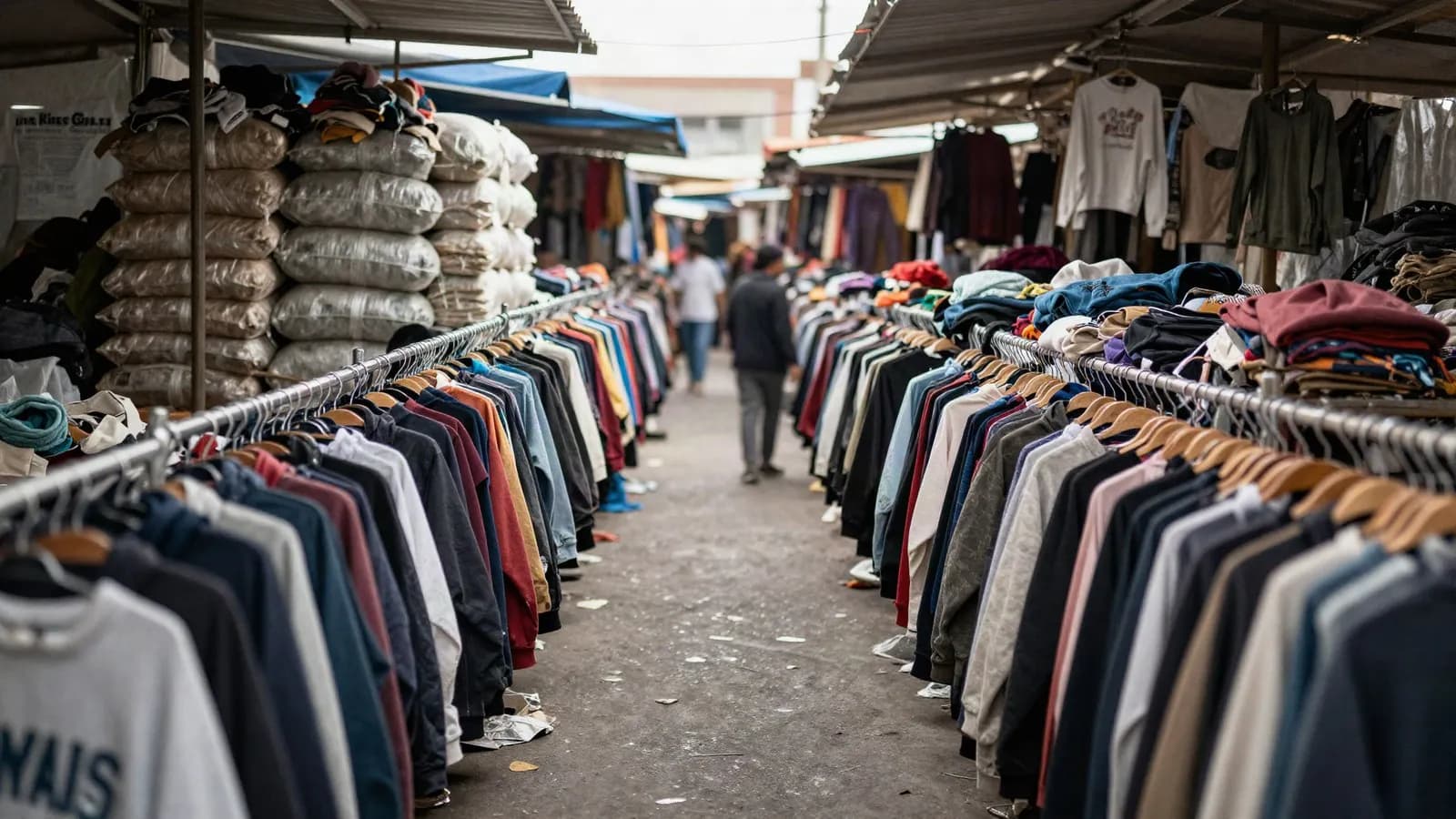
Around 15 million pieces of secondhand clothing arrive in Ghana every week from the United States, the United Kingdom, Australia and elsewhere, compressed into tightly packed bales and routed largely through Kantamanto Market in Accra.
From there, roughly 30 per cent moves on to other markets within Ghana, about 50 per cent is exported to neighbouring countries, and around 20 per cent is sold at Kantamanto itself. This is a distribution network, not a dumping ground, and describing it only as the latter erases the traders, menders, dyers and tailors whose livelihoods it is.
So what is the problem?
The share that cannot be sold, and who pays to deal with it.
Around 40 per cent of textile and apparel imports into Ghana end up as waste, going into landfill that is already overburdened. Of the textile waste collected at Kantamanto, roughly 30 per cent is landfilled and the remaining 70 per cent is abandoned in the environment, which in practice means waterways, beaches and open ground.
The bales are the mechanism. A trader buys a bale without seeing inside it, at a fixed price, and takes the risk. If the contents are worn out, stained, or simply unsuited to the climate, the loss falls on the buyer, and so does the disposal cost. The exporter has already been paid.
That is the structural unfairness. The financial benefit of clearing unsellable stock accrues at one end of the chain and the disposal liability lands at the other, several thousand kilometres away, in a place with far less waste infrastructure.
Has the quality of donations changed?
Yes, and this is the part that connects to everything else.
Traders in Accra have said for years that the bales have got worse. The garments arriving now are more likely to be cheap synthetics that were not built to survive one owner, let alone three. A cotton shirt with a decade of life is a resaleable good. A polyester dress that has already pilled is a disposal problem wearing the costume of a donation.
That is a direct consequence of what clothes are now made of, and it is why the secondhand system is straining. It was built on the assumption that used clothing has residual value, and a growing share of it does not.
Why does recycling not absorb it?
Because the clothes are blends and the technology mostly cannot separate them economically.
Fibre-to-fibre recycling works well on a single-fibre garment and poorly on a cotton-polyester mix, which describes most of the modern wardrobe. The costs of recycled fibre remain high and the linear structure of apparel production was never designed for disassembly. Recycling technology is improving and costs are falling, but the volume arriving does not wait for it.
What would actually change it?
Making the producer pay for the disposal, which is what extended producer responsibility means.
There is active work on applying EPR to textiles in Ghana, and the principle is straightforward: the company that put the garment on the market contributes to the cost of dealing with it at end of life. It changes the design incentive, because a garment that is cheap to make and expensive to dispose of stops being cheap.
Upcycling initiatives in Accra do genuinely good work, and they should be supported without being oversold. They cannot process 15 million items a week, and presenting them as the answer lets the volume question go unasked.
What should you do with a bag of old clothes?
Donate them, and be more careful about what goes in the bag.
The advice is not to stop. Wearable, good-quality clothing entering that trade genuinely gets worn. The advice is to stop using the donation bin as an alternative to the bin. Items that are stained, holed, stretched out or visibly finished are not donations, and sending them abroad transfers a disposal cost rather than doing a kindness.
Sell or pass on what still has life, use dedicated textile recycling for what does not, and repair the things worth repairing. And upstream of all of it, the variable that matters most is still the one in buying fewer things and wearing them longer, which is the only intervention that reduces the volume rather than relocating it.
Published in The Outspoken Digest
Newsletter
The Digest, in your inbox
One edition, sent when it is ready. No noise, and your address is never passed on.
Read Next
More Fashion →
Victoria's Secret Fashion Show Heads to Los Angeles on Sunday With an All-Women Lineup and Three Angel Hopefuls
Oct 15, 2026/2 min read

Anthony Vaccarello Is Leaving Saint Laurent After a Decade, and Kering Has Not Yet Named His Successor
Oct 9, 2026/2 min read

Louis Vuitton Closes Paris Fashion Week With Hovering Cars, Paper-Light Dresses and a Louvre Courtyard Cityscape
Oct 7, 2026/2 min read

Celine Dion Made a Surprise Return to the Catwalk to Close L'Oreal's Paris Fashion Week Opening Show
Sep 29, 2026/2 min read