Cashmere Has a Legal Definition, and It Is the Reason Two Jumpers With the Same Label Can Be Nothing Alike
Under US labelling law the word means goat undercoat averaging no more than nineteen microns. Within that definition sits a range from fibre that pills in a month to fibre that lasts twenty years. Here is what separates them.
Sunday, September 6, 2026/4 min read
A cashmere jumper can be bought for the price of a decent lunch or for the price of a week's holiday, and both will carry a label that says one hundred per cent cashmere. Both may even be telling the truth. The word has a precise meaning, but the meaning describes a floor, not a ceiling, and everything that matters to how the garment wears happens above the floor.
What the word is allowed to mean
In the United States, where the rules are written down most clearly, the Wool Products Labeling Act and its regulations at 16 CFR 300.19 allow the term cashmere only for the fine, dehaired undercoat fibre of the cashmere goat, Capra hircus laniger, with an average diameter of no more than nineteen microns and no more than three per cent by weight of fibres coarser than thirty microns. European and British trading standards work to similar thresholds. A garment that meets those numbers is cashmere. One that does not is a wool product mislabelled, and periodic testing by regulators and by the industry has found plenty of those, some containing little or no cashmere at all.
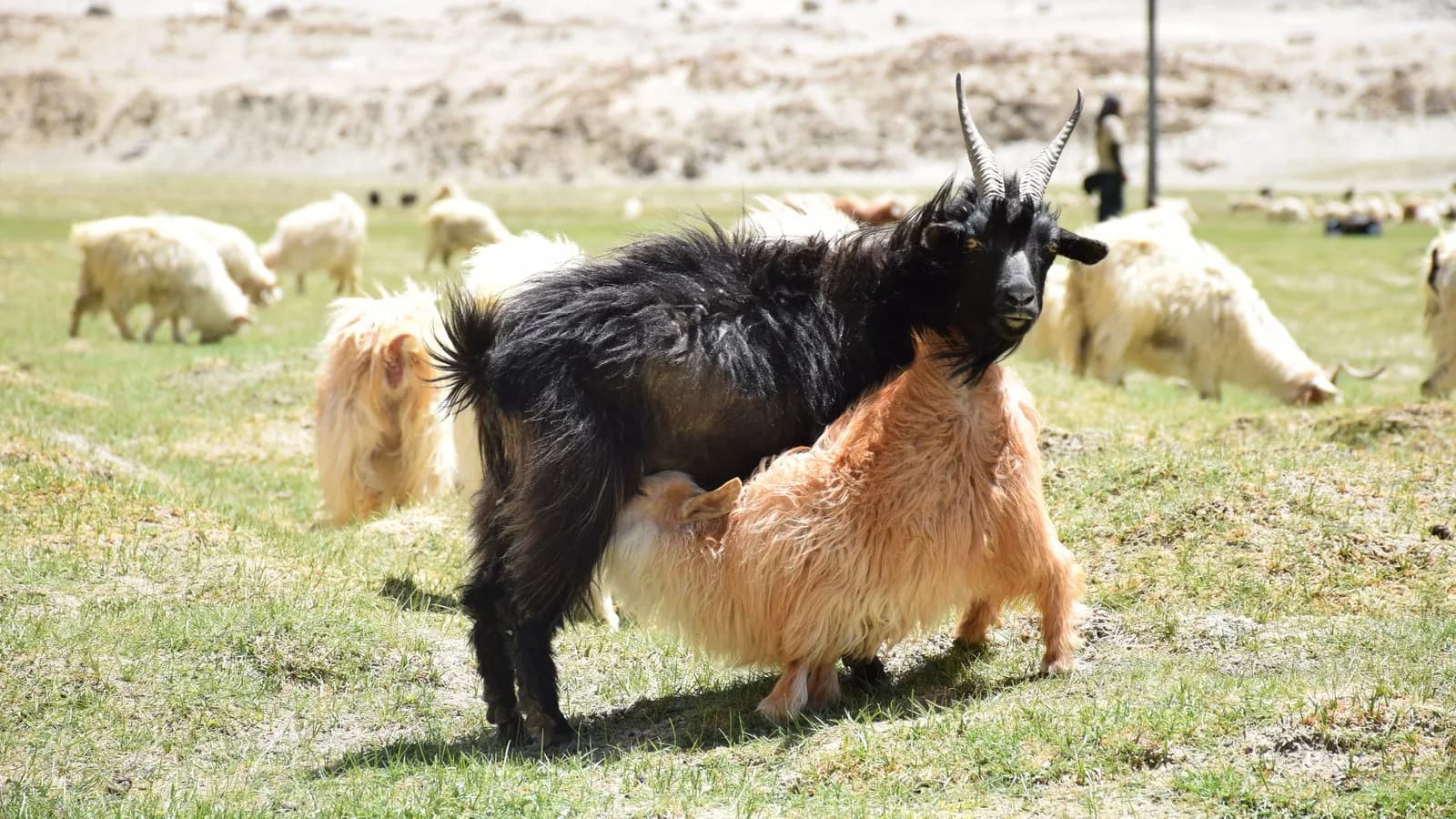
The goat grows the fibre as insulation against a Central Asian winter and sheds it in spring, when it is combed out by hand. China is the largest producer of raw fibre by a wide margin and Mongolia second, with Afghanistan, Iran and the Central Asian republics behind them. A single animal yields a small quantity, and it takes the spring combing of several goats to make one jumper. That is the irreducible reason cashmere costs what it does. Everything cheaper than the irreducible price has been made cheaper somewhere in the chain.
Where the differences hide
Fineness. Nineteen microns is the limit. The best fibre is closer to fourteen or fifteen, and the difference is what the hand feels as softness. Fine fibre costs more because there is less of it and it comes mostly from the coldest regions and the youngest animals.
Length. This is the one the label never mentions and the one that decides whether a jumper pills. Long fibres, above about 36 millimetres, twist together in the yarn and stay put. Short fibres work their way to the surface with wear and friction and tangle into the small balls everyone recognises. The dehairing process that removes the coarse guard hairs also breaks fibre, and it can be done gently and slowly or fast and cheaply. Cheap cashmere is largely short cashmere, and it is legally cashmere.
Ply and gauge. Two-ply yarn, two strands twisted together, is stronger and more even than a single strand and is the minimum for a garment meant to last. Gauge is the number of stitches per inch: a twelve-gauge knit is fine and light, a seven-gauge is chunky. Neither is better, but a very light, loosely knitted jumper made from short fibre will lose its shape within a season, and that describes a great deal of what sells at the low end.
Finishing. New cashmere is often washed and brushed to raise a soft surface that feels wonderful in the shop. Some of that surface is loose short fibre, and it comes off. A jumper that feels almost too soft on the shelf is sometimes telling you something.
The Mongolian problem
The boom in cheap cashmere has a cost that does not appear on the label. Goat numbers on the Mongolian steppe rose steeply as demand grew, and goats graze harder than sheep, pulling plants up by the root. Grassland degradation across large parts of the country is now well documented, and the Sustainable Fibre Alliance was set up to certify herders who keep stocking rates and grazing practices within what the land can carry. Certification is voluntary and covers a minority of the trade, but it is the one label on a cashmere garment, apart from the fibre content, that actually tells you something.
How to judge it in the shop
- Stretch a section gently and let go. Good cashmere recovers. Poor cashmere stays stretched.
- Rub the surface with a flat palm for ten seconds. If fibre begins to roll up under your hand, it will pill within weeks.
- Hold it up to the light. A dense, even knit with no thin patches is a sign of decent yarn and a decent gauge.
- Look for the ply on the swing tag or ask. Single-ply cashmere at a low price is a short-lived purchase.
- Ignore the word grade. Grade A is a marketing convention, not a regulated standard.
The broader method for reading a garment before you pay for it, seams, fabric, hand and finish, is in our guide to judging a garment. Cashmere rewards it more than most fabrics because the label tells you so little.
Care
Hand wash in cool water with a little gentle detergent, squeeze rather than wring, and dry flat on a towel away from heat. Cashmere does not need dry cleaning and is often better without it. Pilling, when it comes, is removed with a cashmere comb or a careful pass of a fabric shaver, and a well-made jumper pills less each year as the short fibres are gradually lost.
Store it clean, folded, and out of reach of clothes moths, which love it. A garment bag or a sealed drawer with cedar is enough; putting a jumper away unwashed is the single commonest way to lose one. Bought well and kept this way, a cashmere jumper is a twenty-year garment, which changes the arithmetic of the price entirely.
Published in The Outspoken Digest
Newsletter
The Digest, in your inbox
One edition, sent when it is ready. No noise, and your address is never passed on.
Read Next
More Fashion →
Victoria's Secret Fashion Show Heads to Los Angeles on Sunday With an All-Women Lineup and Three Angel Hopefuls
Oct 15, 2026/2 min read

Anthony Vaccarello Is Leaving Saint Laurent After a Decade, and Kering Has Not Yet Named His Successor
Oct 9, 2026/2 min read

Louis Vuitton Closes Paris Fashion Week With Hovering Cars, Paper-Light Dresses and a Louvre Courtyard Cityscape
Oct 7, 2026/2 min read

Celine Dion Made a Surprise Return to the Catwalk to Close L'Oreal's Paris Fashion Week Opening Show
Sep 29, 2026/2 min read