China Is Sending a Lander, a Rover and a Hopper to the Lunar South Pole on Monday
Chang'e 7 targets the one part of the Moon where ice may have sat undisturbed for billions of years, in craters the sun has never reached. The hopper is the part nobody has tried before.
Outspoken Digest Technology Desk
Friday, August 21, 2026/3 min read
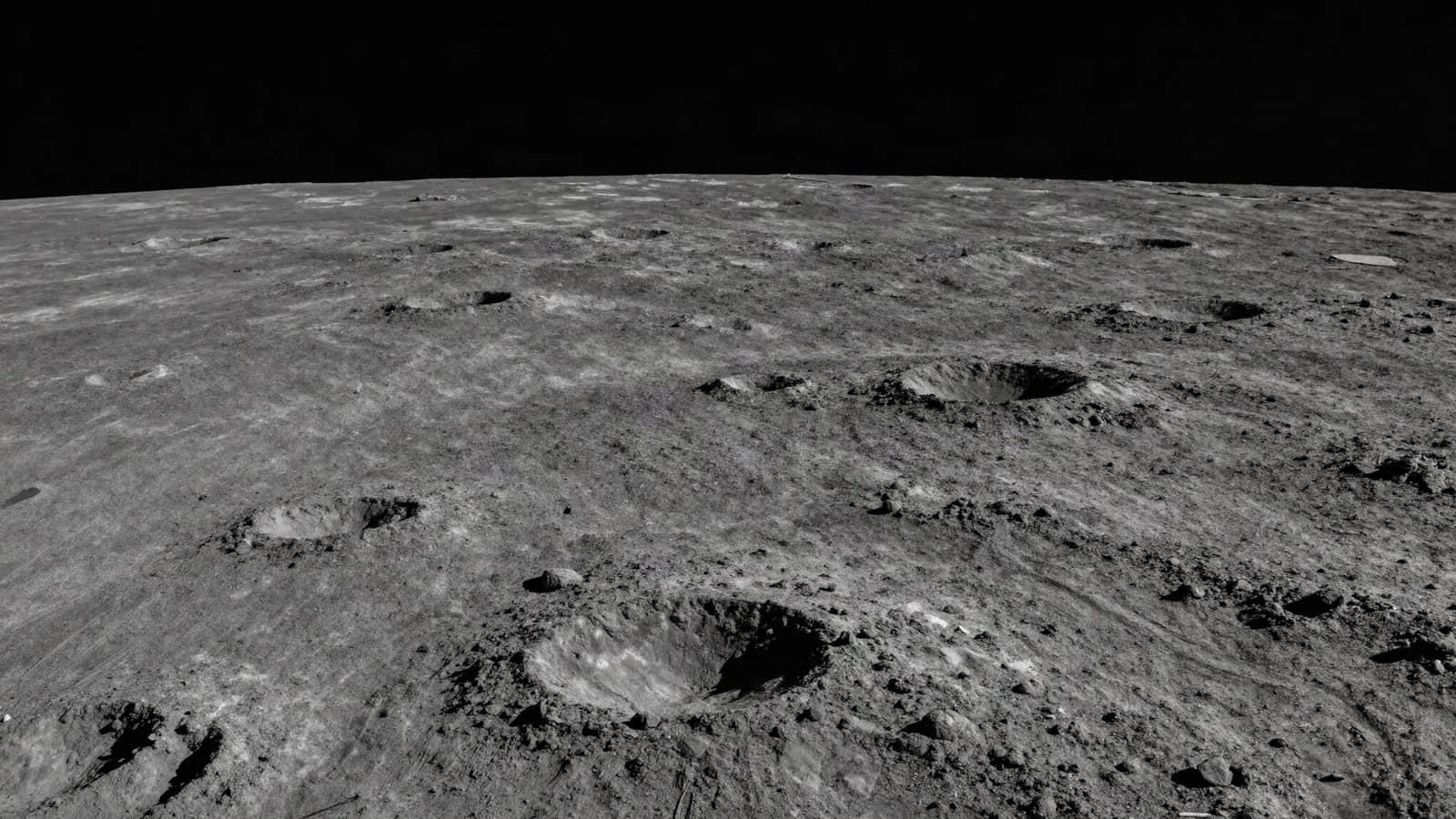
On Monday, China is due to launch Chang'e 7 towards the least hospitable and most valuable piece of real estate on the Moon: the south pole, where the sun sits so low that the floors of some craters have never been lit.
The mission carries a lander, a rover, a set of science instruments, and one component that makes this genuinely different from anything attempted before. It carries a hopper.
Why the south pole?
Because of what may be sitting in the dark.
The Moon has almost no axial tilt, so near the poles the sun never rises far above the horizon. Deep craters there contain regions that have been in permanent shadow for an extremely long time, and temperatures in those places are among the coldest measured anywhere in the Solar System.
Anything volatile that arrived, from comets, from asteroids, from the solar wind, and found its way into one of those cold traps would have had nowhere to go. Signs of water ice have been detected in exactly those permanently shadowed regions, and the working assumption is that some of it has been undisturbed for billions of years.
That makes it two things at once: a resource, and a record. A resource because water can be split into hydrogen and oxygen, which is propellant, and because hauling water up from Earth is the single most expensive thing about sustaining anyone off it. A record because undisturbed volatiles are a sample of what the early Solar System was made of, frozen in place before anything had a chance to rearrange it.
What is the hopper for?
Getting into the craters, which is the problem nobody has solved.
A rover cannot easily descend into a steep, permanently shadowed crater, and if it did it would be operating in extreme cold with no sunlight for power. So the interesting terrain has stayed out of reach of every mission that has gone to look at it.
A hopper is a different answer: a craft that can lift off the surface, fly a short distance under its own power, and set down somewhere a wheeled vehicle could not reach. Sending one to sample inside a shadowed region, rather than measuring it from orbit or from the rim, is the experimental heart of this mission.
It is also the part most likely to go wrong, which is what makes it worth watching. Landing once is hard. Landing, taking off again and landing a second time on a body with no atmosphere is considerably harder.
Why does this matter beyond China?
Because the south pole is where everyone is going, and there is not much of it.
The number of sites that combine near-permanent sunlight on a ridge, for power, with a permanently shadowed crater nearby, for ice, is small. Those sites are the ones every serious lunar programme has on its list. Concentrating multiple national efforts onto a handful of locations raises coordination questions that existing space law was not written to answer.
There is also a straightforward scientific point. Whoever samples the ice first will tell everyone else what it is actually made of, how much there is, and whether extracting it is realistic or a talking point. That answer shapes every plan built on the assumption that lunar water is available.
What happens next?
A busy fortnight, and Chang'e 7 is not the only launch on the calendar.
NASA's Nancy Grace Roman Space Telescope is scheduled for the end of the month, on a Falcon Heavy, pointed in the opposite direction and at a completely different problem.
The two together are a reasonable snapshot of where space activity has settled in 2026: national programmes pushing hard at the Moon as a place to operate, and large science missions pushing at questions about the universe that no amount of engineering on the Moon will answer. Both are expensive, both are slow, and both are the sort of thing that only makes sense on a timescale longer than a political term, which is the tension running through the wider argument about how big science gets funded.
Published in The Outspoken Digest
Editorial desk
Outspoken Digest Technology DeskSoftware, hardware, artificial intelligence and what they change for everyone else.
Newsletter
The Digest, in your inbox
One edition, sent when it is ready. No noise, and your address is never passed on.
Read Next
More Technology →
Astronomers Say a Pulsar's Odd Slowdown Is Explained by a Hidden Sunlike Star, Making It a Rare Stellar Trio
Oct 21, 2026/2 min read
Interstellar Comet 3I/ATLAS May Have Lost Metres of Its Surface to the Sun, a New Estimate Finds
Oct 21, 2026/2 min read
A Power Event in Google Cloud's London Region Knocked Out Banking Apps and Delivery Services for Hours
Oct 21, 2026/2 min read

An Indian Certificate Authority's Private Keys Were Trivially Guessable, and Browsers Have Revoked Them
Oct 21, 2026/2 min read