Three Divers Drifted Off Puerto Galera and Lived. Most of Surviving That Happens Before You Get In
Two men and a woman surfaced from a dive at Canyon Reef, found no boat, and were carried kilometres out. Whether lost divers are found has surprisingly little to do with the search itself.
Tuesday, August 18, 2026/4 min read
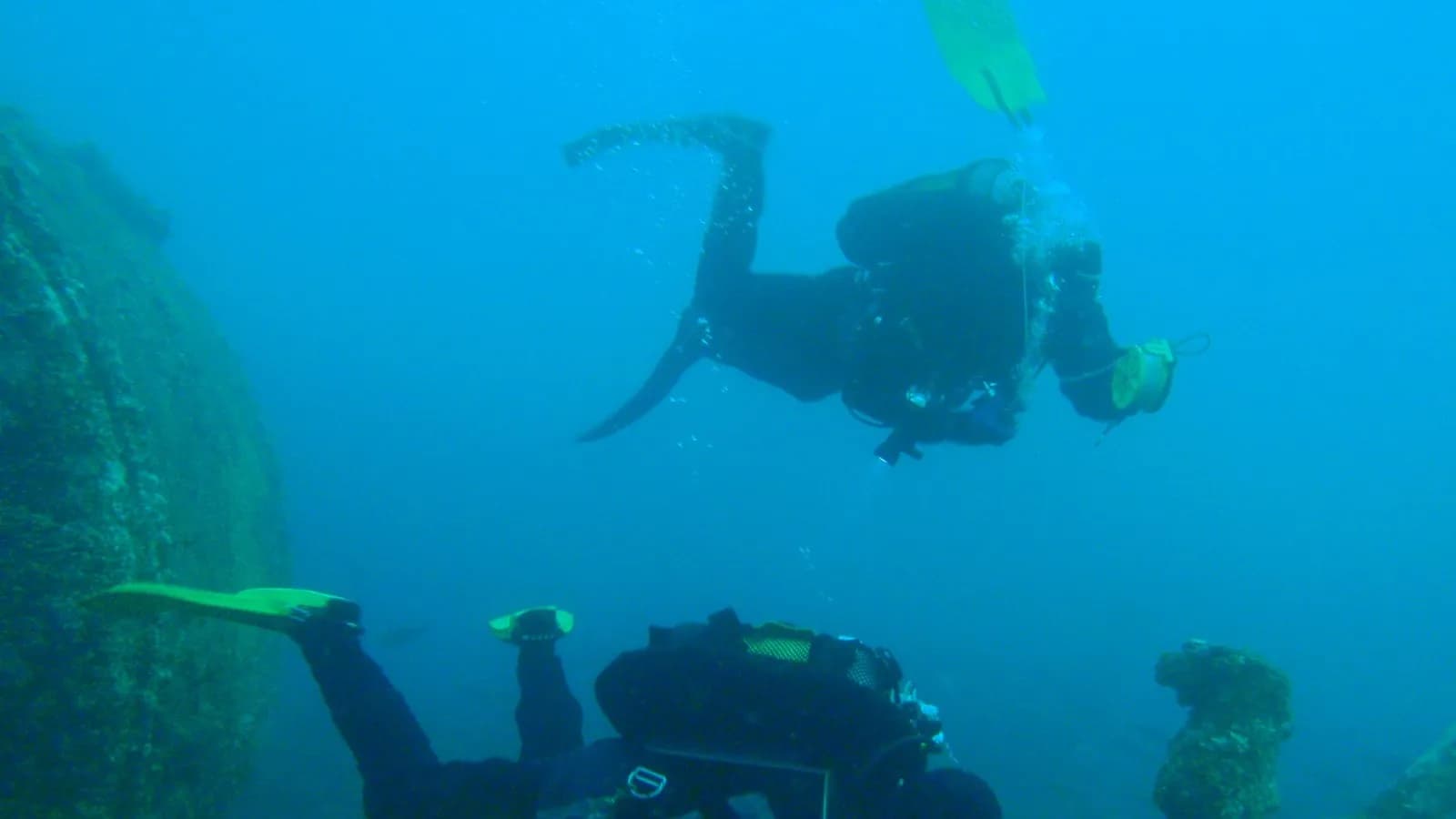
Three South Korean divers went into the water at Canyon Reef, off Barangay Sinandigan in Puerto Galera, on 11 August. Two men and a woman, a scheduled one-hour dive, a site thousands of people dive every season without incident.
They did not surface where the boat was. Conditions worsened. The operator raised the alarm, and by the time they were located they had been carried several kilometres from the site.
They lived. That is the headline, and it is the least useful part of the story.
What happens when a diver surfaces and the boat is gone
The failure people imagine is dramatic: an equipment problem, a medical event, a diver dragged into something. The failure that actually strands divers is duller. You surface a few hundred metres downcurrent of where the skipper is looking, and from the surface you are a coconut.
A diver's head in a swell is roughly the size and colour of floating debris. At 200 metres it is effectively invisible from a small boat in anything above a flat calm. This is not carelessness. It is freeboard and physics, and it is the reason the entire architecture of surface signalling exists.
The current does the rest. One knot, which is unremarkable in the Verde Island Passage and would barely register as drifty to most divers, moves you 1.8 kilometres in an hour. Two knots doubles it. Searchers work a probability circle while the people inside it keep travelling away from its centre.
Why the surface marker buoy is the whole argument
A delayed surface marker buoy, the orange or yellow sausage sent up from depth to stand a metre or more above the water, converts a diver from debris into a target.
The height is the point. Detection at sea is a function of contrast against the horizon, and a vertical orange column is the cheapest way a human body acquires both. Most boat crews will tell you they see the buoy long before they see the diver, and often before they see bubbles.
The practical reading is uncomfortable for a lot of holiday divers. If you cannot deploy a DSMB from depth reliably, without dumping your buoyancy or running the line up through your own kit, then in moving water you are relying on the boat's eyesight and your own luck. That skill is not an advanced extra. On any site with current it is core equipment, and our note on why entanglement is a skill problem rather than a knife problem makes the same case about a different piece of gear.
What belongs on a drift dive
Signalling is layered, because each layer fails in different conditions.
- DSMB and reel or spool. Deployed at the safety stop, not once you are already on the surface looking for the boat. By then the minutes that mattered are gone.
- An audible signal. A whistle costs almost nothing. A gas horn carries far further and still works when your voice has gone.
- A mirror or signal card. Useless under cloud, extraordinary in sun, and visible from an aircraft at distances no orange tube can manage.
- A personal locator beacon or satellite messenger in a dive housing. The layer that has genuinely changed outcomes this past decade. It does not help anyone search faster. It removes the search.
- A torch, always. Searches that begin in daylight do not always end there, and a strobe at night carries far beyond anything reflective.
Was the boat at fault?
No official finding has been published, and nothing here should be read as one. The reporting, carried by Divernet on 17 August, describes an operator who noticed the divers had not surfaced and alerted the authorities, which is the system working rather than failing.
Two questions get collapsed in comment threads and are worth separating. Whether anyone was negligent is for an investigation. Whether the outcome depended on decisions taken before anyone got wet is not really in dispute: site briefing, current assessment, live boat or moored, whether every diver carried a buoy and could use it, whether anyone had a beacon.
Our piece on how diving accidents are actually analysed explains why the chain matters more than the final link. A drift separation is the textbook case. By the time you are watching a boat get smaller, every decision that could have helped you has already been taken.
How long can a diver survive adrift?
Longer than most people expect in warm water, and far less long than they expect in cold.
In the tropics, with a wetsuit giving flotation and some insulation, the limits are usually dehydration, sun and exhaustion rather than hypothermia, which gives searchers a window measured in many hours or days. In temperate water the calculus inverts. Thermal protection becomes the binding constraint and the window can close inside an afternoon.
The Philippines case sits at the forgiving end of that range, which is part of why it ended as it did. That is the luck of geography, not a safety margin anyone should plan around.
The rule that comes out of it
Assume you will surface out of sight of the boat, because on a drift dive that is the normal outcome rather than the emergency. Then ask what you are carrying that ends the search, and whether you can deploy it at six metres with cold hands.
If the honest answer is a whistle and a hope, the plan has a hole in it that experience does not close.
Published in The Outspoken Digest
Editorial desk
Outspoken Digest Diving DeskCovers freediving, recreational and technical diving, dive medicine and the incidents the sport learns from.
Newsletter
The Digest, in your inbox
One edition, sent when it is ready. No noise, and your address is never passed on.
Read Next
More Diving →
Bleached Corals Recovered After Touching a Healthy Clone, Stanford Lab Study Finds
Oct 15, 2026/2 min read
Black Swallower Filmed With a Hugely Swollen Belly 1,259 Metres Down Off Trinidad and Tobago
Oct 13, 2026/2 min read
Playing Recordings of a Healthy Reef Drew More Coral and Fish Larvae to Artificial Structures Off Hawaii
Oct 9, 2026/3 min read
Blacktip Sharks Can Hear a Sound From Nearly 250 Feet Away and Swim Straight Toward or Away From It
Oct 1, 2026/2 min read