Most Divers Who Cannot See Solve It the One Way an Eye Doctor Would Not
Glasses do not fit under a mask, so the default answer is contact lenses. Eighty-five per cent of cases of a rare blinding corneal infection occurred in lens wearers who swam or dived in them, and there is a better option most divers never price.
Thursday, August 20, 2026/5 min read
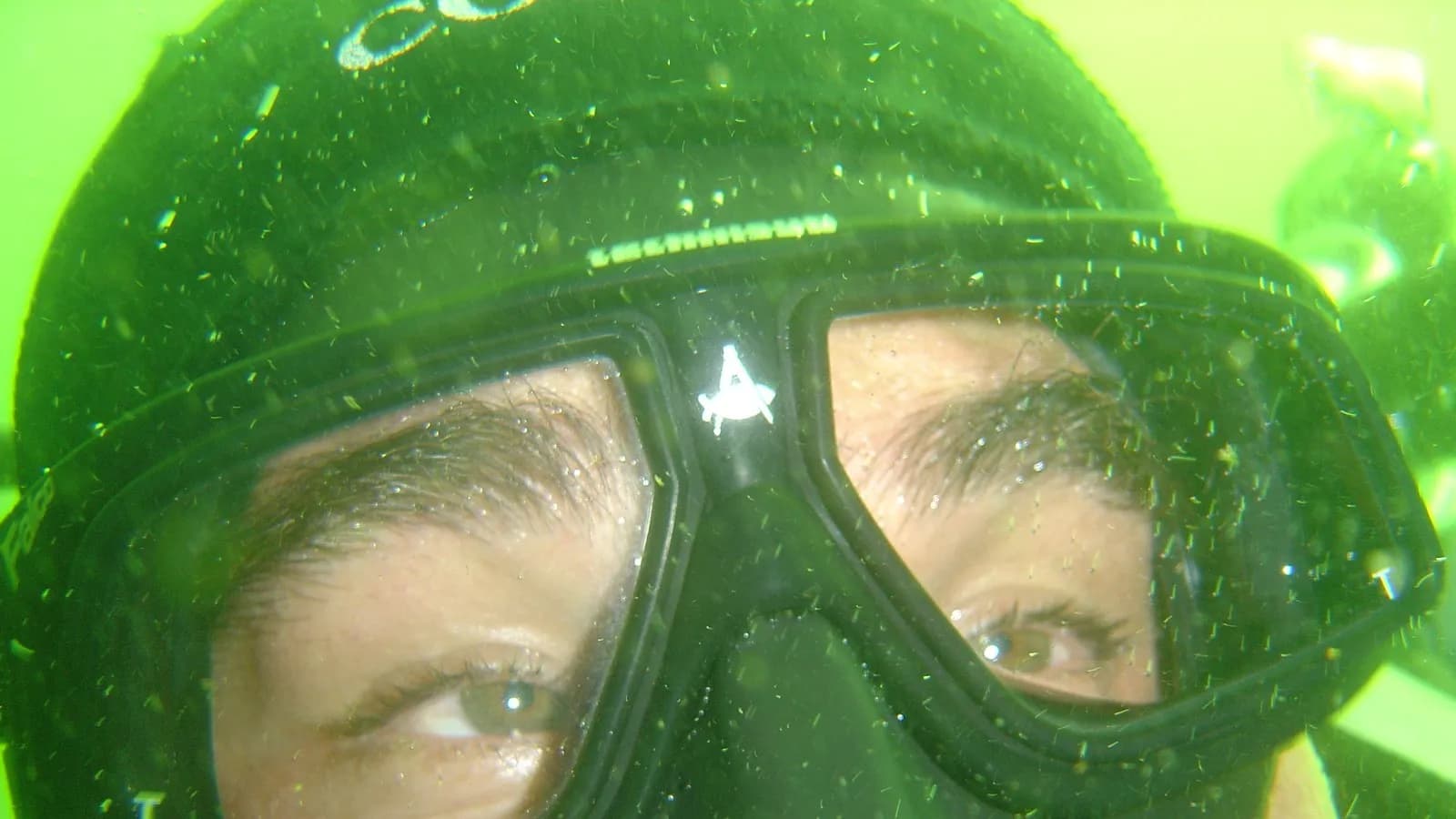
A dive mask has to seal against your face, which is precisely where the arms of a pair of glasses go. That geometric fact has pushed several generations of short-sighted divers toward contact lenses, usually without anybody raising an objection.
There is an objection. It is not the one most divers expect, it is not about the lens popping out, and it is worth knowing before your next trip.
Is it safe to dive in contact lenses?
It depends entirely on which kind, and the difference is physical.
Soft lenses rarely cause trouble underwater. They are permeable enough to let gas pass through, so nitrogen absorbed under pressure escapes without leaving anything trapped against the cornea. Divers Alert Network treats them as broadly workable.
Rigid gas permeable and hard lenses are a different matter, and DAN advises against diving in them. Under increasing ambient pressure they can suction painfully onto the eye. Worse, gas can become trapped between the lens and the cornea, producing bubbles that blur vision at exactly the depth where you would like to read a gauge. Neither problem is an emergency on its own. Both are unpleasant distractions at a moment when your attention has other work to do.
So the standard advice, if you are diving in soft lenses, is to close your eyes if your mask floods or you have to remove it, because an open eye in moving water is how a lens leaves. And carry glasses on the boat, because a diver who has lost a lens and cannot see the dive plan has a problem the sea does not care about.
The risk almost nobody mentions
Here is the part that changes the calculation, and it has nothing to do with the lens falling out.
Acanthamoeba is an amoeba that lives in water. Fresh water especially, but water generally. It can infect the cornea, and Acanthamoeba keratitis is a genuinely serious condition: painful, difficult to treat, and capable of costing sight.
It is rare. But research cited by DAN found that 85 per cent of cases occurred in contact lens wearers who had worn their lenses while swimming or diving. As the ophthalmologist Robert Sanders puts it in DAN's own guidance, any water is prone to bacteria.
The mechanism is unremarkable, which is what makes it easy to ignore. A contact lens sits directly against the cornea and holds whatever gets underneath it in prolonged contact with the eye. A splash of seawater in your face is trivial. The same water pinned against your cornea for the rest of a dive is not the same exposure at all.
The practical rule that follows: if water enters your mask while you are wearing lenses, take them out afterwards. Not that evening. Afterwards. And do not reuse them. Daily disposables are the sensible format for divers for exactly this reason, since throwing a lens away costs less than the alternative.
What about a prescription mask?
This is the option most divers assume is exotic and expensive, and for a lot of prescriptions it is neither.
There are two broad routes.
- Stock or premade corrective lenses. These come in fixed steps and, according to DAN, cover spherical corrections from 0 to −8.00 for short sight and 0 to +4.00 for long sight. They work best when astigmatism is mild, under about 0.75. If your prescription is ordinary, these drop into a compatible mask and cost far less than people imagine.
- Custom lenses. Available as drop-in or laminated types, and these will take essentially any prescription, including significant astigmatism and even prism correction for double vision. More expensive, made to order, and the answer for anyone whose eyes are not a standard shape.
The case for a prescription mask is not only optical. It removes the infection risk entirely, it survives a flooded mask, and it means the person who can see the pressure gauge is the person wearing the gauge. Given that a serious mask already costs real money, and that divers cheerfully spend far more on a wrist computer to display numbers they then cannot focus on, the spend is easy to justify.
DAN also suggests keeping a backup prescription mask if your diving warrants it. Losing your only corrective mask on the first day of a liveaboard is a trip-ending event rather than an inconvenience.
What if the problem is reading the gauge, not the reef?
This is the most common vision complaint in diving and it arrives on a schedule, usually somewhere in the forties.
Presbyopia makes close focus difficult while distance vision stays fine, which underwater translates to a diver who can see a turtle at fifteen metres and cannot read their own computer. Several fixes exist.
Premade gauge reader masks carry a magnified segment in the lower portion of the lens. Custom reading lenses do the same to your prescription. Stick-on readers are adhesive magnifiers you position yourself, which is the cheapest way to find out whether the idea suits you before committing. And Franklin bifocals split the lens with a customisable ratio of distance to near vision, for divers who need correction at both ends.
The stick-on option deserves a word of praise. It costs very little, it can be repositioned, and it lets you discover where you actually look when you check your gas, which is rarely where you would have guessed.
What should you do before the next trip?
Three things, in order of how much they matter.
If you dive in rigid or gas permeable lenses, stop, and talk to your optometrist about alternatives. If you dive in soft lenses, switch to daily disposables and remove them after any mask flood. And price a prescription mask, because if your prescription is within the stock range you will probably be surprised, and it is the only one of these options that solves the problem rather than managing it.
Then get your eyes checked by someone who knows you dive. Vision underwater is not a comfort issue. It is how you read a gauge, find a buddy and confirm a depth, which is the same list of things covered in DAN's wider safety guidance.
Published in The Outspoken Digest
Editorial desk
Outspoken Digest Diving DeskCovers freediving, recreational and technical diving, dive medicine and the incidents the sport learns from.
Newsletter
The Digest, in your inbox
One edition, sent when it is ready. No noise, and your address is never passed on.
Read Next
More Diving →
Breathless and Coughing Pink Froth After a Dive: Immersion Pulmonary Edema Explained
Oct 17, 2026/3 min read
Your Gas Consumption Is Not One Number: Why Depth, Cold and Nerves Change It
Oct 16, 2026/3 min read

SS United States Reef Sinking Targeted for November: What Divers Should Know
Oct 16, 2026/2 min read

Divers Excavating Off Kekova Find a Wreck Believed to Be the World's Oldest, Turkey Says
Oct 15, 2026/2 min read