The Gluten-Free Flour Guide: What Each One Does and What It Cannot Do
Rice flour is not a replacement for wheat, and no single flour is. Here is what each alternative actually contributes, which combinations work, and why psyllium and xanthan are not interchangeable.
Tuesday, August 11, 2026/4 min read
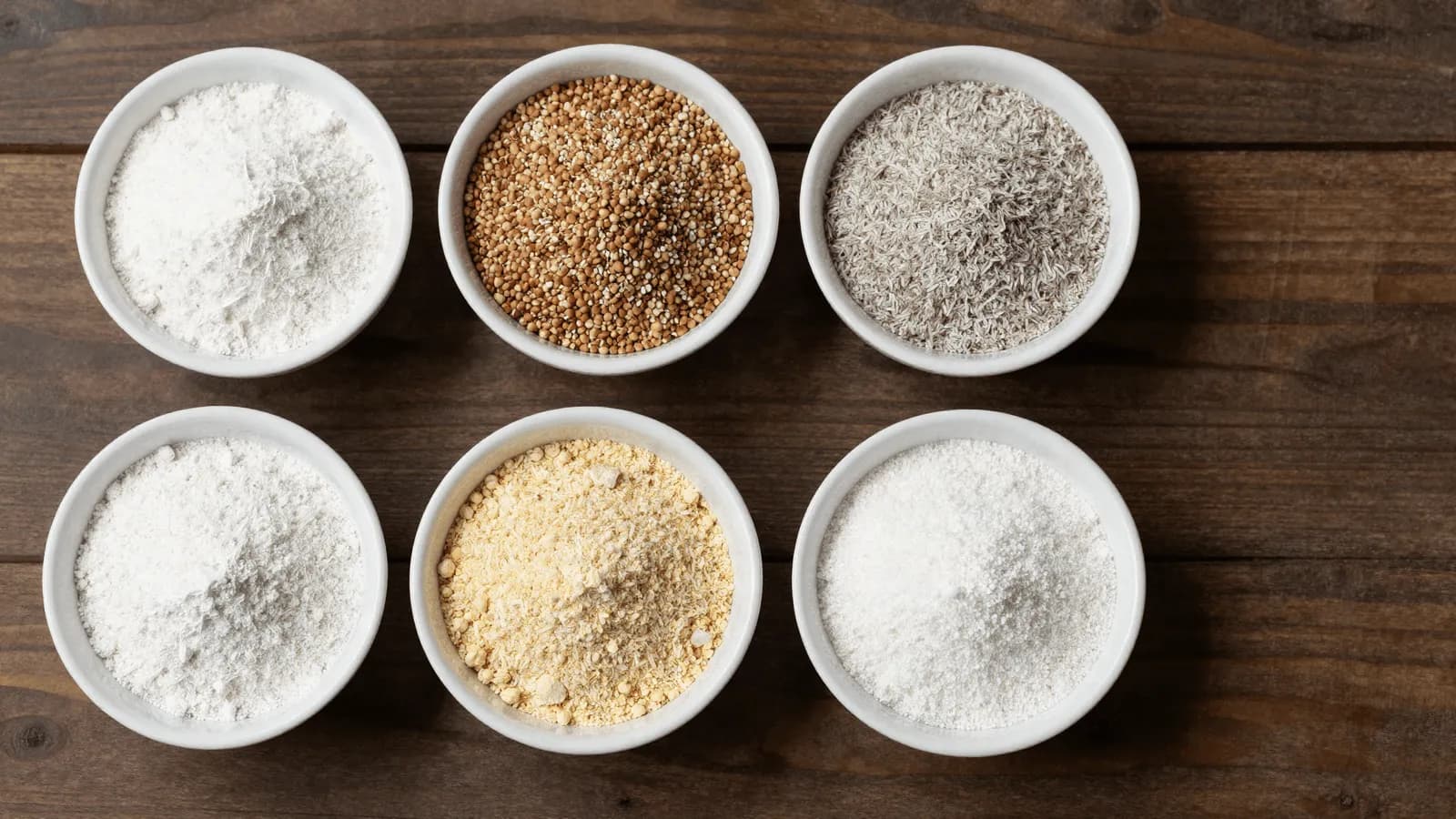
The reason gluten-free baking disappoints people is a category error. They swap one flour for another and expect the same result, when gluten was never doing a flour's job. It was doing a structural one.
In a wheat dough, gluten forms an elastic network that traps gas, gives the dough the strength to hold a shape while it rises, and keeps the finished crumb flexible. Remove it and you have starch and protein with nothing organising them. That is why the bread crumbles, the pastry cracks, and the flatbread snaps.
Getting a good result means replacing three things separately: bulk, structure, and moisture retention. Almost no single flour does more than one.
The starches: bulk and lightness
White rice flour
The workhorse of most blends. Neutral, cheap, available everywhere. On its own it is gritty and dry, and the grittiness is the giveaway in bad gluten-free baking. Buy finely milled if you can.
Brown rice flour
More flavour, more fibre, slightly heavier. Goes rancid faster because of the oil in the bran, so keep it in the fridge.
Tapioca starch
Adds chew and stretch, browns well, and gives the slight elasticity that makes flatbread feel like bread. Too much turns things gummy. Usually 15 to 30 per cent of a blend.
Potato starch
Holds moisture, produces a soft crumb, keeps cakes from drying out. Note that potato starch and potato flour are entirely different products and are not interchangeable.
Cornflour, also sold as cornstarch
Lightens and tenderises. Useful in cakes and shortbread, useless as a base.
The protein flours: flavour and body
Chickpea flour, also called gram or besan
High protein, holds together well, strong savoury flavour. Excellent for socca, pancakes and fritters. Poor in anything sweet, where the taste is intrusive. Cook it thoroughly, since raw chickpea flour tastes bitter.
Almond flour
Rich, moist, no starch structure at all. Wonderful in cakes and biscuits, hopeless as bread flour on its own. It is also the backbone of most low-carbohydrate baking, which is a different project entirely.
Buckwheat flour
Despite the name, no relation to wheat. Earthy, mineral, genuinely good in pancakes, soba noodles and rustic loaves. Strong enough that most people prefer it at 25 to 50 per cent of a blend.
Sorghum and millet
Mild, slightly sweet, the closest in behaviour to soft wheat flour. Underused, and worth seeking out if you bake often.
Teff
Tiny grain, deep flavour, naturally fermentable. The basis of injera, and the one alternative flour with a genuine bread tradition of its own.
The binders: this is the actual replacement for gluten
This is the part people skip, and it is the reason their bread fails.
Psyllium husk
The most useful ingredient in gluten-free bread. A soluble fibre that forms a gel, holds gas, and keeps the crumb pliable rather than brittle. It is what makes a flatbread bend instead of crack, as in our za'atar flatbread.
Use whole husk where you can, hydrate it in the liquid first, and never add it dry to a mixed dough or you get lumps that never hydrate.
Xanthan gum
Adds viscosity and stops crumbling. Good in cakes, biscuits and pastry. Poor at the job psyllium does in bread, which is holding structure over a long prove. Too much gives a slimy texture, and a quarter teaspoon per hundred grams of flour is usually plenty.
Eggs
Structure, lift and richness. Many gluten-free recipes lean on them heavily, which is worth knowing if you are also avoiding eggs.
The short version: psyllium for bread, xanthan for cake, and they are not substitutes for one another.
A blend that works
For general baking, by weight: 40 per cent white rice flour, 20 per cent sorghum or millet, 20 per cent tapioca starch, 20 per cent potato starch. Add psyllium for bread, xanthan for cake.
Mix a batch and keep it in a jar. Commercial blends are convenient and vary enormously in absorbency, which is why one recipe works with one brand and fails with another.
Four practical rules
- Weigh everything. Volume measures are unreliable across flours with very different densities.
- Wetter than you think. Gluten-free doughs should look too wet. Adding flour to fix tackiness produces a dry, crumbling result.
- Rest the batter. Twenty to thirty minutes lets the starches hydrate and removes most of the grittiness.
- Do not overbake. The margin between pliable and brittle is small, and gluten-free bakes dry out faster.
The part that is not about texture
If you are avoiding gluten by choice, cross-contamination is a non-issue. If you have coeliac disease it is the whole issue, and it applies to oats, to shared mills, to spice blends, and to the toaster.
Oats are naturally gluten free but are routinely contaminated in the supply chain, so buy certified. And if you suspect coeliac disease but have not been tested, do not remove gluten first, because the test only works while you are still eating it. The distinctions matter, and we set them out in coeliac, wheat allergy or gluten sensitivity and in why testing comes before the diet.
Published in The Outspoken Digest
Editorial desk
Outspoken Digest Food DeskCooking, ingredients, restaurants and the economics of what ends up on the table.
Newsletter
The Digest, in your inbox
One edition, sent when it is ready. No noise, and your address is never passed on.
Read Next
More Nutrition →
Potassium-Rich DASH Diet Did Not Raise Blood Potassium to Unsafe Levels in Adults on Blood Pressure Drugs
Oct 13, 2026/2 min read
Matched for Calories and Macronutrients, an Ultra-Processed Meal Still Drew a Bigger Insulin Response in a Small Trial
Oct 9, 2026/3 min read
A Study of 371,000 Americans Found Whole Fruit, Not Juice, Is Linked to Better Heart Health
Oct 1, 2026/2 min read

Tirzepatide Switched On Calorie-Burning Brown Fat in Obese Mice, Independent of Its Appetite-Suppressing Effect
Sep 29, 2026/2 min read