GUE: The Agency That Will Fail You, and Thinks That Is the Point
Global Underwater Explorers standardises equipment, teaches in teams, tests fitness, and hands out provisional passes rather than certificates. It is the most divisive system in diving, and the most internally consistent.
Wednesday, August 12, 2026/4 min read
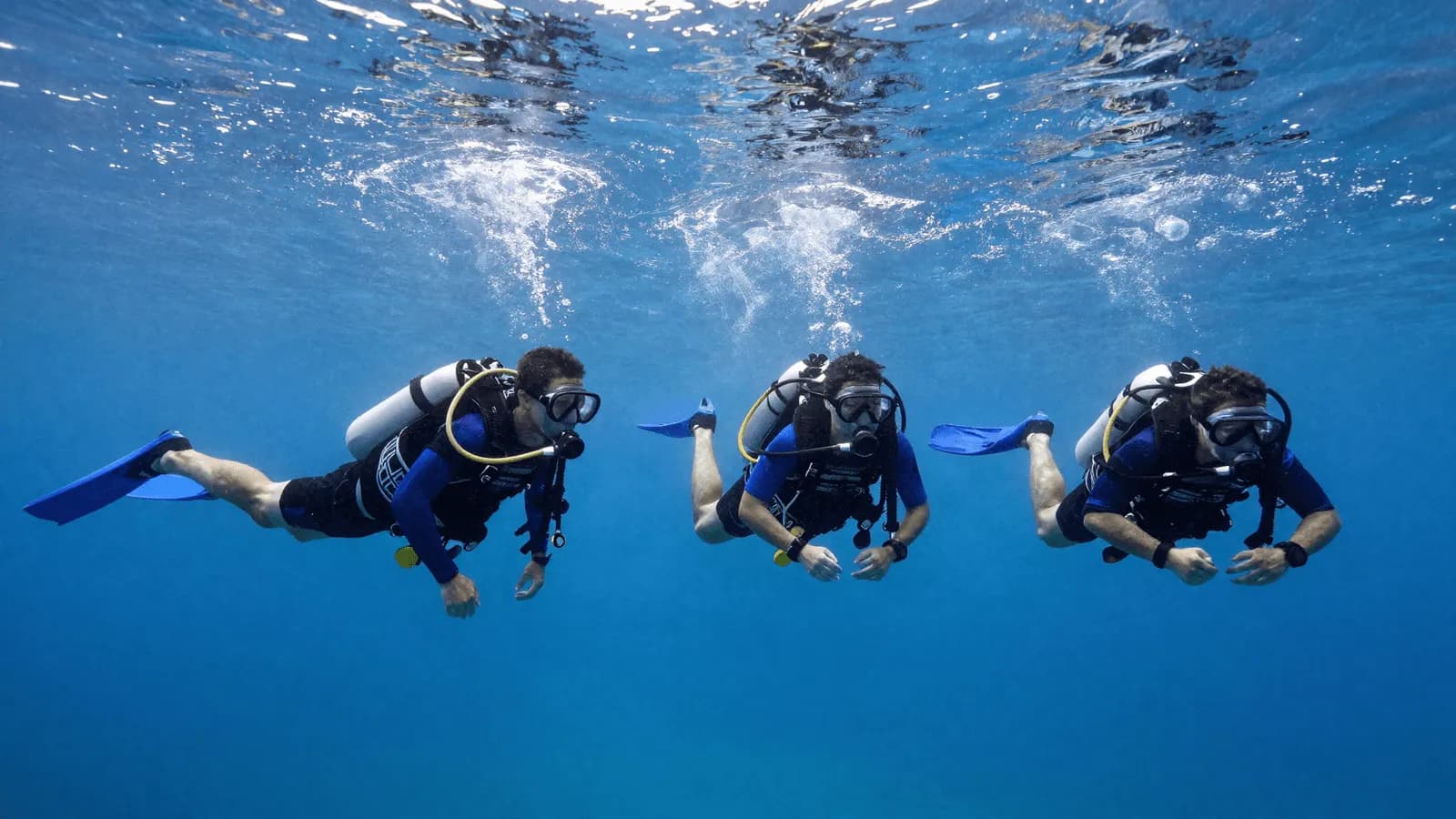
Most training agencies are built to certify you. Global Underwater Explorers is built to find out whether you can do it, which is not the same thing, and the difference explains almost everything people love and hate about it.
GUE emerged from the cave exploration community in the late 1990s, out of the equipment and procedure philosophy that became known as Doing It Right. It is a non-profit, it is small, and it is unusually opinionated.
The four commitments
1. Standardised equipment
In GUE, configuration is not a preference. Hose routing, the long hose for gas sharing, backplate and wing, light and reel placement, are all specified.
The reasoning is entirely about teams. If every diver's kit is identical, any diver can find any other diver's regulator, cutting tool or light without looking. In an emergency, in poor visibility, this converts a search into a reach. The cost is obvious: you dive their way or you do not dive with them.
2. Standardised gas
GUE uses a small set of standard mixes for defined depth ranges, rather than optimising a bespoke blend per dive. It gives up some efficiency and buys back an enormous amount of planning simplicity and team compatibility, which matters when six people are running the same decompression schedule.
3. The team, not the individual
GUE trains divers as units. Ascents are made together, gas is a shared resource, and a problem belongs to the team rather than the diver who has it.
This is a genuine departure from recreational practice, where the buddy system is often theatre. It is also the reason GUE divers can be tiresome about proximity, and the reason their incident record in demanding environments is respected.
4. Fitness and no smoking
GUE sets swim and breath-hold requirements at entry level and does not certify smokers. Few agencies impose either. Given that cardiovascular health dominates recreational fatality data, it is hard to argue the concern is misplaced, even if the policy is paternalistic.
Fundamentals, and the provisional pass
The entry course, GUE Fundamentals, is where most divers meet the system. It is not an entry-level diving course. It is a course about how you move through water: buoyancy, trim, propulsion techniques, situational awareness and basic team skills.
It has three outcomes. Technical pass, recreational pass, or provisional, meaning you did not meet the standard yet and may return within a set period to demonstrate it.
Experienced divers with hundreds of dives routinely come out provisional, and this is the single most contentious fact about GUE. Two readings are available and both are partly true.
The generous reading: an agency that fails people is measuring something real, and a card that everyone passes measures nothing. The critical reading: it filters on stylistic conformity as well as on capability, and the atmosphere it creates can be off-putting to divers who would have benefited from the content.
What is not really contested is the effect on skills. Divers of every affiliation take Fundamentals for the buoyancy and trim work and come out better, which is the highest compliment a course can be paid.
The progression
Beyond Fundamentals the ladder runs through technical, cave and rebreather grades, into the exploration projects the organisation is genuinely known for: cave systems, deep wrecks, and long-running documentation and conservation work.
That exploration output is the argument for the whole system. GUE's protocols were not derived in a classroom. They came from projects where a team failure would have been unrecoverable.
The real criticisms
- Availability. Few instructors, few courses, and long waits in most regions. In much of the Gulf and Red Sea you will travel for it.
- Cost and time. Longer courses, mandatory equipment purchases, and often a repeat visit.
- Cultural rigidity. The community's certainty is a real barrier for some divers, and the DIR debates have generated more heat than any technical question deserves.
- Interoperability. Standardisation is a benefit inside the system and a friction outside it, since a GUE diver on a general charter is often the odd one out.
Who it is for
GUE suits divers who want to be measured, who dive regularly with the same people, and who are heading towards demanding environments where team capability is the actual safety system.
It suits you badly if you dive twice a year on holiday with whoever is on the boat, though even then, Fundamentals remains the most effective buoyancy course available.
If the goal is technical progression rather than the philosophy, weigh it against the routes described in our piece on IANTD, and against the more general question of what actually changes when you go technical.
The uncomfortable thing about GUE is that its critics rarely dispute that its divers are good. They dispute what it costs to be told so.
Published in The Outspoken Digest
Editorial desk
Outspoken Digest Diving DeskCovers freediving, recreational and technical diving, dive medicine and the incidents the sport learns from.
Newsletter
The Digest, in your inbox
One edition, sent when it is ready. No noise, and your address is never passed on.
Read Next
More Diving →
Black Swallower Filmed With a Hugely Swollen Belly 1,259 Metres Down Off Trinidad and Tobago
Oct 13, 2026/2 min read
Playing Recordings of a Healthy Reef Drew More Coral and Fish Larvae to Artificial Structures Off Hawaii
Oct 9, 2026/3 min read
Blacktip Sharks Can Hear a Sound From Nearly 250 Feet Away and Swim Straight Toward or Away From It
Oct 1, 2026/2 min read
A Sea Turtle Species Never Recorded Nesting in the United States Laid Eggs on a Southern California Beach
Oct 1, 2026/2 min read