Nasal Rinsing Works, and the Water You Use Can Kill You
Saline nasal irrigation has reasonable evidence behind it for sinus symptoms. It also has a rare, almost uniformly fatal complication, and avoiding it requires one specific instruction that most people have never been given.
Friday, September 4, 2026/3 min read
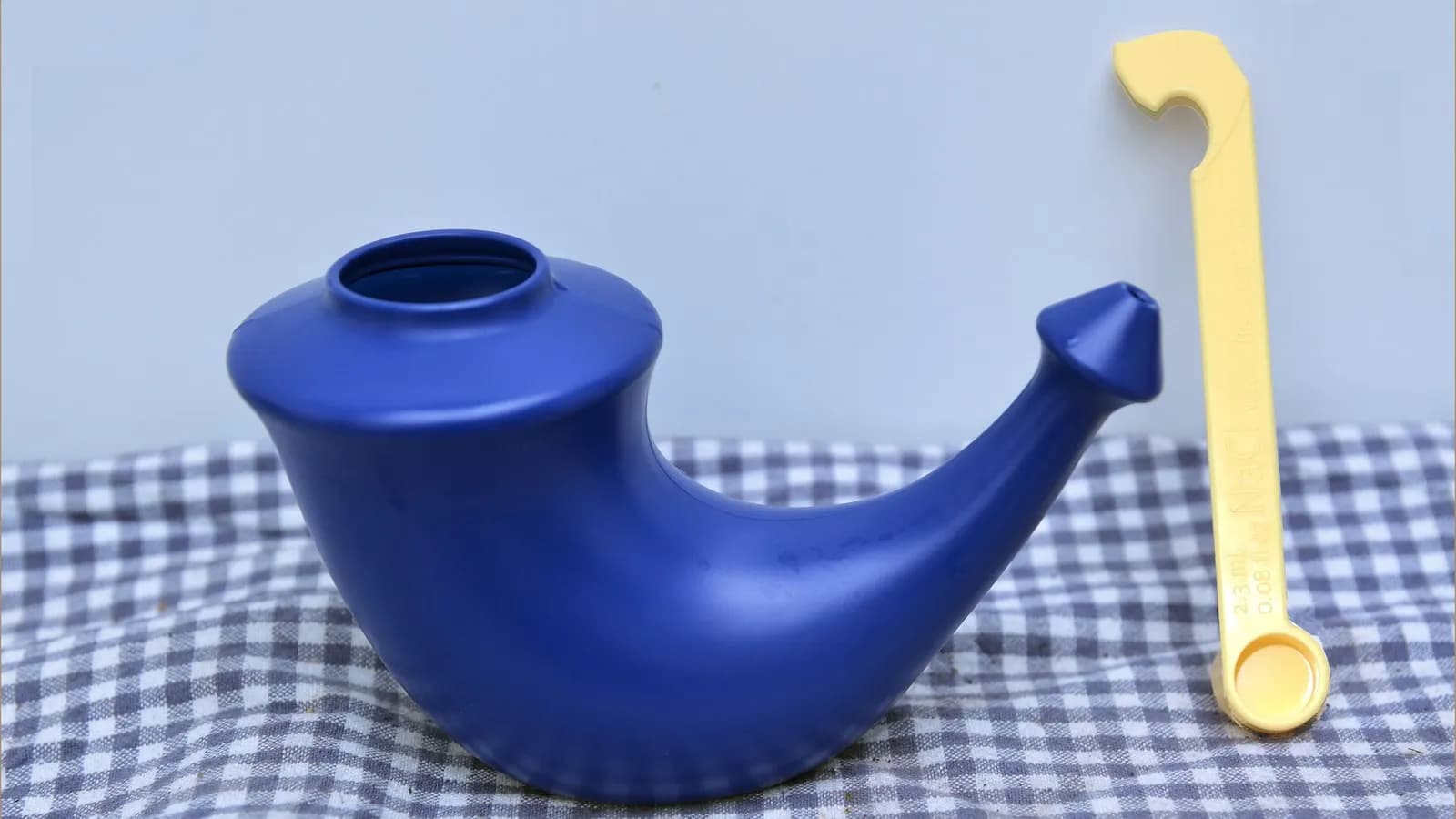
Jala neti, rinsing the nasal passages with warm salt water, is one of the shatkarma, the six cleansing practices of hatha yoga. It has been absorbed into mainstream medicine as saline nasal irrigation, sold in every pharmacy, and recommended by ear, nose and throat specialists.
It is a rare case of a traditional practice crossing over almost intact. It also carries a specific and serious hazard, and the hazard is entirely about the water rather than the technique.
The rule, first, because it is the important part
Never use water straight from the tap.
The United States Food and Drug Administration is explicit. Use distilled or sterile water, or water that has been boiled for at least one minute and then cooled. Ordinary filter jugs of the Brita type do not make tap water safe for this purpose.
The reason is a free-living amoeba called Naegleria fowleri. It can be present at low levels in water that is entirely safe to drink, because stomach acid destroys it. Introduced into the nose, it can travel along the olfactory nerve into the brain and cause primary amoebic meningoencephalitis.
This is very rare. It is also very nearly always fatal. In the United States there were 164 reported cases between 1962 and 2023, with four survivors. Two deaths in Louisiana in 2011 were linked by the state health department to neti pot use with contaminated tap water.
Rare and nearly always fatal is an unusual combination, and it means the arithmetic is not about probability. Sterile water costs almost nothing and boiling costs a minute, and there is no benefit whatsoever to using tap water. There is simply no reason to accept the risk.
The rest of the safety instructions
Make the saline correctly. Roughly a level teaspoon of non-iodised salt per 500ml, sometimes with a pinch of bicarbonate of soda. Plain water without salt stings badly, because it is hypotonic relative to the tissue and draws water into the mucosa.
Use it body temperature. Cold water is unpleasant and can trigger a headache.
Clean and dry the pot between uses. A damp neti pot is a place for organisms to grow, which reintroduces the problem you were avoiding.
Do not rinse when your nose is completely blocked. If neither side is passing air, the water has nowhere to go, and forcing it can push fluid towards the middle ear.
Lean forward over a basin and turn your head sideways, so the water enters one nostril and leaves the other. Breathe through your mouth throughout. Then blow gently, one side at a time, rather than hard, which is another route to pushing fluid into the ear.
What it is actually good for
Symptom relief, mainly, and that is not a small thing.
Saline irrigation is widely recommended as an adjunct for chronic rhinosinusitis and allergic rhinitis, and is used after sinus surgery. What it does is mechanical: it clears mucus, removes allergens and irritants, and moistens the mucosa. It is not an antimicrobial treatment and it does not cure infection.
People who use it regularly for allergic symptoms tend to report it helps, and it is cheap, drug-free and compatible with almost everything else. That is a reasonable basis for trying it.
What it does not do
It does not detoxify anything, a word we take apart in a separate piece. It does not prevent respiratory infections in any way that has been demonstrated. Some people find daily long-term use makes symptoms worse rather than better, possibly by stripping protective components of the mucus layer, so if you are rinsing every day indefinitely and it is not clearly helping, stop and see whether you are better without it.
The other yogic practice with genuine physiological effects and its own set of real risks is slow breathing, which we cover in this piece. The pattern in both is the same: the practice is worth doing, and the safety instructions are not decoration.
Published in The Outspoken Digest
Editorial desk
Outspoken Digest Health DeskMedicine, public health and the research behind the headlines, read carefully.
Newsletter
The Digest, in your inbox
One edition, sent when it is ready. No noise, and your address is never passed on.
Read Next
More Health →
Cochrane Review Finds Medical Cannabis Has No Clear Benefit for Insomnia, With Weak Evidence Either Way
Oct 13, 2026/2 min read

Lancet Commission Names 17 Threats to Global Health Through 2100, With Obesity the Largest by Burden
Oct 12, 2026/2 min read

FDA Approves Pritelivir for Herpes Lesions That Resist Standard Antivirals in Immunocompromised Adults
Oct 10, 2026/2 min read