Oxford Physicists Reproduce the Aharonov-Bohm Effect on a Hybrid Quantum Computer
A trapped-ion machine mixing qubits and quantum oscillators halted a particle's tunnelling by interference alone, a 1959 prediction now seen in a simulated gauge theory.
Thursday, October 15, 2026/2 min read
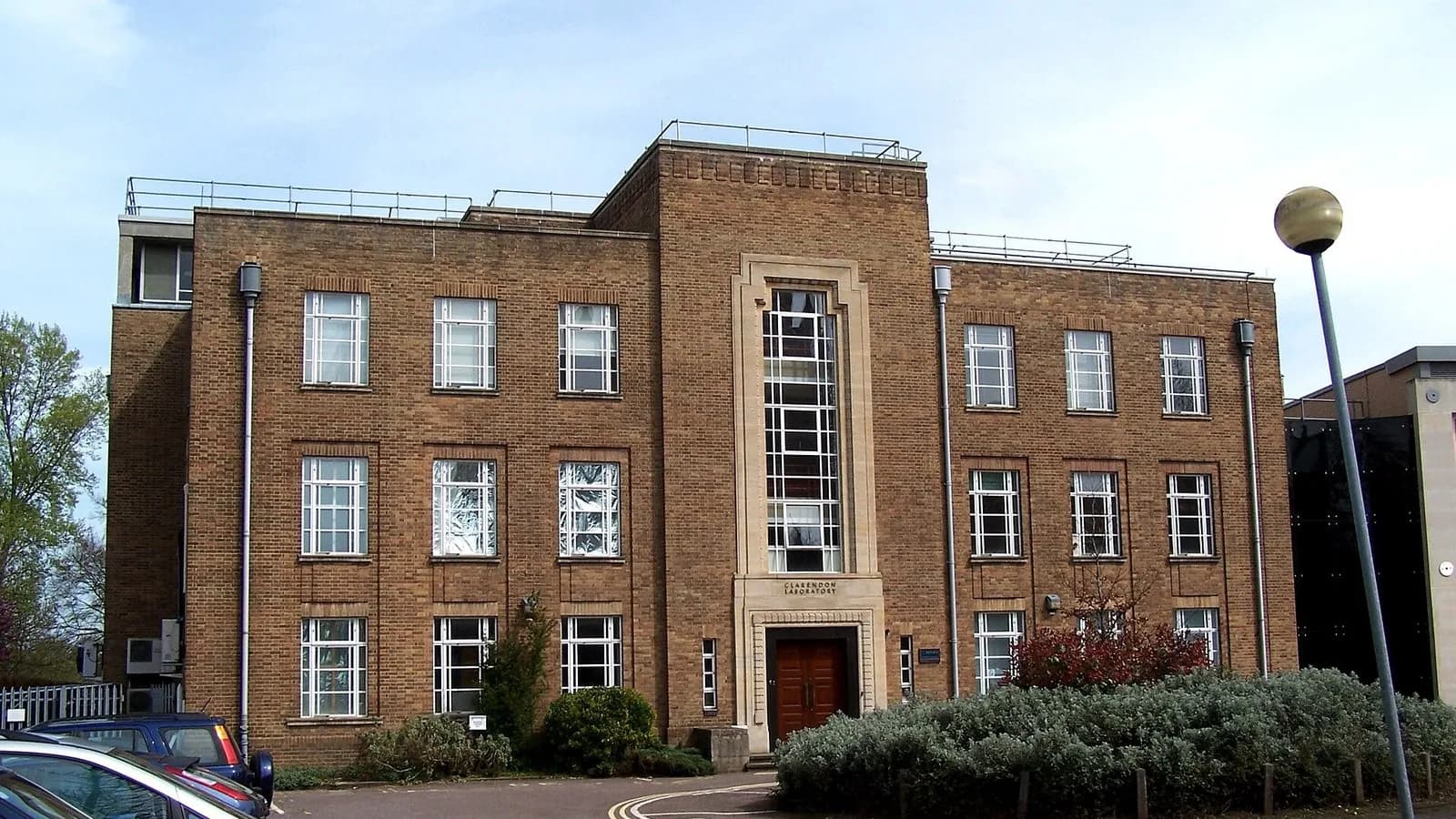
A particle can feel a magnetic field it never touches. That was the claim made in 1959 by Yakir Aharonov and David Bohm, and it has been confirmed in many experiments since. This month a team at the University of Oxford reported a new way to see it: not in a laboratory magnet, but inside a quantum computer built to mimic the physics.
The paper, "Aharonov-Bohm interference in a Z2 lattice gauge theory on a hybrid qubit-oscillator quantum computer," appeared in Nature Physics on 25 September, and Oxford's account of the work was circulated in the second week of October, as The Quantum Insider reported on 12 October.
What is the Aharonov-Bohm effect?
In the textbook version, a charged particle travels around a region containing a magnetic field, never entering it, and still picks up a measurable shift in its quantum phase. Two possible paths around the region interfere, and the field decides whether they add up or cancel. It is one of the clearest demonstrations that the electromagnetic potentials matter in quantum mechanics, not only the fields.
How did Oxford simulate it?
The team, led by Dr Sebastian Saner with colleagues including Dr Oana Bazavan and Dr Alejandro Bermudez of the Instituto de Fisica Teorica in Madrid, began the work in 2022. They used trapped ions as a hybrid device. Qubits stored in the ions' internal electronic states represented the gauge fields, and the ions' vibrations, which behave as quantum oscillators, represented matter.
They built a small loop of two matter oscillators linked by two field qubits. Preparing the two qubits in an entangled state encoded the magnetic flux through the loop. With no flux, a matter particle tunnelled freely around the loop. With flux switched on, its two possible paths interfered destructively, tunnelling stopped completely and the system stayed in its starting state, Interesting Engineering reports.
Why does a flux that is itself quantum matter?
In conventional versions the flux is a fixed background. Here the flux lives in a gauge field that is itself dynamical, part of the same quantum evolution as the particle. Saner said the matter and the gauge field become part of the same quantum dynamics. He described the flux-in-qubits encoding as a workaround that turned out to be the more interesting route, because the hardware could not supply the conventional fixed background.
What are the limits?
This is a simulation of one elementary loop in one specific Z2 lattice gauge theory, not a general-purpose calculation and not a measurement of a real magnetic field. A University of Maryland group led by Professor Norbert Linke published a related, independently developed study alongside it, which simulated a different system, the Yukawa potential, on similar hybrid hardware.
The bigger prize is scale. Lattice gauge theories underpin the standard model of particle physics and are hard for classical computers to simulate, so the next question is how many loops such hybrid machines can handle before their errors swamp the physics.
Published in The Outspoken Digest
Editorial desk
Outspoken Digest Science DeskReports for The Outspoken Digest across Technology, Latest Trends, Health.
Newsletter
The Digest, in your inbox
One edition, sent when it is ready. No noise, and your address is never passed on.
Read Next
More Technology →
Some White Dwarfs Would Look Green, Pink or Purple, Warwick Astronomers Calculate
Oct 15, 2026/2 min read

Japan Will Fund Up to $21 Billion for Two GlobalFoundries Chip Plants in New York
Oct 15, 2026/2 min read
Apple's $299 HomeView Smart Display Takes Preorders, but Not in the European Union
Oct 15, 2026/2 min read

Google Makes Gemini 4 Argon Widely Available, With a Half-Price Launch Rate Until 30 November
Oct 15, 2026/2 min read