Where Shakshuka Actually Comes From
Tunisia has the strongest claim, the name means roughly a mixture, and no version of the dish can be older than the sixteenth century. The argument about who owns it is really about something else.
Friday, August 14, 2026/4 min read
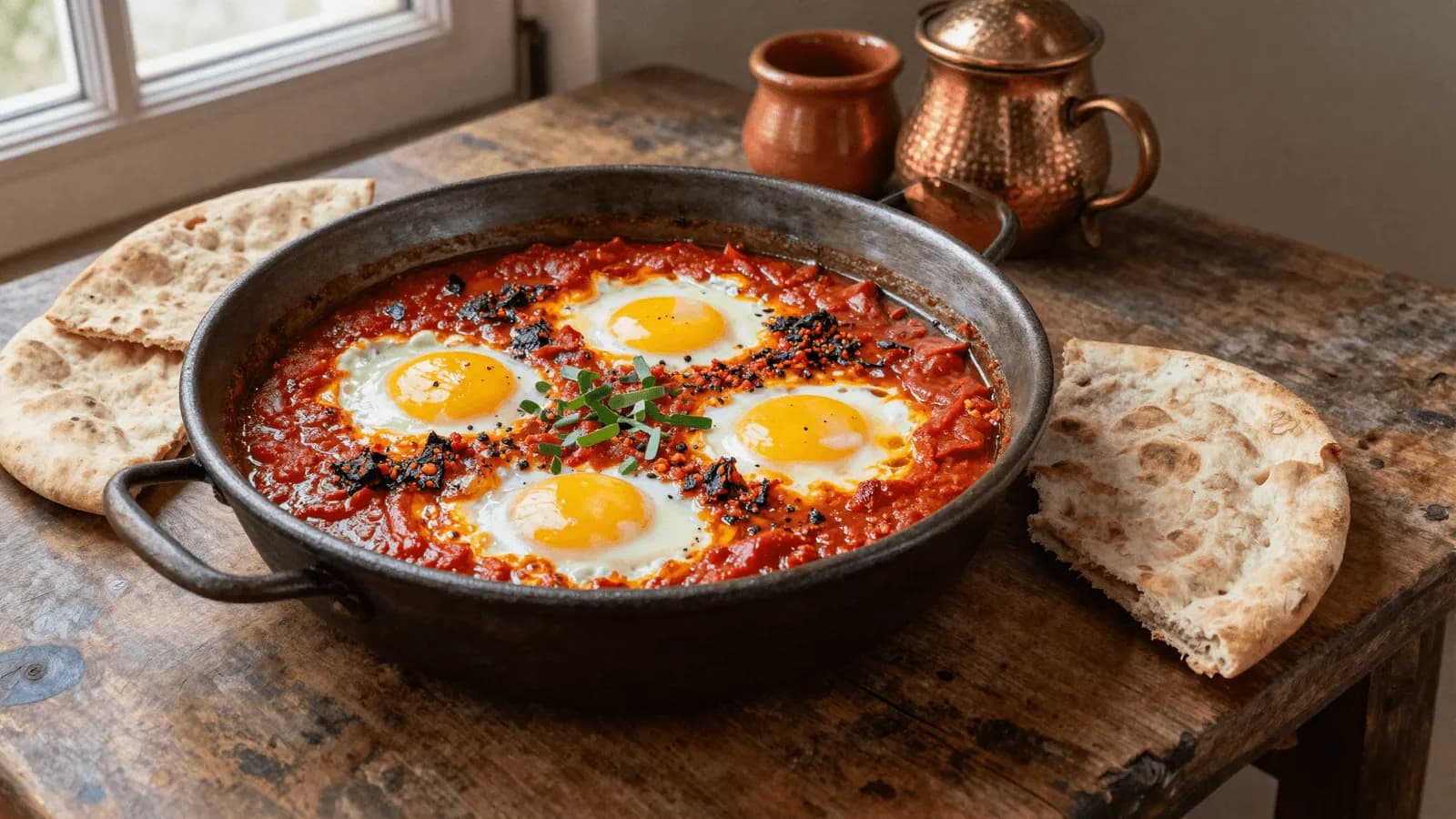
Shakshuka is North African in origin, and the strongest claim belongs to Tunisia. The name comes from a Maghrebi Arabic word meaning roughly a mixture or something shaken together, and the dish spread through Libya, Algeria and Morocco before reaching Israel in the mid twentieth century with North African Jewish immigrants, who are the reason most of the world has heard of it.
That is the short answer. The longer one is more interesting, because it contains a date that settles part of the argument on its own.
Tomatoes make it younger than people claim
Every origin story that places shakshuka in antiquity runs into the same wall. Tomatoes and chilli peppers are both New World crops. Neither existed anywhere in Africa, Asia or Europe before the Columbian exchange of the late fifteenth and sixteenth centuries.
Tomatoes reached the Ottoman world and North Africa through the sixteenth and seventeenth centuries and were not widely eaten for some time after that, being treated with suspicion in several places for decades. A tomato-based dish cooked as a staple cannot meaningfully predate the eighteenth century, and probably arrived in something like its current form in the nineteenth.
This does not make it less authentic. It makes it roughly as old as most of the dishes people think of as ancient, which is a useful correction to apply widely. Whatever you have read about a recipe going back to the Ottomans, the Phoenicians or biblical times, if it contains tomatoes, peppers, potatoes, maize or chilli, it does not.
The name
The most widely accepted etymology traces shakshuka to a Maghrebi Arabic or Berber root carrying the sense of a mixture, a jumble, or something shaken together. That is a description of the method rather than of an ingredient, which is why the name attaches easily to a family of dishes rather than one fixed recipe.
There is a Turkish dish called sakuska, and the similarity of the names is real. It is a cold aubergine and pepper dish, and whether the names share a root or converged is not settled. It is not the same dish.
Why Tunisia rather than Morocco
The Tunisian claim is the strongest for three reasons.
The etymology fits Maghrebi Arabic. The dish is a national staple in Tunisia in a way it is not in Morocco, where it exists but sits further from the centre of the cuisine. And the Tunisian version carries the ingredients that read as original rather than adapted: harissa, and often merguez or preserved lemon.
Moroccan versions are usually milder and lean on cumin and paprika without the harissa heat. Both are entirely real. If someone tells you shakshuka is Moroccan, they are describing a genuine regional version rather than the point of origin.
How it became Israeli in the public mind
This is the part that generates the argument, and the history is not actually disputed by anyone who looks at it.
Between roughly 1948 and the 1960s, large Jewish communities left Tunisia, Libya, Morocco and Algeria, many under duress, and a substantial number went to Israel. They brought their cooking. Shakshuka was a cheap, filling, one-pan dish, and it moved from those households into Israeli cafes and then, from the 1990s onward, onto international restaurant menus.
The people who made it famous in Israel were North African. Israeli restaurants and Israeli chefs then made it famous globally. Both of those statements are true, and the argument almost always comes from treating them as mutually exclusive.
Calling shakshuka Israeli in origin is inaccurate. Denying that Israeli cooks drove its global popularity is also inaccurate.
Is shakshuka Moroccan, Tunisian or Israeli?
Tunisian in origin, Maghrebi by tradition, and globally famous because of Israel. That sentence covers it, and it is not a compromise between positions so much as the actual sequence of events.
It is worth naming what the argument is usually about. Food ownership disputes in this region are rarely about recipes. They are about whether a community's history is acknowledged, and dishes become the vehicle because they are the part of a culture that survives displacement most reliably. That is why these arguments are heated and why they will not be settled by a food article.
The wider family
Eggs poached in a spiced tomato sauce is an idea that has occurred independently in many places, which is what happens when a cheap ingredient meets a cheap protein.
- Uova in purgatorio, southern Italy: eggs in a spicy tomato sauce, named for the flames.
- Huevos rancheros, Mexico: eggs on tortilla with tomato and chilli salsa.
- Menemen, Turkey: eggs scrambled through tomato and green pepper rather than poached whole, and a genuinely different dish, which we cover in our menemen recipe.
- Piperade, Basque country: peppers, tomato and onion, with eggs stirred through.
- Eggs in purgatory, chraime, matbucha and a dozen others across the Mediterranean.
These are not descendants of shakshuka. They are parallel answers to the same question, and treating any of them as a corrupted version of another gets the history backwards.
What the original looks like
A Tunisian shakshuka is more sauce-forward and hotter than most international versions. It leans on harissa, uses a high proportion of peppers to tomatoes, and is often built with merguez sausage or with potato. It is not a brunch dish there; it is eaten at any time and is more likely to be dinner.
The version that spread internationally is milder, tomato-heavier, and frequently finished with feta, which is a Greek and Balkan cheese and not part of the original at all. That is not a criticism. It is how dishes move.
Our own shakshuka recipe sits closer to the mild end, and the one technique that matters regardless of which version you cook is reducing the sauce properly before the eggs go in.
Published in The Outspoken Digest
Editorial desk
Outspoken Digest Food DeskCooking, ingredients, restaurants and the economics of what ends up on the table.
Newsletter
The Digest, in your inbox
One edition, sent when it is ready. No noise, and your address is never passed on.
Read Next
More Recipes →
Swangy Tamarind Glazed Chicken Wings for the Flavour Replacing Swicy on Fast Food Menus
Sep 29, 2026/3 min read

Baked Apple Cider Doughnuts for a Cider Season That Peaked Earlier Than the Calendar Says
Sep 29, 2026/3 min read
An Obatzda Bavarian Beer Cheese Dip for the Final Stretch of Oktoberfest 2026
Sep 29, 2026/3 min read