Some White Dwarfs Would Look Green, Pink or Purple, Warwick Astronomers Calculate
Modelling the light of nearby dead stars suggests one cool white dwarf may be the first genuinely green star and another the reddest known, though no human eye could see either.
Thursday, October 15, 2026/2 min read
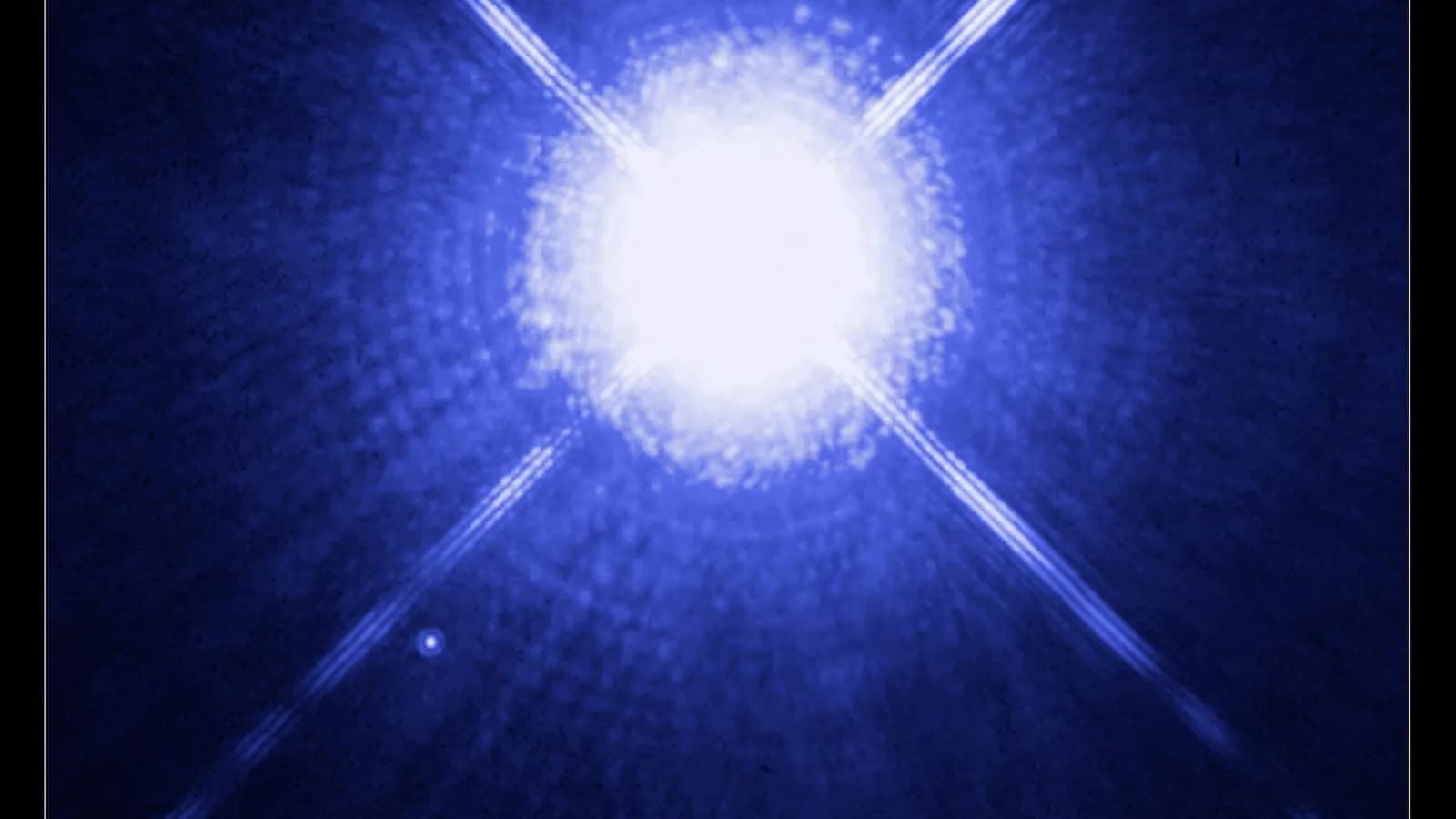
Stars are not supposed to be green. A blackbody glow moves from red through orange and yellow to white and blue, and the colour of most stars is set almost entirely by temperature. Astronomers at the University of Warwick now argue that a handful of white dwarfs break that rule, and that one of them may be the first genuinely green star on record.
The work, led by Dr Mark Hollands with Professor Boris Gansicke, is titled "Any colour you like: The diverse chromaticities of white dwarfs" and appears in RAS Techniques and Instruments, with a preprint posted to arXiv on 13 October. Phys.org summarised it the next day.
How can a dead star be green?
White dwarfs are the burnt-out cores of stars like the Sun. No white dwarf is close enough to see its colour directly, so the team ran routinely collected spectra through a model of human colour vision to work out what each would look like. According to Phys.org, the key is density. The coolest atmospheres reach about one gram per cubic centimetre, roughly the density of water, and at that density trace elements can absorb light across wide stretches of the spectrum.
Carbon-rich white dwarfs tend toward pink or purple. Those polluted with debris from asteroids, comets or old planetary systems can look yellow, and cool atmospheres of mixed hydrogen and helium can look cyan or pale blue.
Which star is the green one?
The standout is WD J1330+6435, a cool white dwarf with lithium in its spectrum. The paper gives it a temperature of about 4,240 kelvin. Strong, broad sodium absorption at orange wavelengths and calcium absorption at violet ones push its brightest light to around 500 nanometres, which the models render as a chartreuse green. Hollands said sodium in its atmosphere absorbs the orange part of the spectrum and leaves a ghostly green glow. The authors say that, to their knowledge, white dwarfs are the only stars claimed to look green, and they note its spectrum is somewhat noisy, so the exact hue could shift.
At the other end, WD J1011+2845, about 48 light-years away, may be the reddest star recorded, with most of its light beyond 600 nanometres and a salmon-pink tone.
Are most white dwarfs still white?
Yes. In a local sample of 152 white dwarfs within 20 parsecs (about 65 light-years), the median colour temperature is about 6,800 kelvin, which reads as white. Five were too far from blackbody colours to include in that analysis, two yellow and three pink, and the authors estimate that about one in 30 is unusually coloured. That estimate rests on a small sample, and hotter, bluer white dwarfs are easier to find, so the true share of oddballs is uncertain. Gansicke put it plainly: the average white dwarf really is white.
The colours are model predictions, and the green and reddest-star labels are hedged by the authors themselves. Better spectra of the faintest candidates would turn a striking calculation into a firm record.
Published in The Outspoken Digest
Editorial desk
Outspoken Digest Science DeskReports for The Outspoken Digest across Technology, Latest Trends, Health.
Newsletter
The Digest, in your inbox
One edition, sent when it is ready. No noise, and your address is never passed on.
Read Next
More Technology →
Oxford Physicists Reproduce the Aharonov-Bohm Effect on a Hybrid Quantum Computer
Oct 15, 2026/2 min read

Japan Will Fund Up to $21 Billion for Two GlobalFoundries Chip Plants in New York
Oct 15, 2026/2 min read
Apple's $299 HomeView Smart Display Takes Preorders, but Not in the European Union
Oct 15, 2026/2 min read

Google Makes Gemini 4 Argon Widely Available, With a Half-Price Launch Rate Until 30 November
Oct 15, 2026/2 min read