Yoga Nidra Is Not Sleep, and the Research on It Is Better Than the Research on Most Things Sold Beside It
A guided practice of lying still while systematically moving attention around the body. It has accumulated a real randomised trial literature for sleep, stress and anxiety, and a rebranded version has attracted claims that literature does not support.
Friday, September 4, 2026/3 min read
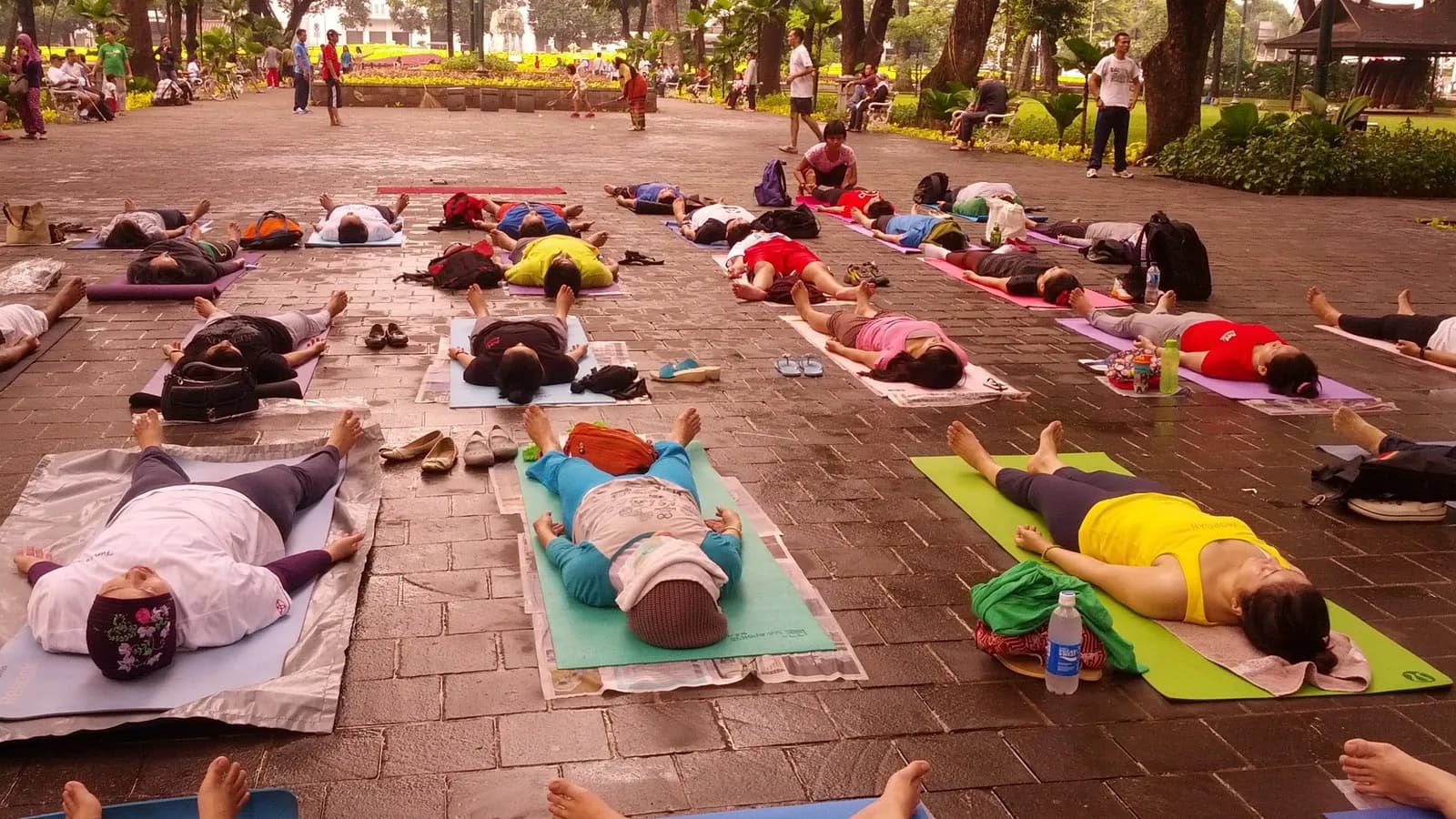
Yoga nidra means yogic sleep, which is misleading. The practice involves lying on your back, completely still, while a voice guides your attention systematically around the body, through breath, through pairs of opposing sensations, and through imagery. The aim is a state where the body is fully relaxed and the mind is not asleep.
It is worth writing about for a specific reason. Most practices marketed for relaxation have essentially no trial evidence. This one has a genuine and growing literature, and the gap between that literature and what gets claimed for its rebranded cousin is instructive.
What the trials show
Better than expected for a practice of this kind.
A systematic review and meta-analysis published in 2026 in the Annals of the New York Academy of Sciences found significant effects on stress, anxiety and depression across multiple randomised trials. A separate 2026 systematic review of randomised trials in sleep disturbance and insomnia, published in Sleep and Breathing, reported improvements in sleep onset latency, total sleep time and sleep efficiency.
Those are meaningful outcome measures rather than vague wellbeing scores, and sleep onset latency in particular is objective enough to be hard to fake.
The usual caveats apply and should be stated. Trials in this field are often small, blinding is essentially impossible when the intervention is a voice telling you to relax, and comparison against an active control is much less common than comparison against doing nothing. The effects are real; their size and durability are less well pinned down.
The NSDR problem
Yoga nidra has been repackaged in recent years as non-sleep deep rest, or NSDR, a term coined to describe the practice without its religious inheritance.
There is nothing wrong with renaming a practice. The problem is what has been attached to the new name. The most widely circulated claim, that this kind of rest substantially restores striatal dopamine, rests on a single small PET imaging study with eight participants. That is a preliminary finding, not an established mechanism, and it has been repeated across podcasts and articles as though it were settled.
The second problem is that the evidence base concerns structured yoga nidra protocols, typically 20 to 40 minutes and following a specific sequence. It does not automatically transfer to any ten-minute audio track labelled NSDR. A study of a defined protocol tells you about that protocol.
How to actually do it
Lie on your back somewhere warm, with support under the knees if your lower back objects. Cover yourself, because body temperature drops when you are still.
Follow a recording. This is not a practice that works well self-directed, because the entire structure is external guidance moving your attention faster than you would move it yourself.
Expect the sequence: an intention, then a rotation of consciousness through the body part by part, then breath awareness, then pairs of opposites such as heaviness and lightness, then imagery, then a return.
Twenty to thirty minutes is the usual length. Do it lying down rather than sitting, which is the opposite of the instruction for seated meditation, and it is deliberate.
Falling asleep, and whether it counts
Almost everyone falls asleep during yoga nidra at first, and the traditional framing treats this as missing the point, since the aim is conscious rest rather than unconsciousness.
In practice, if you are doing it because you sleep badly and you fall asleep, that is a result rather than a failure. If you want the state the practice actually describes, do it earlier in the day, less tired, and with your eyes covered rather than closed in a dark room.
Where it sits
Yoga nidra is a low-risk practice with reasonable evidence for sleep and anxiety, no equipment, and no cost. That is a good profile.
It is not a replacement for treatment of a diagnosed sleep disorder, and cognitive behavioural therapy for insomnia remains the first-line intervention with much stronger evidence, a point our piece on sleep hygiene makes at greater length. It also sits in the same family as seated meditation, which carries an adverse event literature worth knowing about, covered in this piece.
Published in The Outspoken Digest
Editorial desk
Outspoken Digest Health DeskMedicine, public health and the research behind the headlines, read carefully.
Newsletter
The Digest, in your inbox
One edition, sent when it is ready. No noise, and your address is never passed on.
Read Next
More Health →
Cochrane Review Finds Medical Cannabis Has No Clear Benefit for Insomnia, With Weak Evidence Either Way
Oct 13, 2026/2 min read

Lancet Commission Names 17 Threats to Global Health Through 2100, With Obesity the Largest by Burden
Oct 12, 2026/2 min read


FDA Approves Pritelivir for Herpes Lesions That Resist Standard Antivirals in Immunocompromised Adults
Oct 10, 2026/2 min read