They Have Photographed the Star Hiding Inside Betelgeuse, and They Still Are Not Certain It Is There
The clearest picture yet of Betelgeuse B was taken with the Very Large Telescope. The caveat almost all the coverage dropped is the astronomer's own: he cannot be sure until he sees it again on the other side of the star, a year from now.
Outspoken Digest Technology Desk
Friday, August 28, 2026/4 min read
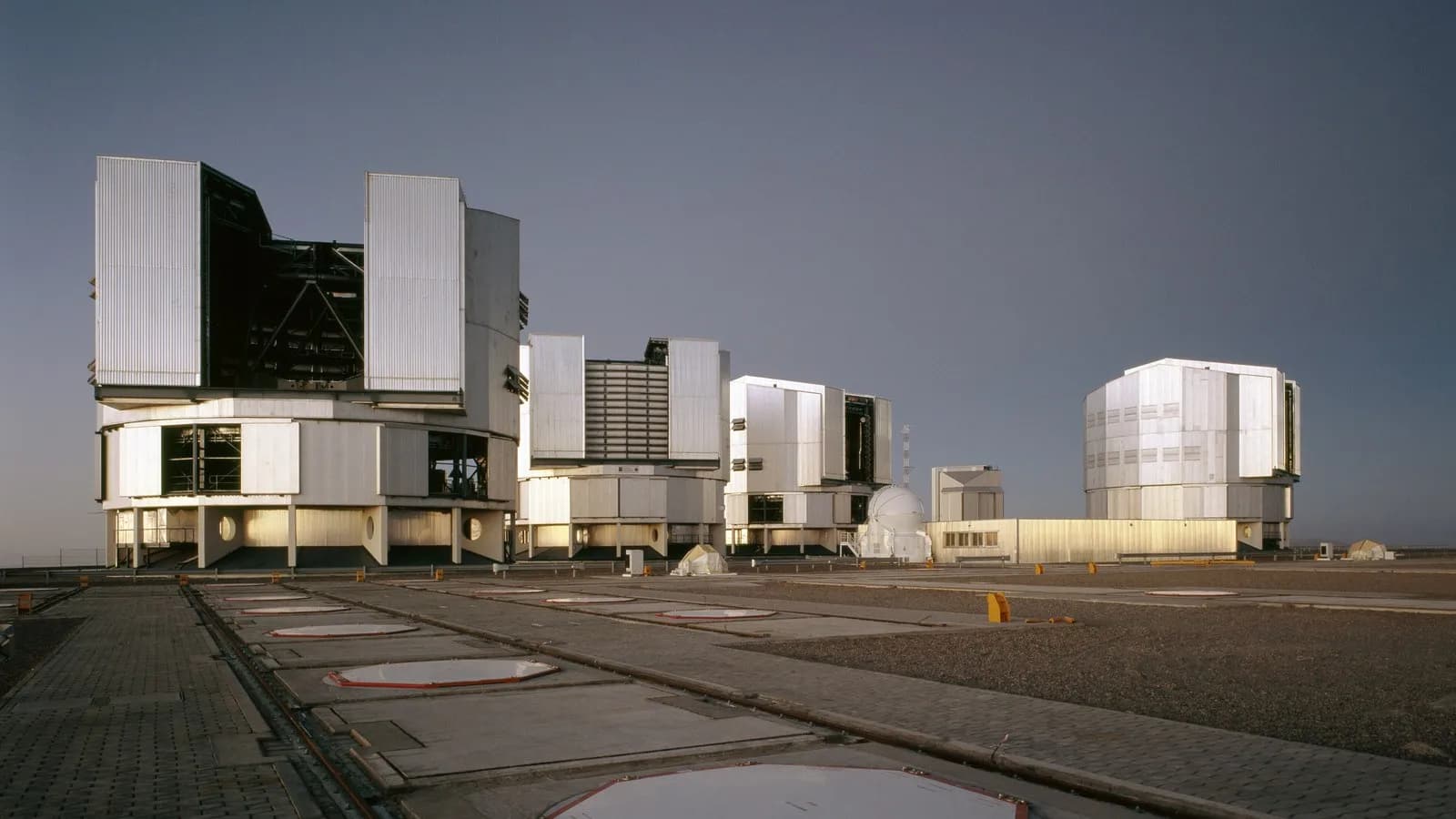
Betelgeuse is the red shoulder of Orion, the most watched star in the sky, and for about a century it has been suspected of keeping company. This week the European Southern Observatory published the clearest image yet of that companion, and the astronomer who took it went out of his way to say the case is not closed.
Miguel Montargès of the Observatoire de Paris, who led the work: "I jumped from my chair when I saw the processed images." And then, in the same release: "To be certain that the companion is really there, we still need to observe it in one year on the other side of the star."
Both sentences are the story. Most of the coverage carried the first.
What was actually observed
The team used SPHERE-ZIMPOL on ESO's Very Large Telescope in Chile, on 3 and 6 December 2024, timed for the moment the companion was predicted to sit at its widest apparent separation from Betelgeuse as seen from Earth. The results were published in Astronomy and Astrophysics.
The object sits about 52 milliarcseconds from Betelgeuse, which works out at roughly 8.8 astronomical units, a little beyond Saturn's distance from our own Sun. Its mass comes out at 2.6 to 3.1 times the Sun's. It shows no hydrogen alpha emission, no ultraviolet and no X-rays, which is to say it looks like an ordinary young main sequence star rather than anything exotic.
Fifty two milliarcseconds is a very small angle sitting immediately beside one of the brightest objects in the night sky. That is the achievement, and it is a real one.
The mass is not a small detail
Because it does not match the previous answer.
In July 2025 a team led by Steve Howell at NASA's Ames Research Center used the 'Alopeke speckle imager on Gemini North in Hawaii and reported a companion about six magnitudes fainter than Betelgeuse, orbiting inside the supergiant's extended atmosphere. That detection was widely read as a low mass star, and the modelling that preceded it had generally pointed at something around a solar mass.
Two point six to three point one solar masses is a different object. Either the earlier estimate was wrong, or the new measurement is measuring something else, or the two observations are not looking at the same thing. This is the ordinary condition of a hard measurement at the edge of what instruments can do, and it is exactly why the confirmation observation matters more than the picture.
What the companion would explain
A puzzle that has been sitting in the data for decades.
Betelgeuse brightens and dims on a cycle of roughly 400 days, which is the star pulsating and is well understood. Sitting on top of that is a second, longer cycle of about six years, known as the long secondary period, and nobody has ever satisfactorily explained it. Long secondary periods turn up across a large fraction of red giants and remain one of the standing embarrassments of stellar astrophysics.
A companion on a five and a half to six year orbit would do it. Sweeping through the dust in the supergiant's extended envelope, it would pile material up in some places and clear it from others, dimming and brightening our view of the star on precisely the period observed. The orbit and the cycle match. That is the strongest argument for the companion being real, and it is an argument from consistency rather than from the image.
Why this star gets the attention
Because it is the one that might explode in our lifetime.
Betelgeuse is a red supergiant late in its life, and the great dimming of 2019 and 2020 produced a global run of speculation that it was about to go supernova. It was dust. The underlying fact stands, though: this star will end as a supernova, it will be bright enough to see in daylight when it does, and nobody can tell you the year.
A companion changes the arithmetic of that ending. Work on the object suggests it is slowly spiralling inward under tidal drag and will eventually be absorbed by the star it orbits, which is a fairly dramatic thing to have in the neighbourhood of a supergiant already close to the end of its life.
What happens next
One observation, roughly a year from now, on the far side of the orbit.
If the object turns up where an orbit says it should, Betelgeuse B is a star and the long secondary period has an answer after decades of not having one. If it does not, this becomes an instructive paper about how hard it is to see anything at all next to something that bright.
That is a cleaner test than most results in astronomy ever get, and it is worth noting that the team stated it plainly rather than letting the image do the arguing. We have written before about how much of modern astronomy is the slow subtraction of glare, in the Hubble survey of Andromeda and in the first entanglement drawn from ordinary sunlight. The instrument is usually not the hard part. Being sure is.
Published in The Outspoken Digest
Editorial desk
Outspoken Digest Technology DeskSoftware, hardware, artificial intelligence and what they change for everyone else.
Newsletter
The Digest, in your inbox
One edition, sent when it is ready. No noise, and your address is never passed on.
Read Next
More Technology →
NASA's Dragonfly Flies Its Hardest Titan Manoeuvre, Autonomously, in Its Most Thorough Simulation Yet
Oct 26, 2026/2 min read

Quest Diagnostics Confirms Hackers Reached Patient Records Through Its Quanum Lab Platform
Oct 26, 2026/2 min read

Instacart Is Reportedly Exploring a Sale, With DoorDash and Uber Said to Have Held Talks
Oct 26, 2026/2 min read

NASA Ends the Swift Mission After Nearly 22 Years as Its Orbit Decays and Re-Entry Looms
Oct 25, 2026/2 min read