Nevada Approved Up to 8,000 Robotaxis. Tesla's Own Cybercab Engineer Says It Might Manage 2,500.
The Nevada Transportation Authority voted unanimously to let Tesla, Waymo and Uber run paid driverless rides in Clark County. The permitted number and the deliverable number are very different figures, and the company said so itself.
Outspoken Digest Technology Desk
Saturday, August 22, 2026/3 min read
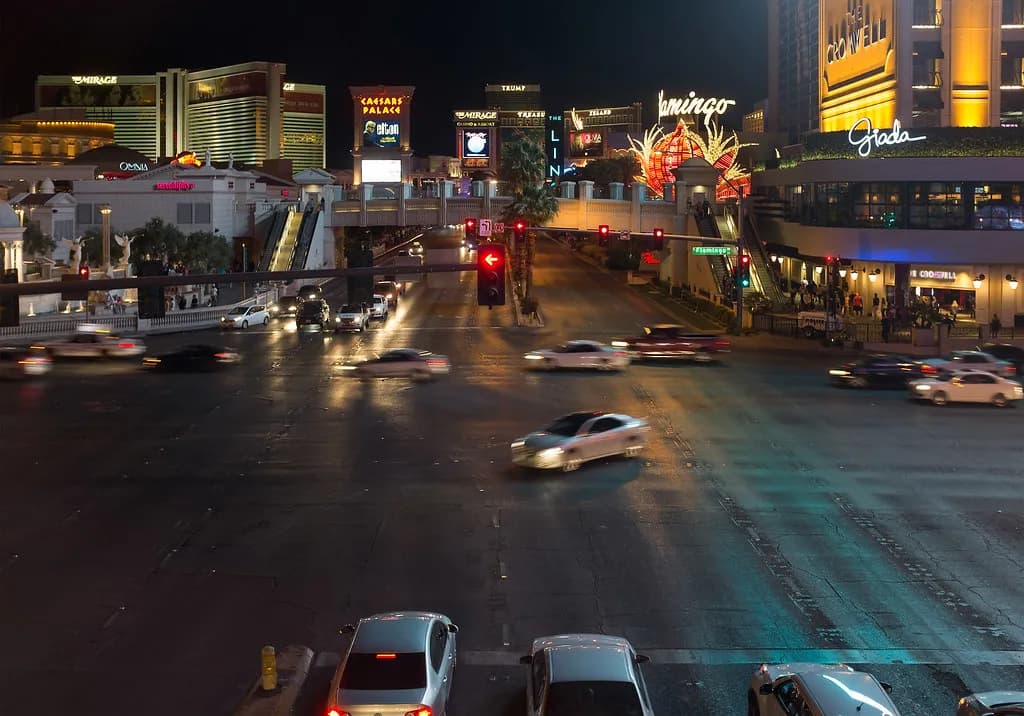
The Nevada Transportation Authority voted unanimously this week to grant Autonomous Vehicle Network Company permits to Tesla, Waymo and Uber, clearing all three to run paid driverless ride-hailing across Clark County, which contains Las Vegas.
The headline number is up to 8,000 vehicles over the next year. The number worth paying attention to came from Tesla.
What was actually approved?
Three permits, with the allocation weighted heavily towards one company.
- Tesla: up to 5,000 vehicles.
- Waymo: up to 1,000.
- Uber: up to 1,000.
For Tesla this is an enormous change of position rather than an incremental one. The vote replaces an interim order that had limited it to ten robotaxis operating on a narrow stretch of the Las Vegas Strip. Going from ten to a permitted five thousand in a single vote is the kind of regulatory jump that rarely happens in this sector.
So will 8,000 driverless cars appear?
No, and the most useful correction came from inside Tesla rather than from a critic.
Eric Early, chief engineer on the Cybercab, said he did not think the company would be in a position to deploy 5,000 vehicles within the year, and that he would be extremely happy and satisfied to reach around 2,500, perhaps somewhat higher.
That is a striking thing for a chief engineer to say days after his employer secured permission for double that. It is also the single most informative statement in the whole story, because a permit ceiling is a legal maximum and says nothing about manufacturing, validation, depot capacity, charging, cleaning, remote support staffing or insurance.
Read the permit as removing a constraint, not as a forecast.
Why Las Vegas?
Because it is close to the easiest hard city an autonomous fleet could pick.
The weather is dry and predictable for most of the year, which removes the sensor problems that rain, snow and spray create. The street grid is regular. A very large share of demand runs between a small number of well-mapped destinations: the airport, the Strip hotels, the convention centre. And the passenger base is disproportionately visitors, who have no established loyalty to an incumbent taxi service and are unusually willing to try a novelty.
None of that makes it trivial. Pedestrians in Las Vegas behave unpredictably at night in ways that would challenge any driver, human or otherwise.
What does this mean for the people driving now?
The question the announcement did not address, and the one with the most immediate consequences.
Clark County has a substantial workforce of taxi and ride-hailing drivers whose earnings depend on precisely the airport and Strip journeys that a driverless fleet is best placed to take. If even a quarter of the permitted vehicles arrive, that is a meaningful share of the market moving to a service with no driver in it.
The honest position is that nobody knows the pace. Deployment could be slow enough that attrition absorbs it, or fast enough that it does not. What is not credible is the claim that a technology explicitly designed to remove the driver has no effect on drivers.
What should a reader watch for?
Three things, none of which is the vehicle count.
Whether the service area expands beyond the easy zone. Operating on the Strip and to the airport is a solved-ish problem. Suburban Clark County at three in the morning is not.
How incidents are reported. The credibility of the whole sector now rests on whether operators disclose collisions and near-misses in a form that can be independently checked, rather than through selective statistics.
Whether the fleets are actually driverless. Remote human supervision is normal in this industry and rarely foregrounded. A vehicle with nobody in the front seat is not necessarily a vehicle with nobody involved.
Tesla's wider financial position depends heavily on this category delivering, which is the pressure running underneath its spending on AI and robotics. The same pressure sits behind the recurring talk about restructuring across its affiliated companies. Permission is now the part it has. Production is the part it has just publicly cast doubt on.
Published in The Outspoken Digest
Editorial desk
Outspoken Digest Technology DeskSoftware, hardware, artificial intelligence and what they change for everyone else.
Newsletter
The Digest, in your inbox
One edition, sent when it is ready. No noise, and your address is never passed on.
Read Next
More Technology →
Astronomers Say a Pulsar's Odd Slowdown Is Explained by a Hidden Sunlike Star, Making It a Rare Stellar Trio
Oct 21, 2026/2 min read
Interstellar Comet 3I/ATLAS May Have Lost Metres of Its Surface to the Sun, a New Estimate Finds
Oct 21, 2026/2 min read
A Power Event in Google Cloud's London Region Knocked Out Banking Apps and Delivery Services for Hours
Oct 21, 2026/2 min read

An Indian Certificate Authority's Private Keys Were Trivially Guessable, and Browsers Have Revoked Them
Oct 21, 2026/2 min read