Designing for 45C: What Gulf Architecture Knew Before Air Conditioning
Thick walls, small openings, shaded courtyards and wind towers were not decorative. They were a cooling system, and a glass tower in the desert is a decision to pay for that work with electricity instead.
Friday, August 7, 2026/4 min read
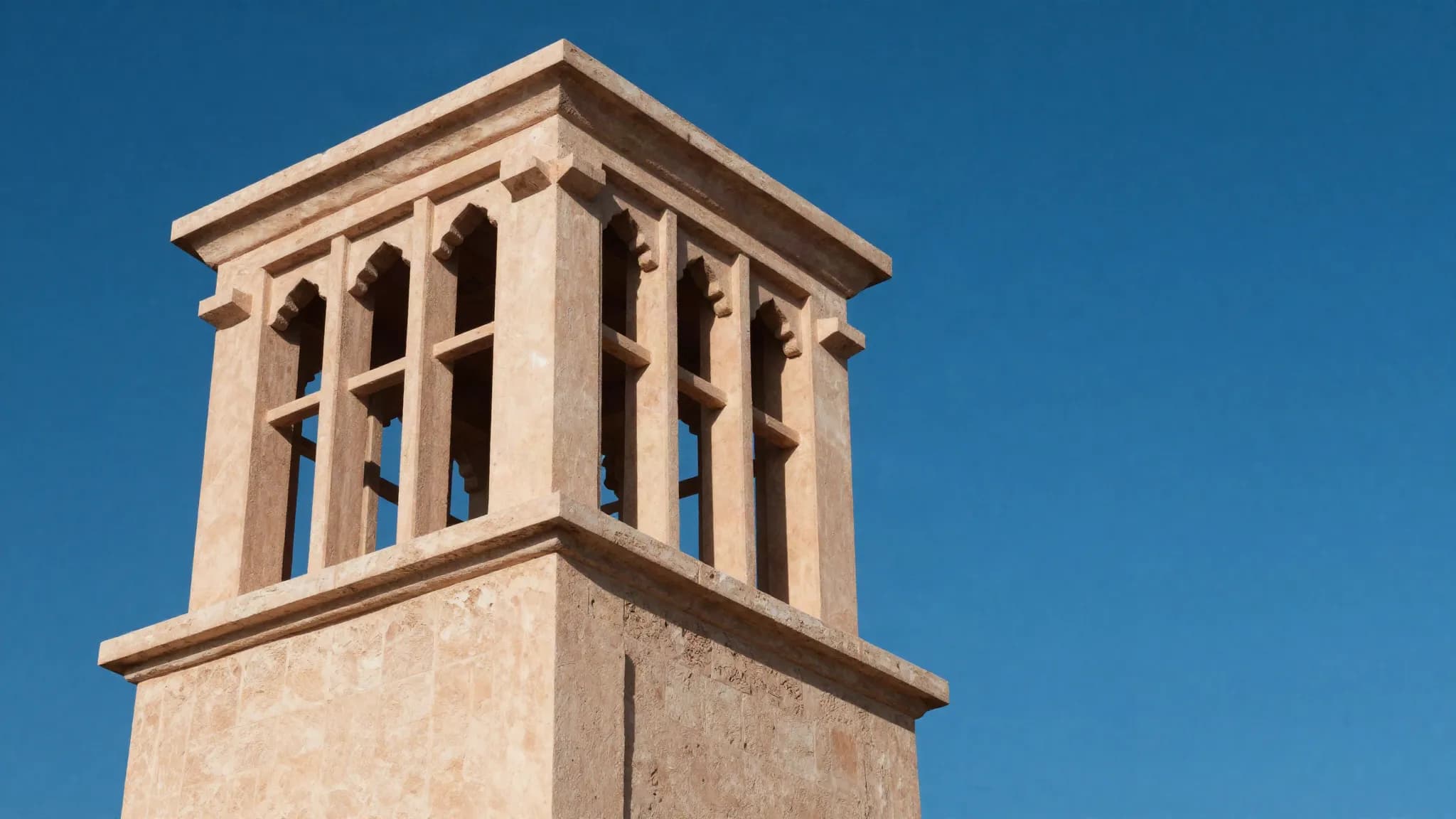
Before mechanical cooling, people lived through Gulf summers in buildings that stayed liveable. Not comfortable by modern standards, but survivable through August without electricity.
The techniques that made that possible were not folk charm. They were an engineering response to a specific climate, refined over centuries, and most of them were abandoned within a single generation of air conditioning arriving.
The four things the old buildings did
Thermal mass. Walls built thick from coral stone, mud brick or gypsum absorb heat slowly through the day and release it slowly at night. The effect is a lag: the interior peaks hours after the exterior does, and it peaks lower. In a climate with a large day-to-night temperature swing, mass alone does a great deal.
Shade before insulation. The cheapest cooling is heat that never arrives. Narrow lanes between buildings shaded each other. Openings were small, deeply recessed and screened. Mashrabiya lattice let air and filtered light through while blocking direct sun and preserving privacy at the same time.
The courtyard. An enclosed courtyard is a shaded air reservoir. Cool night air settles into it, the surrounding rooms draw from it during the morning, and the walls shade it for most of the day. Add water and planting and evaporation lowers the temperature further.
The wind tower. The barjeel is the most visible of these and the most misunderstood. Open on several faces, it catches breeze from any direction and channels it down into the rooms below. When there is no wind, it still works in reverse: hot air rises and escapes through the tower, drawing cooler air up from the courtyard. It is a passive ventilation stack that requires no input.
Why all of it was dropped
The honest answer is that air conditioning is better. It works at any humidity, at any hour, with no breeze, and it delivers a temperature the old methods cannot reach.
Once cooling became a purchasable commodity, the constraints that shaped the architecture disappeared. Glass became affordable and desirable. Land economics favoured towers over courtyard houses, since a courtyard occupies valuable plot area and produces no lettable floor space.
So the building form inverted. Small shaded openings became full-height glazing. Thick mass became thin curtain wall. Self-shading clusters became isolated towers exposed on all sides.
Each of those decisions increases the cooling load, and the increase is paid every hour of every summer for the life of the building.
What is worth bringing back, and what is not
Not everything old is worth reviving. Wind towers on a sealed, air-conditioned tower are ornament, and pretending otherwise is greenwashing.
But three principles transfer directly to contemporary construction.
Shading is the highest-return intervention available. External shading, meaning louvres, deep reveals, screens and overhangs, blocks solar gain before it passes the glass. Internal blinds do not; by the time light is inside, the heat is inside. A modern reinterpretation of mashrabiya as a perforated external screen is not nostalgia, it is the correct order of operations.
Orientation and self-shading cost nothing at the design stage and are irreversible afterwards. Minimising east and west glazing, where low sun is hardest to shade, matters more than the specification of the glass.
Courtyards and shaded ground-level space work at neighbourhood scale even where they do not work per building. A shaded, planted, sheltered route between buildings extends the number of months in which walking outdoors is tolerable, and that changes how a district is used.
The comfort question nobody asks
There is a second-order effect worth noting.
Buildings cooled to a uniform low temperature year-round produce occupants who are poorly adapted to heat. Moving repeatedly between 22C indoors and 45C outdoors is physiologically demanding, and it makes any interruption to power supply considerably more dangerous than it would otherwise be. The World Health Organization's work on heat and health is blunt that indoor overheating during outages is a leading cause of heat mortality, and our own guide to what actually works against extreme heat covers the personal side of the same problem.
Designs that allow a wider indoor temperature range, with shaded transitional spaces between inside and outside, tend to produce buildings that are cheaper to run and occupants who cope better with the climate they actually live in.
The realistic conclusion
Nobody is proposing that the Gulf abandon air conditioning. The point is narrower and more useful.
The old buildings represent a set of solutions to a problem that has not changed. The sun is in the same place, the humidity is the same, the night still cools. A building that shades itself, has mass where mass helps, and is oriented deliberately will need less mechanical cooling to reach the same comfort.
That is not heritage. It is load reduction, and it is the part of sustainable design in this region that gets skipped in favour of adding equipment.
Published in The Outspoken Digest
Newsletter
The Digest, in your inbox
One edition, sent when it is ready. No noise, and your address is never passed on.
Read Next
More Design →
Drew Henry Reset Courreges for Spring 2027 With a Pared-Back Debut at the Palais de Tokyo
Oct 1, 2026/3 min read
Choosing Light Bulbs: Lumens, Kelvin and Colour Rendering Explained, Room by Room
Sep 21, 2026/3 min read
The Bench With the Extra Armrest Is Not Being Thoughtful About Your Posture
Sep 2, 2026/4 min read