Aluminium or Steel Decides How Much Lead You Carry, and Almost Nobody Is Told Why
The standard aluminium 80 is negatively buoyant full and positively buoyant empty, which is why safety stops go wrong at the end of a dive. Steel behaves differently, and the valve and testing rules differ too.
Saturday, September 5, 2026/3 min read
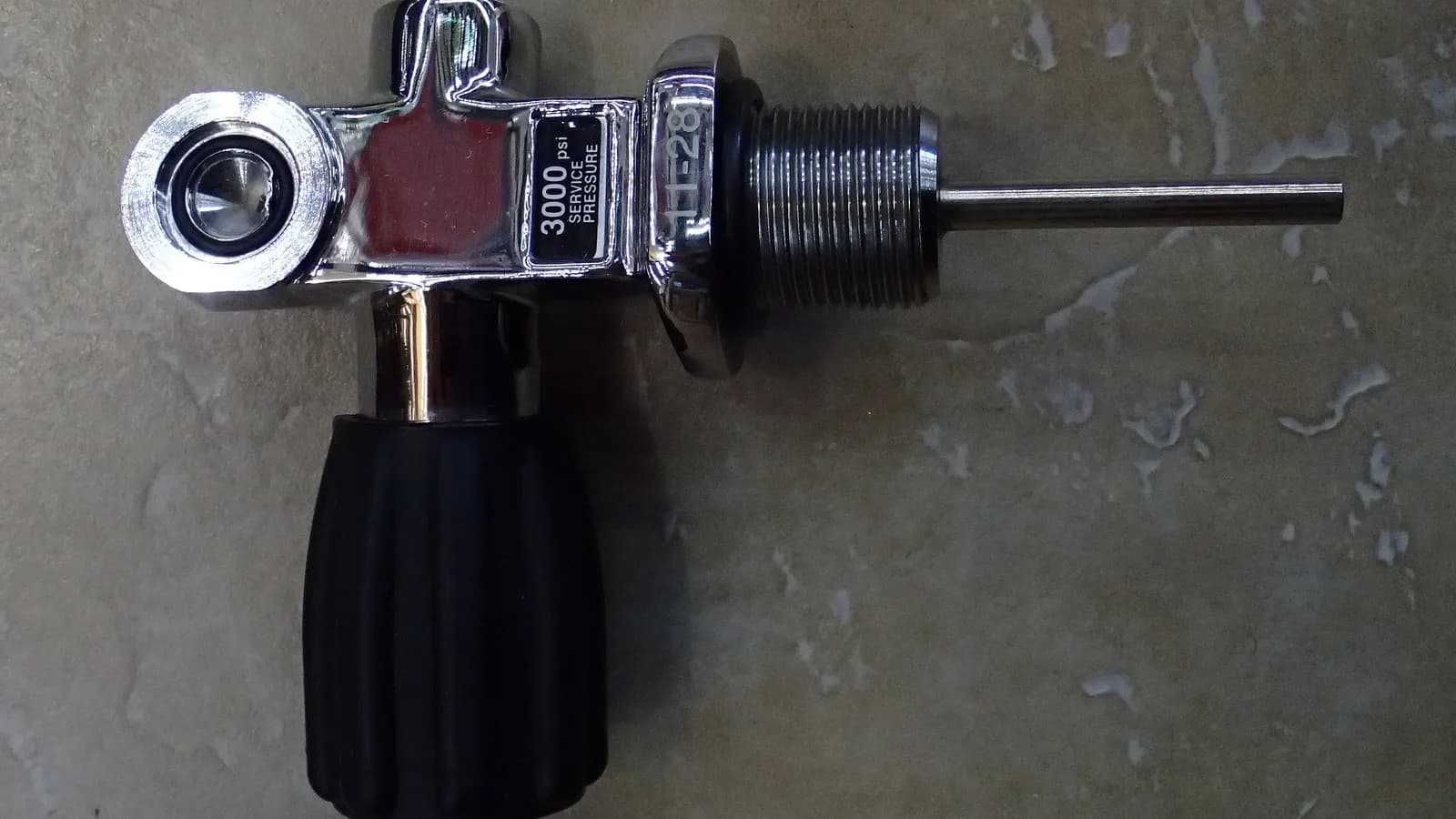
A scuba cylinder looks like the least interesting object in the kit bag. It is a metal tube that holds gas. In practice the choice between the two common materials changes your weighting, your trim and how your dive feels in the last ten minutes, and most recreational divers are never told any of it.
The buoyancy swing
Every cylinder gets lighter as you breathe it, because the gas inside has mass. A full recreational cylinder holds roughly two and a half kilograms of air, and that mass leaves over the course of the dive.
What differs is where each material starts.
The aluminium 80, the workhorse of tropical recreational diving, holds about eleven litres at 207 bar. Full, it is slightly negative. Nearly empty, it becomes roughly one and a half to two kilograms positively buoyant.
A steel cylinder of similar capacity has thinner walls for the same pressure rating, because steel is stronger, and it stays negatively buoyant throughout. Empty, it is still trying to sink.
The consequence is direct. Weight yourself for a full aluminium cylinder and you will be around two kilograms light at your safety stop, fighting to stay at five metres with an almost empty tank in whatever swell is running. That single fact explains an enormous number of struggling safety stops, and it is why the weight check has to be done at the end of the dive rather than the start, as we set out in today's piece on weighting.
Which to choose
Steel if you dive cold water in a thick wetsuit or drysuit. The suit needs lead anyway, and a steel cylinder replaces some of it with weight that sits on your back where it helps your trim rather than on a belt where it drags your hips down.
Aluminium if you dive warm water in a thin suit or a rash vest. With little suit buoyancy to offset, a heavy steel cylinder can leave you unable to establish neutral buoyancy at all at the start of a dive. Aluminium is also cheaper, more corrosion tolerant, and what every rental operation on a warm coast owns.
The trade is that aluminium cylinders are physically larger for the same gas, and heavier out of the water, which you notice walking down a jetty.
Valves, and the fitting that will catch you out
Two systems, and they are not interchangeable without an adapter.
Yoke, also called A-clamp or INT, has the regulator clamp over the valve. It is the standard in North America and much of the warm water recreational world and is rated to 232 bar.
DIN screws into the valve. It is standard in Europe and in technical diving, handles higher pressures up to 300 bar, and is less prone to being knocked off the valve, because a threaded connection cannot be levered off the way a yoke can.
The practical advice for anyone travelling to dive: carry a DIN to yoke adapter, and know which one your regulator uses. Turning up in a country that uses the other system is a common and entirely avoidable way to lose a day.
Testing, and the marks on the shoulder
Cylinders are pressure vessels and they are inspected on a schedule.
Visual inspection is annual in most regimes, internal and external, looking for corrosion, pitting and damage. Hydrostatic testing, which pressurises the cylinder in a water jacket and measures how much it permanently deforms, is typically every five years, though intervals vary by country. Both leave a stamp or sticker, and any fill station will refuse an out of date cylinder.
The rule that prevents most cylinder problems is dull and important: never breathe a cylinder completely empty, and never store one empty. A cylinder at zero pressure will draw in humid air, and moisture inside a cylinder is how internal corrosion starts. Leave 20 to 30 bar in it and have it filled with the valve closed.
Oxygen service
If you are filling with enriched air above about 40 percent oxygen, the cylinder and valve need to be oxygen clean, meaning free of hydrocarbon residues that could ignite in a high oxygen environment, and filled by partial pressure blending.
Most recreational nitrox up to 40 percent is now filled by continuous blending into standard cylinders, which is why the requirement is less visible than it used to be. It has not gone away, and it is worth knowing which regime your fill station operates. What the gas itself buys you is covered in today's nitrox piece.
Published in The Outspoken Digest
Editorial desk
Outspoken Digest Diving DeskCovers freediving, recreational and technical diving, dive medicine and the incidents the sport learns from.
Newsletter
The Digest, in your inbox
One edition, sent when it is ready. No noise, and your address is never passed on.
Read Next
More Diving →
Bleached Corals Recovered After Touching a Healthy Clone, Stanford Lab Study Finds
Oct 15, 2026/2 min read
Black Swallower Filmed With a Hugely Swollen Belly 1,259 Metres Down Off Trinidad and Tobago
Oct 13, 2026/2 min read

Playing Recordings of a Healthy Reef Drew More Coral and Fish Larvae to Artificial Structures Off Hawaii
Oct 9, 2026/3 min read

Blacktip Sharks Can Hear a Sound From Nearly 250 Feet Away and Swim Straight Toward or Away From It
Oct 1, 2026/2 min read