In a Current You Are Not Swimming Anywhere, and the Skill Is Knowing That Early
Drift diving turns a dive from a route into a ride. The techniques that make it safe are mostly about the surface and the boat, and the mistake that kills people is trying to fin against water that is stronger than they are.
Saturday, September 5, 2026/3 min read
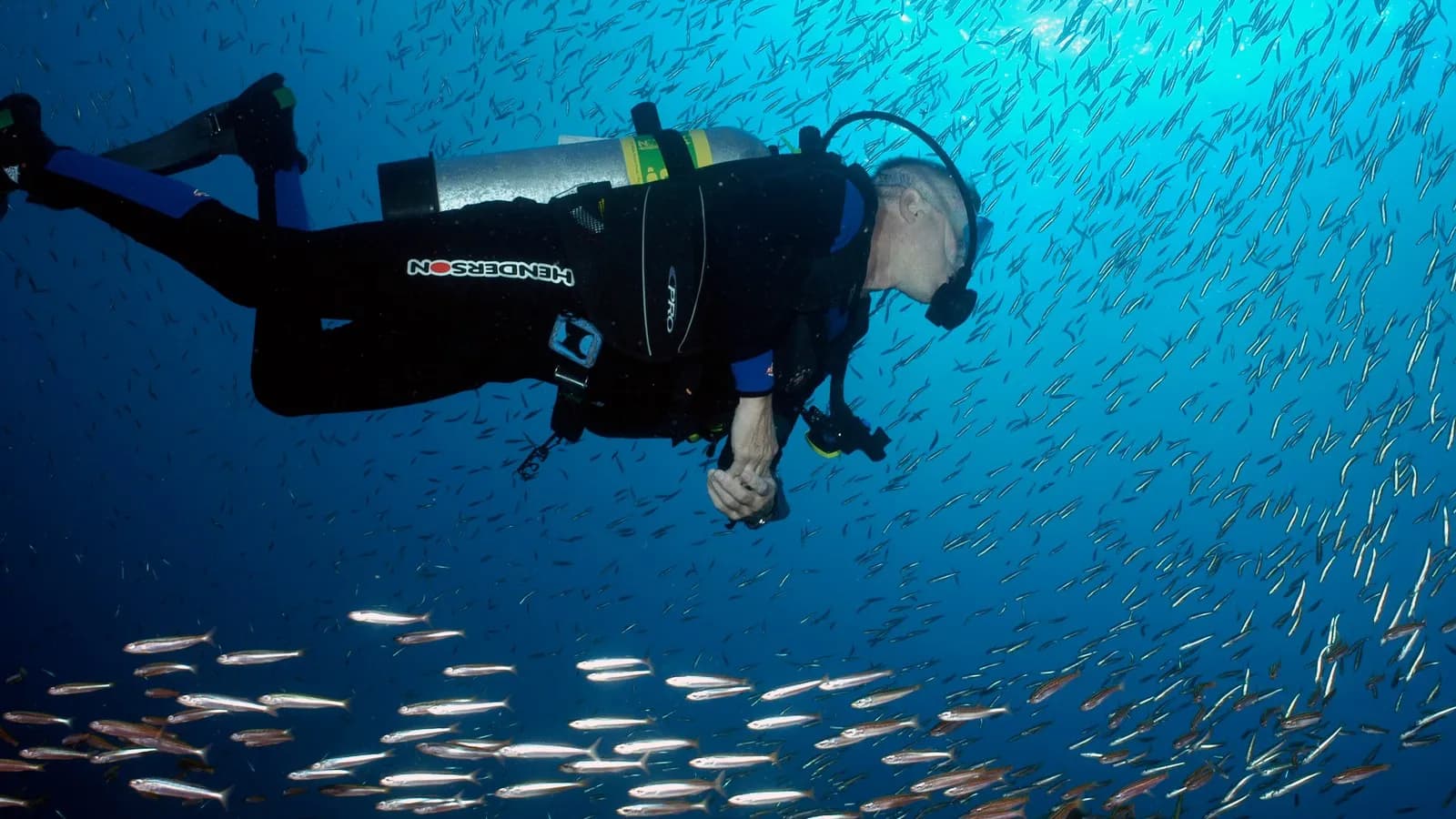
Most recreational diving is a loop. You descend, swim a route, and come back to where you started. Drift diving discards that entirely: you enter, the water carries you, and a boat collects you somewhere else.
Done properly it is the least effortful and most exhilarating diving there is, because you cover ground without working for it. Done badly it is the situation in which divers are most often separated, lost on the surface, or exhausted.
The first rule
Do not fight the current.
A fit diver in full equipment can sustain something in the region of half a knot to a knot against moving water for a short period. Currents on a drift site frequently run at two knots or more. The arithmetic is not close, and the outcome of trying is a diver who is out of breath, out of gas and still in the current.
If you find yourself finning hard and not moving relative to the reef, stop. Get low, get behind something, or accept the drift and signal. The reflex to swim back to the group is the one that has to be trained out.
Getting in
Negative entry, usually, and it is worth understanding why.
On a current site the boat cannot hold position. A conventional entry, where divers float at the surface and assemble before descending, hands the current several minutes to scatter everyone across a few hundred metres.
A negative entry means entering with the buoyancy compensator empty and descending immediately. You go in, you go down, you regroup at depth where the current is usually weaker. It requires the whole group to be ready simultaneously and the descent to be committed rather than tentative, and it is not a skill to attempt for the first time on a strong site.
What the current actually does around structure
Water is not uniform, and this is where the useful technique lives.
On the upcurrent side of a reef or pinnacle, water piles up and accelerates around the edges. Immediately behind, on the downcurrent side, there is an eddy of comparatively still water. That is where you rest, where the fish are, and where a group can regather.
The hazard is the down-current, water pushed downward as it meets structure. It is not always obvious, and it can take a diver deeper very quickly. The correct response is to swim horizontally away from the wall rather than trying to fin up against it, because the downward flow is local and the way out is sideways.
Reef hooks, a short line with a hook clipped to the harness, let a diver anchor to dead rock or rubble and hang in the flow to watch. They are standard in Palau, the Maldives and parts of Indonesia. Hook onto rock, never onto living coral, and always be able to release quickly.
The surface is the dangerous part
Almost every drift diving fatality is a surface problem, not a depth problem.
A diver on the surface in open water is very small, very low, and very hard to see against chop. If they have drifted away from the group, the boat may be looking in the wrong place entirely.
So a delayed surface marker buoy is not optional equipment on a drift site. It is the primary safety device, deployed from depth before you ascend so the boat is tracking you throughout, and we cover the technique in today's piece on SMBs and spools.
Carry a secondary signalling method that works in daylight and at distance. A whistle carries poorly across engine noise; a compact air horn on the low pressure inflator carries much further. A signalling mirror is extraordinarily effective in sun and useless in cloud. A small strobe or torch works at dusk. Carrying two that fail differently is the point.
Briefings worth listening to
On a drift site the briefing is the dive plan, and there are four things it must contain: which way the current is running, where you will be picked up, what the recall signal is, and what you do if you surface alone.
If the briefing does not cover the last one, ask. The answer should be specific: deploy your buoy, stay on the surface, stay put, keep the buoy up, do not swim for shore.
Drift conditions in this region are covered in our guide to diving Fujairah, Dibba and Musandam, and the way currents shape a trip further afield is in our Raja Ampat piece.
Published in The Outspoken Digest
Editorial desk
Outspoken Digest Diving DeskCovers freediving, recreational and technical diving, dive medicine and the incidents the sport learns from.
Newsletter
The Digest, in your inbox
One edition, sent when it is ready. No noise, and your address is never passed on.
Read Next
More Diving →
Bleached Corals Recovered After Touching a Healthy Clone, Stanford Lab Study Finds
Oct 15, 2026/2 min read
Black Swallower Filmed With a Hugely Swollen Belly 1,259 Metres Down Off Trinidad and Tobago
Oct 13, 2026/2 min read
Playing Recordings of a Healthy Reef Drew More Coral and Fish Larvae to Artificial Structures Off Hawaii
Oct 9, 2026/3 min read
Blacktip Sharks Can Hear a Sound From Nearly 250 Feet Away and Swim Straight Toward or Away From It
Oct 1, 2026/2 min read