Fatteh Batinjan: Stale Bread, Fried Aubergine, Garlic Yogurt
A dish built to use up yesterday's bread, assembled in layers while everything is still hot so half the bread softens and half stays crisp. Timing is the whole technique.
Saturday, August 15, 2026/5 min read
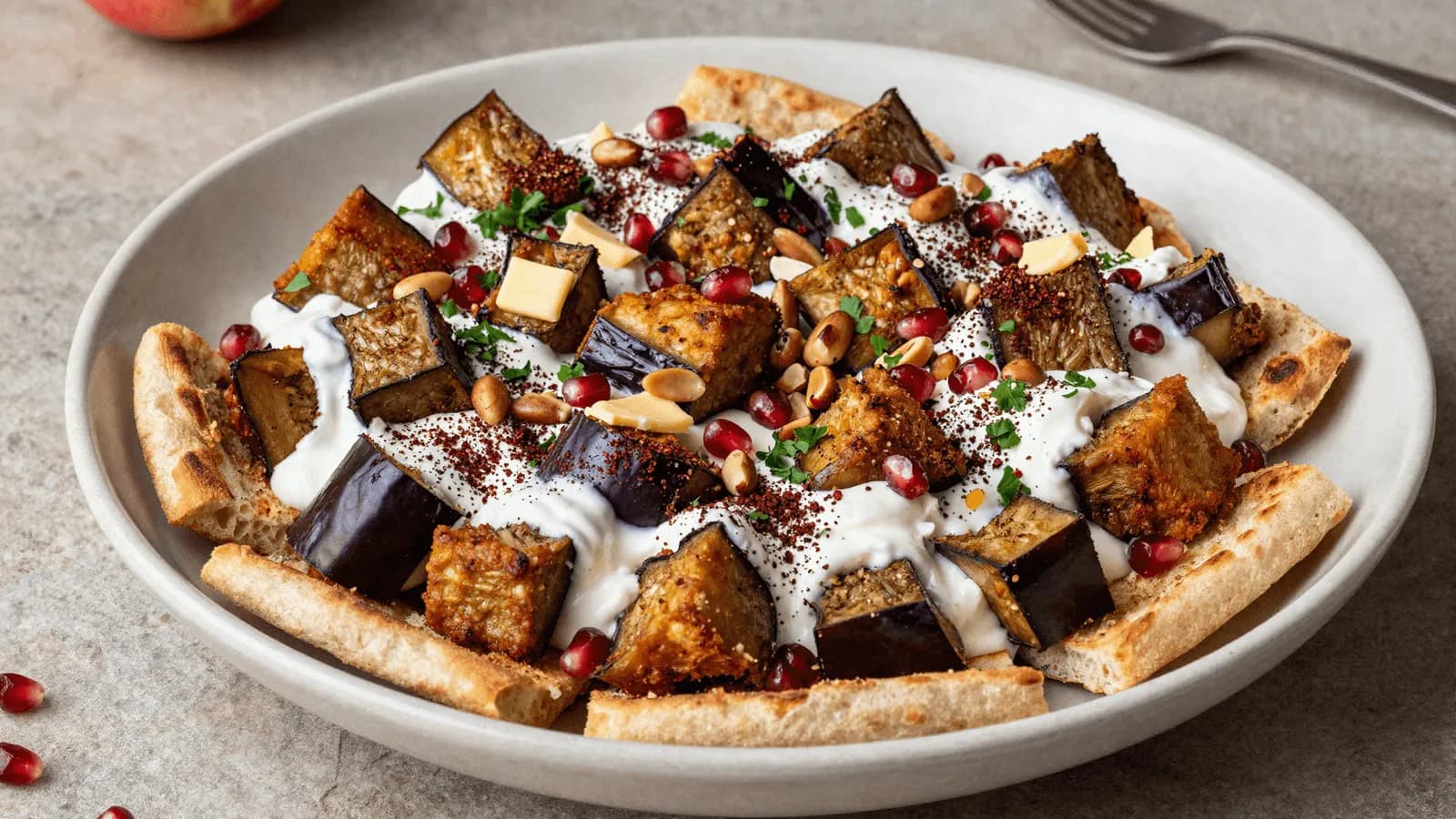
Fatteh is not really a dish, it is a construction method. The word comes from the Arabic for crumbs or breaking up, and it describes any dish built on a base of broken flatbread with something wet layered over it.
There is a whole family. Chickpeas with garlic yogurt gives you fattet hummus, the breakfast version. Lamb gives you fattet lahmeh. And fried aubergine gives you fatteh batinjan, which is the best of them and the one least often made outside the region.
Like most of the great peasant dishes it exists because bread went stale and nobody could afford to waste it.
The timing rule
Everything about fatteh comes down to when you assemble it, and the answer is at the last possible moment, with everything hot.
The bread has to be in two states at once. The pieces at the bottom, in contact with the aubergine and its juices, should soften into something that eats almost like pasta. The pieces at the top should still shatter. That contrast is the entire pleasure of the dish, and it has a working life of about five minutes.
Assemble it early and every piece of bread turns to mush uniformly. Assemble it cold and none of them soften at all and you have a salad with croutons. There is no make-ahead version of this. You can prepare all three components in advance and you must combine them at the table.
Whether to salt the aubergine
Older recipes insist on salting aubergine and leaving it to drain for an hour to remove bitterness. Modern varieties are bred with the bitterness largely gone, so that reason is mostly obsolete.
Salt it anyway, but for a different reason. Aubergine is a sponge of air pockets, and salting collapses some of that structure so it absorbs noticeably less oil when it hits the pan. Thirty minutes is enough. Then rinse and dry it thoroughly, because wet aubergine in hot oil spits violently and steams rather than frying.
Ingredients
Serves 4. About 50 minutes.
- 2 large aubergines, cut into 2 cm cubes
- Salt, for drawing out and for seasoning
- Oil for frying, or 4 tablespoons for roasting
- 2 large flatbreads or pitta, preferably a day old
- 500 g thick yogurt, full fat
- 3 cloves garlic, crushed to a paste with salt
- 2 tablespoons tahini
- Juice of 1 lemon
- 2 tablespoons butter or ghee
- 3 tablespoons pine nuts
- 1 teaspoon ground cumin
- 1 teaspoon sumac, to finish
- Handful of parsley or mint, chopped
- Pomegranate seeds, to finish (optional)
Full fat yogurt is not negotiable. Low fat yogurt is thinner, more acidic, and will slide off the bread instead of coating it.
Method
1. Salt the aubergine
Toss the cubed aubergine with a tablespoon of salt in a colander and leave it 30 minutes. Rinse well and dry thoroughly on a tea towel, pressing to squeeze water out.
Take the drying seriously. This is the difference between aubergine that browns and aubergine that stews in its own moisture.
2. Fry or roast it properly
Deep or shallow fry the aubergine in hot oil in batches until deeply golden and completely soft inside, then drain on kitchen paper.
To use less oil, toss it with four tablespoons of oil and roast at 220C for 30 to 35 minutes, turning once. It will not be quite as good but it is close, and it lets you make this on a weeknight. Either way, aubergine must be cooked properly through. Undercooked aubergine is squeaky and unpleasant, and there is no halfway point.
3. Toast the bread
Split the flatbreads open, tear them into rough pieces the size of a matchbox, and toast them in a hot oven for six to eight minutes until crisp and pale gold, or fry them in a little oil.
Day-old bread is better than fresh, which is the origin of the dish. Fresh bread has too much moisture and goes leathery rather than crisp.
4. Make the garlic yogurt
Whisk the yogurt with the crushed garlic, tahini, lemon juice and a good pinch of salt until completely smooth.
It should be pourable but not runny, roughly the consistency of double cream. Loosen it with a spoonful of water if it is too stiff to spread. Taste and correct the lemon; the sauce has to cut through a lot of fried aubergine and it needs to be sharper than seems right on its own.
5. Brown the butter and nuts
Melt the butter in a small pan and fry the pine nuts until they are golden, which takes about two minutes and demands your attention because they burn in seconds.
Take the pan off the heat and stir the cumin into the hot butter. Keep it warm; it goes on last and it should still be sizzling.
6. Assemble immediately, and serve
Spread the toasted bread over a wide shallow dish. Spoon over the hot aubergine. Pour the garlic yogurt over the top so it covers most but not all of it, then pour the cumin butter and pine nuts over that.
Finish with sumac, herbs and pomegranate seeds. Carry it to the table now, and eat it now.
What is the difference between fatteh and fattoush?
Both are built on broken bread and the names share a root, but they are different dishes. Fattoush is a cold chopped salad where the toasted bread is one component among many vegetables, dressed with lemon, sumac and pomegranate molasses. Fatteh is a hot layered dish where the bread is the base and is deliberately half-softened by a warm topping and yogurt. Our fattoush recipe covers the salad.
Can you make fatteh ahead of time?
Not assembled, no. The layers can each be prepared in advance: the aubergine fried and reheated, the bread toasted and kept in an airtight container for a day, the yogurt sauce made and refrigerated for two days. But the assembly has to happen at the table, because the entire point is the moment when some of the bread has softened and the rest has not. Fatteh that has stood for twenty minutes is a different and much worse dish.
Is fatteh batinjan vegetarian?
Yes, as written, and it is one of the more substantial vegetarian dishes in the Levantine repertoire rather than a side. To make it vegan, replace the yogurt with a thick plant yogurt or a cultured cashew base and use oil instead of butter for the pine nuts. The tahini in the sauce is doing a lot of the work already, so the substitution is less noticeable than in most yogurt-based dishes. We cover the wider picture in the vegetarian guide.
The rest of the aubergine
If you have fried more than you need, the surplus is good cold the next day with lemon and mint, and better still folded into moutabal for texture.
Aubergine carries an unreasonable share of this cuisine, and the range of what it is asked to do is set out in the aubergine guide.
Published in The Outspoken Digest
Editorial desk
Outspoken Digest Food DeskCooking, ingredients, restaurants and the economics of what ends up on the table.
Newsletter
The Digest, in your inbox
One edition, sent when it is ready. No noise, and your address is never passed on.
Read Next
More Recipes →
Swangy Tamarind Glazed Chicken Wings for the Flavour Replacing Swicy on Fast Food Menus
Sep 29, 2026/3 min read

Baked Apple Cider Doughnuts for a Cider Season That Peaked Earlier Than the Calendar Says
Sep 29, 2026/3 min read


An Obatzda Bavarian Beer Cheese Dip for the Final Stretch of Oktoberfest 2026
Sep 29, 2026/3 min read