Palestinian Food: A Guide to the Dishes, Regions and Rules
Not a single cuisine but several, split between coast, hills and desert. What defines it, which dishes matter, and why so much of it is built on olive oil, wheat and the seasons.
Sunday, August 9, 2026/3 min read
Ask what Palestinian food is and you get different answers depending on who is asked and where their family is from. That is not evasion. It is the accurate answer, because the cooking splits along the land itself.
The coastal plain around Gaza and Jaffa leans on fish, chilli and dill. The central hills around Nablus, Ramallah and Jerusalem are olive oil country, built on wheat, pulses, seasonal greens and slow-cooked meat. The Naqab in the south carries a bedouin tradition of fire cooking, dried yoghurt and simple bread.
What follows is the shape of it: the ingredients that recur, the dishes worth knowing, and the logic underneath.
The four things almost everything rests on
Olive oil. Not a finishing flourish but the cooking fat, the preserving medium and frequently the dish itself, poured over labneh or soaked into bread. The autumn harvest is the fixed point of the year in the hill villages.
Wheat. In more forms than most cuisines bother with: flour for bread, bulgur cracked coarse and fine, freekeh smoked green, and maftoul rolled by hand into pearls.
Sumac and za'atar. Sumac gives sourness without liquid, which matters in a kitchen that cannot always reach for lemon. Za'atar is both the wild herb and the blend built around it with sesame and salt.
Yoghurt, fresh and dried. Fresh as laban, strained as labneh, and dried into jameed, the hard salted rounds that dissolve back into the sauce for mansaf.
The dishes that define it
Musakhan
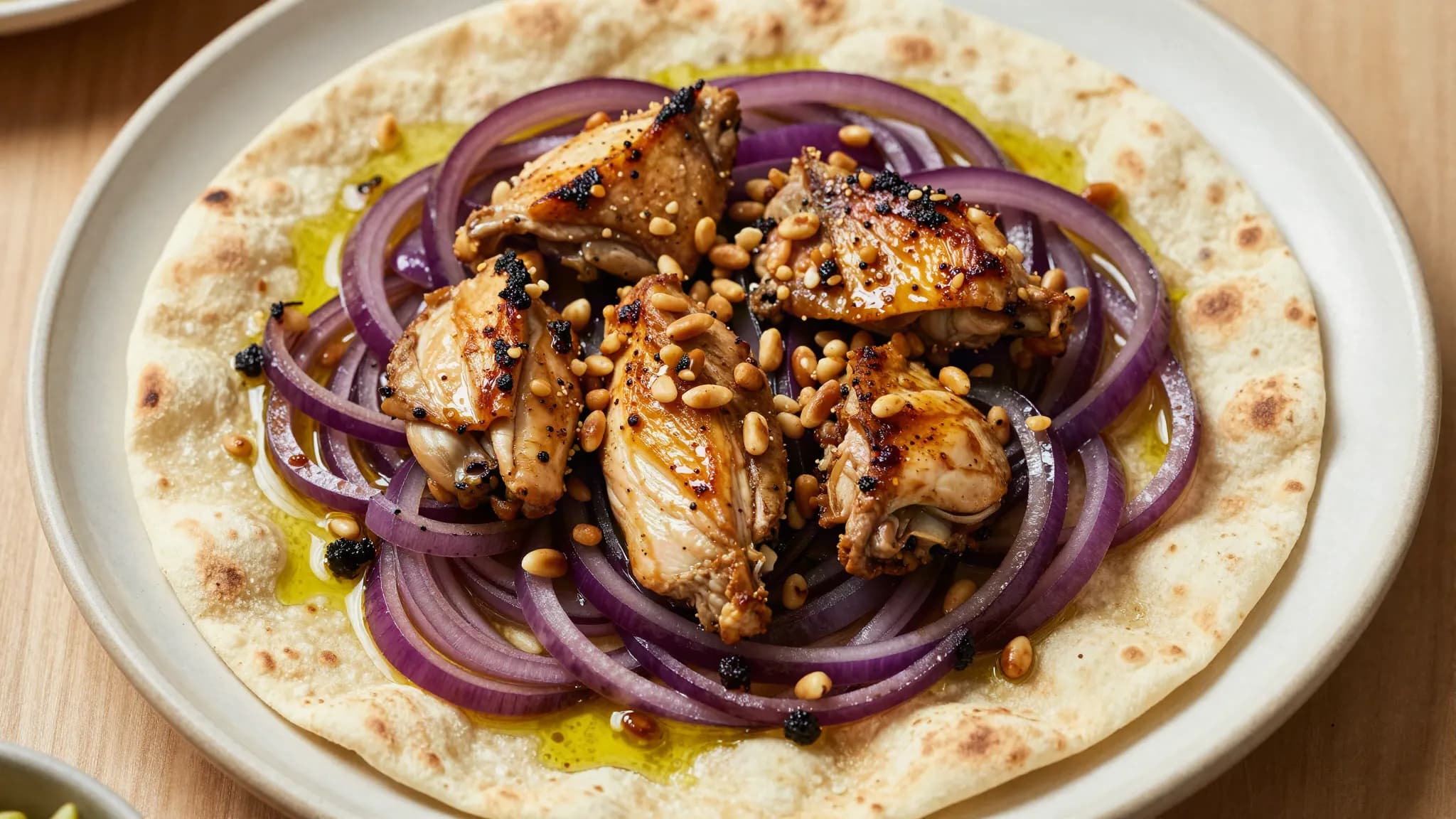
If one dish had to represent the cuisine it would be this. Taboon bread soaked in olive oil, buried under onions cooked down with a great deal of sumac, topped with roast chicken and toasted pine nuts.
It is a harvest dish, made to use new oil, and the quantities are the point: far more onion and far more oil than feels reasonable, cooked until the whole thing goes soft and purple.
Maqluba
Meaning upside down, and it is. Rice, fried vegetables such as aubergine and cauliflower, and meat layered in a pot, cooked, then inverted onto a platter so the layers hold as a standing cake. The flip at the table is the event.
Maftoul
The hand-rolled wheat pearls, much larger and nuttier than North African couscous, steamed over the broth they are served with and topped with chicken and chickpeas. We have the full method here.
Mansaf
Shared with Jordan and contested affectionately between them. Lamb cooked in a sauce of reconstituted jameed, poured over rice and thin bread, eaten communally. It is the dish of weddings and funerals, and the version made with fish in Aqaba is a genuine regional variant rather than a novelty.
Musabaha and the hummus question
Musabaha is the looser, warmer, coarser relative of hummus: whole chickpeas barely crushed, warm, with tahini, lemon and oil poured over. Eaten at breakfast, not as a dip.
The everyday food nobody photographs
Restaurant menus skew towards the celebration dishes. The daily cooking is quieter and largely vegetarian by economics rather than intention.
Mujaddara, lentils and rice under deeply browned onions. Fasoulia, white beans in tomato. Bamia, okra stewed slowly. Sayadieh on the coast, fish with caramelised onion rice. Stuffed vegetables of every kind, including cored courgettes simmered in tomato. And khubz with oil, za'atar and tea, which is what most mornings actually look like.
Foraging, which is not a trend here
Wild greens are a real part of the diet rather than a garnish. Akkoub, a thistle whose hearts are cleaned laboriously and cooked with lemon. Hindbeh, wild chicory, boiled and dressed with fried onion. Miramiyeh, wild sage, in tea.
These are seasonal, gathered rather than bought, and they anchor the cooking to a specific few weeks of a specific hillside in a way that supermarket cooking cannot reproduce.
How a table is actually built
Not as courses. A spread arrives together: several cold mezze, bread, pickles, one or two hot dishes, and a single large centrepiece if the occasion warrants it.
Salad means tabbouleh, which is a parsley dish with some bulgur in it rather than the reverse, or salata arabiyeh chopped very fine.
Sweets are their own category and mostly bought rather than made: knafeh in the Nablus style with sweet cheese under orange semolina pastry, qatayef during Ramadan, and dates with coffee that is cardamom-heavy and served in small cups.
Where to start
Cook musakhan first. It teaches the three things the cuisine runs on at once: be unafraid of olive oil, cook onions far longer than seems sensible, and let bread do work rather than sit beside the plate.
Then maqluba, for the technique. Then maftoul, for the patience.
Published in The Outspoken Digest
Editorial desk
Outspoken Digest Food DeskCooking, ingredients, restaurants and the economics of what ends up on the table.
Newsletter
The Digest, in your inbox
One edition, sent when it is ready. No noise, and your address is never passed on.
Read Next
More Recipes →
Swangy Tamarind Glazed Chicken Wings for the Flavour Replacing Swicy on Fast Food Menus
Sep 29, 2026/3 min read

Baked Apple Cider Doughnuts for a Cider Season That Peaked Earlier Than the Calendar Says
Sep 29, 2026/3 min read
An Obatzda Bavarian Beer Cheese Dip for the Final Stretch of Oktoberfest 2026
Sep 29, 2026/3 min read