A Pavilion Built From Police Riot Shields Asks What a Material Remembers
The Pangolin Shield goes up on the Strand next month, assembled from Indian police shields and rain shields over bamboo. Reuse in architecture usually argues about carbon. This one argues about meaning.
Monday, August 17, 2026/3 min read
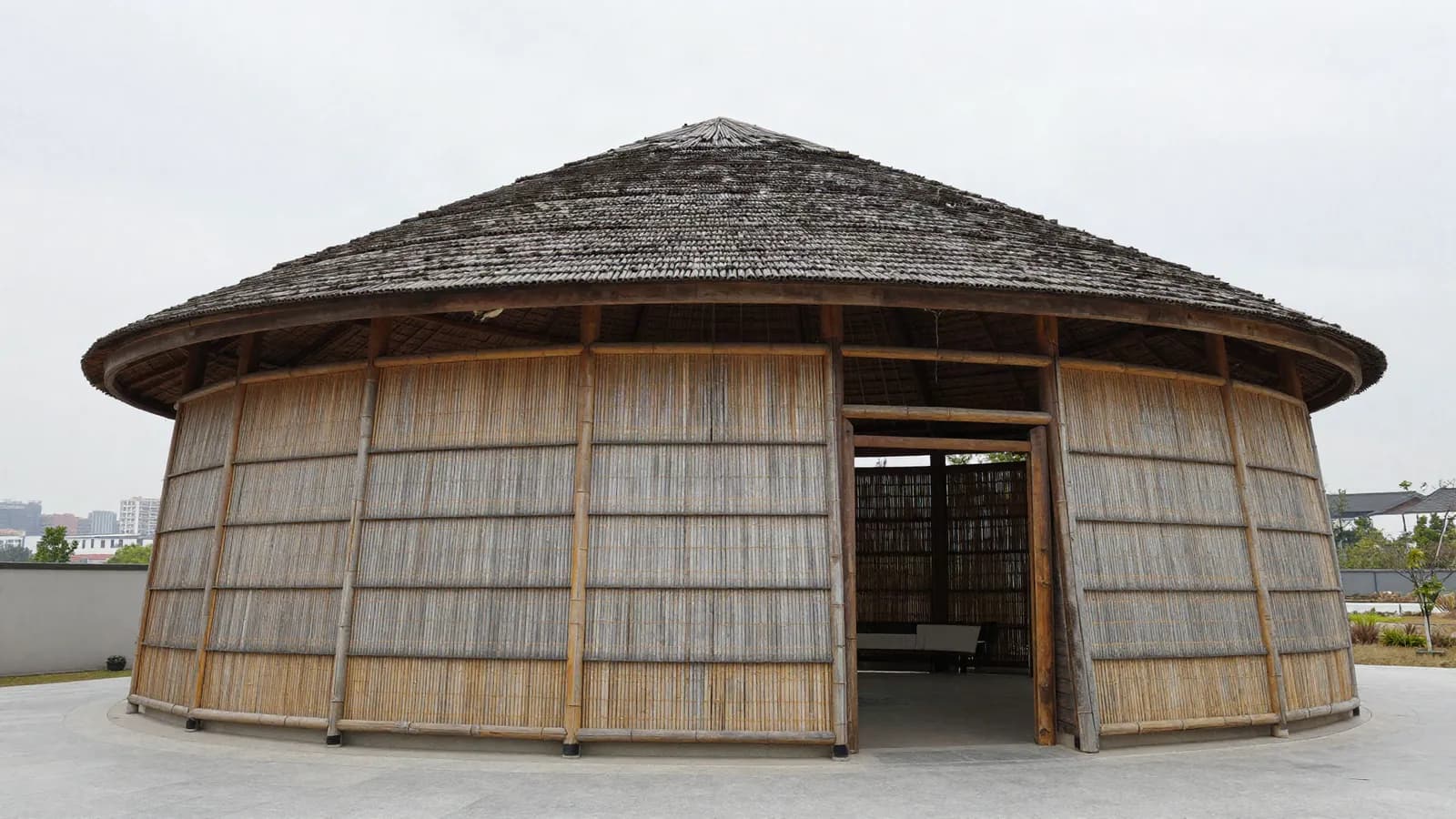
The first landmark project announced for this year's London Design Festival is a pavilion called the Pangolin Shield, by Studio Saar with engineers Atelier One. It stands on the Strand, it is built around bamboo, and its skin is made from Indian police riot shields and rain shields, overlapped like the scales the name refers to.
It faces the bust of Jawaharlal Nehru outside India House. That siting is not incidental, and neither is the choice of object.
Reuse usually argues about carbon. This argues about memory
Most reclaimed-material architecture makes an environmental case. Reused steel avoids the emissions of new steel. Salvaged brick avoids firing new brick. The argument is quantitative, it is increasingly well evidenced, and it treats the old material as neutral stuff that happens to already exist.
A riot shield is not neutral stuff. It is an object whose entire design purpose is the separation of a crowd from a state, and putting several hundred of them on a public street in London, facing a diplomatic building, is a sentence rather than a specification.
That is the interesting move. The pavilion asks whether a material carries its history into its second life, and answers yes by choosing a material whose history is impossible to ignore.
Why bamboo underneath
The structural choice is doing quieter work. Bamboo is fast growing, strong in tension for its weight, and long established across South Asia as a scaffolding and building material, which makes it a legible reference rather than a novelty.
It is also genuinely difficult to build with at this scale in a British context. Bamboo behaves anisotropically, splits at connections, moves with humidity, and does not slot into standard structural codes, which is why engineered timber has captured the low-carbon conversation while bamboo remains marginal outside the regions that have used it for centuries.
Putting a demanding natural structure under an industrial reused skin sets up the contrast the pavilion is built on: something grown holding up something manufactured for control.
What working designers can take from it
Three things transfer beyond the festival, and none of them require a temporary pavilion budget.
Sourcing is a design decision, not a procurement one. The single most expressive choice in this project happened before a drawing was made. Studios that hand material sourcing to the last stage of a job give away their strongest tool.
Reuse has an assembly problem, not a supply problem. Reclaimed components come in fixed sizes, uncertain quantities and variable condition, which means the design has to absorb irregularity rather than specify it away. Overlapping scales are a smart answer: a shingled surface tolerates variation that a flush panel system cannot.
Meaning is not free. A loaded material commits a project to an argument, and audiences will read that argument whether or not the studio intended it. That is the risk and the reason to do it.
Where it sits in the festival
London Design Festival runs from 12 to 20 September across eleven districts, with the Pangolin Shield among the landmark projects and the V&A staging an exhibition, Awakenings, that runs through its galleries. Our wider preview of the programme covers the districts and smaller studios.
The pavilion belongs to a broader shift in what design festivals are for. A landmark installation used to be a sculptural object that photographed well. Increasingly it is an argument made in material, which is harder to photograph and easier to remember.
Does reuse actually reduce impact?
Usually, and not automatically. The saving comes from avoided manufacturing, so it is real when the component is used close to where it was found and in a form near its original one. It shrinks when the material is shipped long distances, heavily reprocessed, or held in a temporary structure that is dismantled and discarded after nine days.
The honest question to ask of any festival pavilion is what happens to it on the twenty-first of September. A reuse project that ends in a skip has made an argument it did not keep. Our piece on materials being engineered rather than salvaged looks at the other end of the same problem.
Published in The Outspoken Digest
Newsletter
The Digest, in your inbox
One edition, sent when it is ready. No noise, and your address is never passed on.
Read Next
More Design →
Jaguar Type 01 Arrives as a 1,030hp Electric Grand Tourer With No Rear Window and the Concept's Look Intact
Oct 13, 2026/2 min read
Drew Henry Reset Courreges for Spring 2027 With a Pared-Back Debut at the Palais de Tokyo
Oct 1, 2026/3 min read
Choosing Light Bulbs: Lumens, Kelvin and Colour Rendering Explained, Room by Room
Sep 21, 2026/3 min read