The Same Word Is on Your Serum, Your Collagen Powder and the Vial Someone Is Selling on Telegram
Peptide is a chemical category, not a claim. The two versions most people actually buy are the ones with the least regulation and, oddly, the best safety record. Here is what the trials support and what physics gets in the way of.
Thursday, August 20, 2026/4 min read
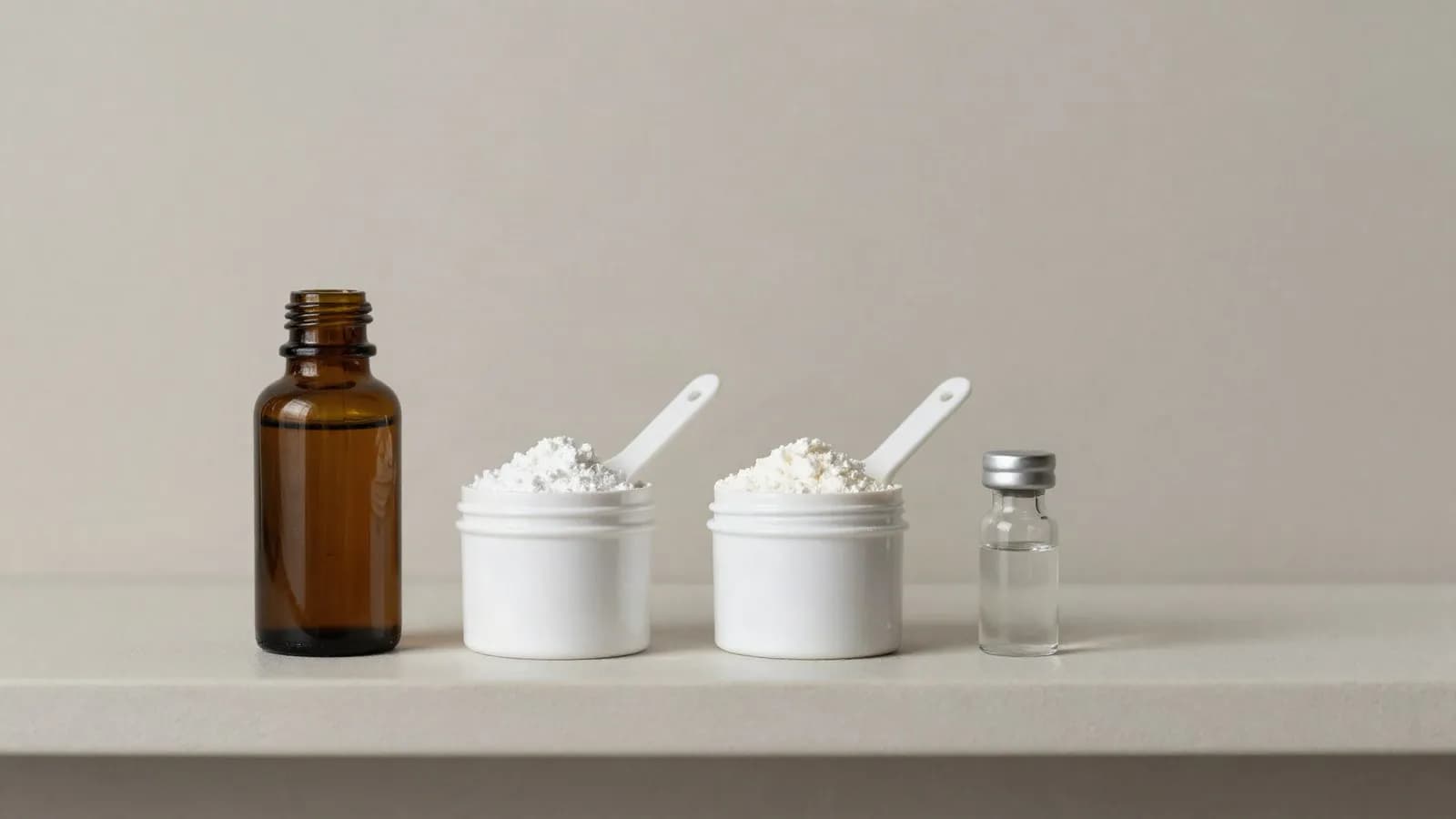
Insulin is a peptide. So is semaglutide. So is the collagen powder in your kitchen, the anti-ageing serum on the shelf, and the unlabelled vial someone is selling in a group chat. The word describes a chain of amino acids shorter than a protein. It says nothing whatsoever about whether the thing works, and we have written before about how much that gap now sells.
What is odd is the inversion. The two peptide products most people actually buy, a tub of collagen and a bottle of serum, are the least regulated of the lot and also the least likely to hurt you. The scrutiny and the risk are pointing in opposite directions.
Does oral collagen actually do anything?
More than the sceptics expected, and less than the packaging implies.
The obvious objection has always been digestive. You cannot eat a knee and grow a knee. Collagen is a protein, and your gut dismantles proteins into amino acids and short fragments before anything is absorbed. There is no postal service routing swallowed collagen to your face.
And yet a systematic review and meta-analysis of 26 randomised controlled trials covering 1,721 participants found that hydrolysed collagen supplementation significantly improved skin hydration and elasticity compared with placebo. That is a real body of evidence, not a single industry-funded trial.
The likely explanation is not that collagen travels intact. It is that the specific fragments produced when collagen is broken down, some of which do appear in blood, may act as signals rather than raw material, telling fibroblasts to get to work. Alongside that, a scoop of collagen is a meaningful dose of protein and glycine, which people with thin diets are frequently short of.
Two caveats belong on the same page as those results. Effects on hydration varied by collagen source and by how long people took it, which is a sign that the effect is real but modest and easily swamped. And skin hydration and elasticity are measurable, but they are not the same as looking younger, which is what the tub is actually selling.
Why is a serum different from a supplement?
Because a serum has to solve a physics problem that a powder does not.
Your skin's outer layer exists specifically to keep things out, and it is good at its job. The rough working rule in dermatology is that molecules much above 500 daltons struggle to get through the stratum corneum at all. Peptides are frequently larger than that and are water-loving, which is precisely the wrong profile for crossing a lipid barrier.
So the peptide that signals beautifully in a dish of fibroblasts may never reach a fibroblast. This is why formulators attach fatty acid tails, palmitoyl being the common one, to make the molecule better at slipping into a lipid environment. It genuinely improves partitioning into the outer layer. It does not guarantee arrival in the dermis, where collagen is actually made.
Which topical peptides have real evidence?
The honest ranking is short, and it separates the two big categories.
- Signal peptides, such as palmitoyl pentapeptide-4, sold as Matrixyl. These mimic the fragments released when collagen breaks down, effectively telling skin it has been damaged and should rebuild. This class has the strongest human data, including placebo-controlled split-face work and a randomised study of a 3 per cent formulation reporting reduced wrinkle volume with histological evidence of increased collagen density at 12 weeks. Histology is the part that matters: someone looked at the tissue rather than at a questionnaire.
- Neurotransmitter-inhibiting peptides, such as acetyl hexapeptide, sold as Argireline. Marketed with the phrase botox in a jar, which should always start an argument. There is human trial evidence of wrinkle improvement, including significant reductions in measured roughness. There is also skin penetration work suggesting the molecule is unlikely to reach the neuromuscular junction it is supposed to act on. Something is happening. The proposed mechanism may not be the reason.
Notice what both entries have in common. Twelve weeks. These are slow, cumulative, modest effects, and any product promising a visible change by Friday is not describing peptide biology.
How does this compare with the injectable side?
It barely does, and conflating them is how people get hurt.
A cosmetic peptide is applied to the outside of a barrier designed to exclude it, at concentrations measured in single-digit percentages, with an upper bound on harm that is essentially irritation. An injectable peptide bypasses every barrier your body has and acts on receptors that regulate blood sugar, appetite, heart rate and growth.
They share a chemical category and nothing else that matters. When a seller uses the safety record of the first to imply anything about the second, that is the whole trick. It is why what turns up in grey-market vials and the trade in unapproved drugs like retatrutide are a different subject from your moisturiser, even when the marketing language is identical.
So is any of it worth buying?
A defensible position, given what the evidence actually supports.
Collagen is a reasonable purchase if you treat it as a protein supplement with a plausible bonus rather than as a cosmetic intervention, and if you would not otherwise hit your protein target. It is a poor purchase at luxury prices, since the meta-analysis found no clear superiority between sources for elasticity, and marine collagen at four times the cost of bovine is buying a story.
A peptide serum is worth it if you already have the basics in place and want a marginal addition. It is not worth it instead of sunscreen and a retinoid, which have decades of evidence and effect sizes these peptides do not approach. Peptides are a reasonable third act. They are a poor first one.
And whatever you buy, judge it at twelve weeks with a photograph taken in the same light, not at ten days in a bathroom mirror when you are already invested.
Published in The Outspoken Digest
Editorial desk
Outspoken Digest Health DeskMedicine, public health and the research behind the headlines, read carefully.
Newsletter
The Digest, in your inbox
One edition, sent when it is ready. No noise, and your address is never passed on.
Read Next
More Health →
Kenya's Ebola Count Rises to Seven After Three Health Workers Who Treated the First Patient Test Positive
Oct 17, 2026/2 min read
BMJ Analysis Warns Fast-Growing Private Testosterone Prescribing Could Land on the NHS
Oct 14, 2026/2 min read

Cochrane Review Finds Medical Cannabis Has No Clear Benefit for Insomnia, With Weak Evidence Either Way
Oct 13, 2026/2 min read

Lancet Commission Names 17 Threats to Global Health Through 2100, With Obesity the Largest by Burden
Oct 12, 2026/2 min read