The 2026 Pritzker Went to an Architect Who Builds Small, Strange Things Out of Stone and Fibreglass
Chile's Smiljan Radic Clarke is the fifty fifth laureate of architecture's most significant prize, cited for work that is immediately recognisable and conceptually evasive. In a decade of megaprojects, the jury picked the opposite.
Saturday, August 22, 2026/3 min read
On 12 March 2026 the Pritzker Architecture Prize went to Smiljan Radic Clarke, the Chilean architect who established his practice in 1995 and who is, at 61, the fifty fifth person to receive it.
The citation described work that is immediately recognisable yet conceptually evasive, and praised his experimentation and his engagement with something fundamental about the human condition. The jury, chaired by Alejandro Aravena, credited his material experimentation, his handling of spatial perception, and his careful attention to landscape and context.
Why is this choice interesting?
Because of what it is not.
The architecture that has dominated public attention for a decade is very large, very expensive and very photographed: linear cities, cultural districts built all at once, towers that compete on height. Radic's best-known work is the opposite of all of that. It is small, it is often rural, it is built from materials that are cheap or found or awkward, and much of it would fit inside the lobby of the buildings that usually make the news.
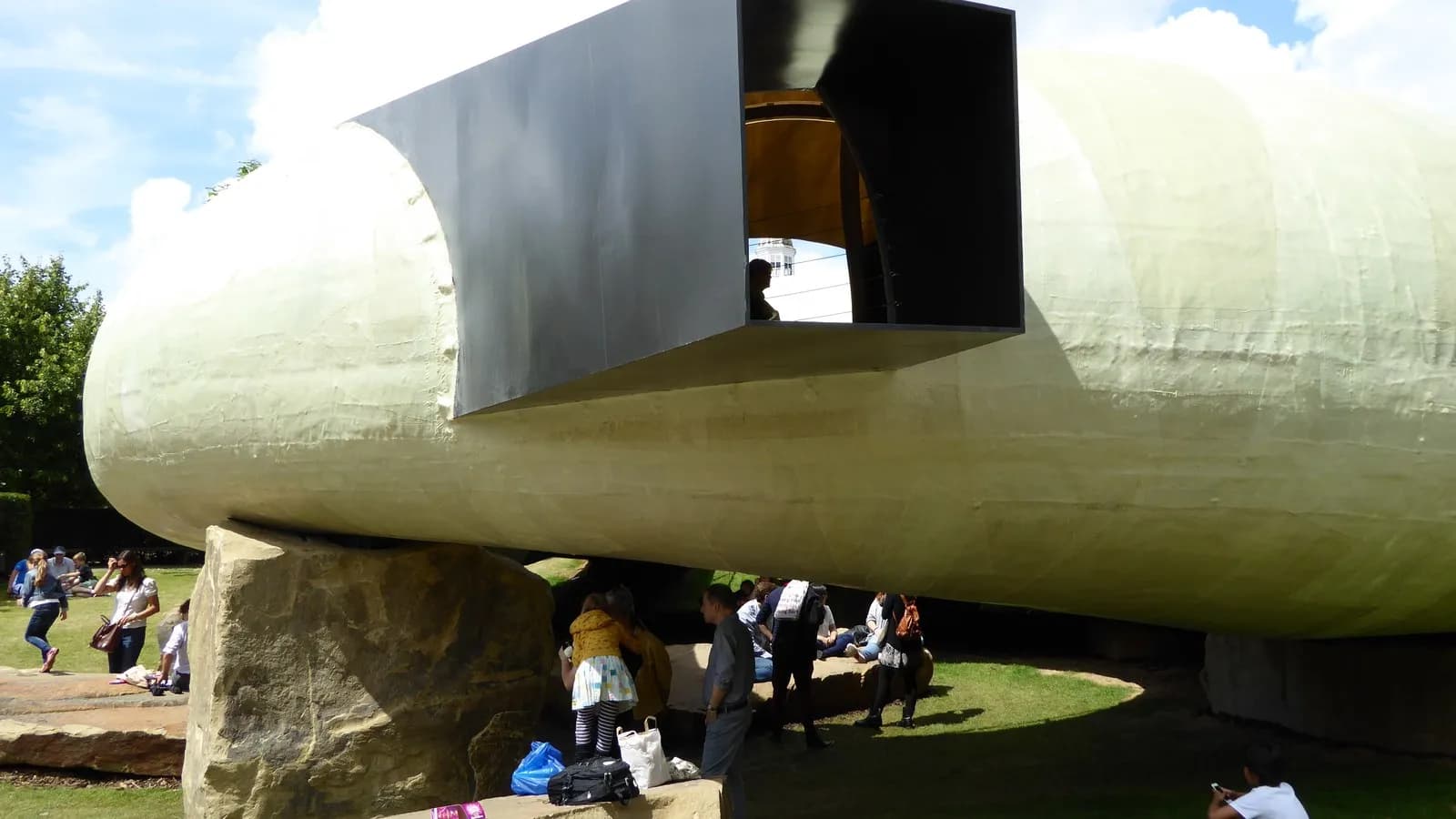
The work most international readers will have encountered is the Serpentine Gallery Pavilion he built in London in 2014, a translucent shell resting on large rough stones. It was temporary, it was modest in budget by the standards of world architecture, and it was strange in a way that photographs badly and works well in person.
Giving the discipline's highest honour to that sensibility, in this decade, is a statement about what architecture is for.
What does conceptually evasive actually mean?
It is jury language, and it is more precise than it sounds.
A building that is conceptually legible can be explained in a sentence. It looks like a wave, or a sail, or a stack of boxes. That legibility is what makes an image travel, and it is why so much recent architecture is designed to be understood at a glance on a screen.
Work that resists the sentence is harder to publicise and harder to imitate. You cannot reduce it to a diagram, which means you cannot reproduce it as a diagram somewhere else. The jury is praising something that actively works against the medium in which architecture is now mostly consumed.
Who is Alejandro Aravena and why does the chair matter?
He is the 2016 laureate, also Chilean, and the person best known for social housing that is deliberately half finished.
Aravena's practice became famous for building the structural, expensive half of a house, the part families cannot construct themselves, and leaving the rest for residents to complete as they could afford it. It was an argument that architecture's job is to spend limited money where it does the most good rather than to produce a finished object.
A jury chaired by that person, awarding an architect whose work is material, restrained and hard to reproduce, is a coherent position rather than a coincidence. Radic is the second Chilean to win, after Aravena himself.
How does it fit the recent list?
It continues a direction rather than breaking one.
- 2022: Diebedo Francis Kere, for schools and clinics in Burkina Faso built with local clay and local labour.
- 2023: David Chipperfield, for restraint and for restoration work.
- 2024: Riken Yamamoto, for architecture organised around community rather than the isolated dwelling.
- 2025: Liu Jiakun.
- 2026: Smiljan Radic.
Read together, the last five awards are consistently uninterested in spectacle. That is the actual news here. The prize has spent half a decade honouring architects who work with modest budgets, local materials and social conditions, during precisely the period when the most visible architecture in the world was doing the reverse.
Does that tell us anything about where design is going?
It tells us what the discipline honours, which is not the same as what gets built.
The money still goes to the large projects. But the profession's own judgement of merit has moved decisively towards material intelligence and restraint, and juries lead client taste more often than they follow it. The same instinct is visible in interiors, where the interest has shifted from finish to substance, something we traced in the return of colour and craft.
It is also a useful corrective to the assumption that ambition and size are the same thing. The most demanding constraint in architecture is rarely how tall you can build. It is what you can do with a small budget, a difficult site and materials nobody considers prestigious, which is the problem Radic has spent thirty years on, and the reason the region's own building programme is now being judged on whether it works at human scale.
Published in The Outspoken Digest
Newsletter
The Digest, in your inbox
One edition, sent when it is ready. No noise, and your address is never passed on.
Read Next
More Design →
Jaguar Type 01 Arrives as a 1,030hp Electric Grand Tourer With No Rear Window and the Concept's Look Intact
Oct 13, 2026/2 min read
Drew Henry Reset Courreges for Spring 2027 With a Pared-Back Debut at the Palais de Tokyo
Oct 1, 2026/3 min read

Choosing Light Bulbs: Lumens, Kelvin and Colour Rendering Explained, Room by Room
Sep 21, 2026/3 min read