Frank Gehry's Largest Museum Opens in Abu Dhabi on 11 December, a Year After He Died
Ten cones rising to eighty eight metres, thirty galleries and twenty three thousand square metres of outdoor exhibition space. The Guggenheim Abu Dhabi is the last and biggest building by the architect who made a museum into an economic strategy.
Saturday, August 22, 2026/4 min read
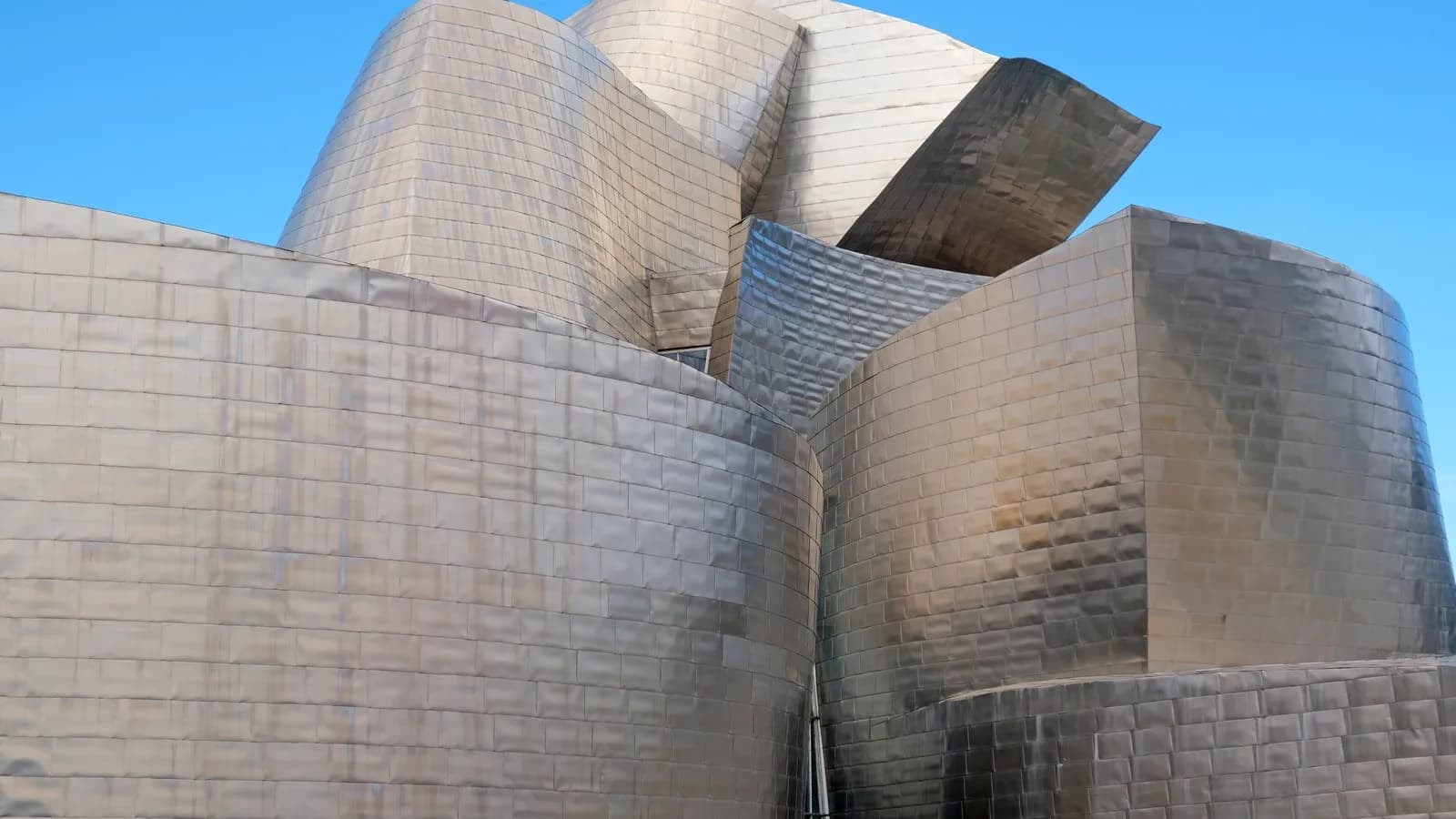
The Guggenheim Abu Dhabi opens on 11 December 2026, in the Saadiyat Cultural District. It is the largest museum Frank Gehry ever designed, and he will not see it open. Gehry died at his home in Santa Monica on 5 December 2025, after a brief respiratory illness, at the age of 96.
The building therefore arrives as something unusual: a major work by one of the defining architects of the last fifty years, completed and opened without him, almost exactly a year after his death.
What is actually being opened?
A building large enough that the numbers do most of the describing.
- Around 80,000 square metres in total.
- 11,600 square metres of gallery space across 30 galleries.
- 23,000 square metres of outdoor exhibition areas, which is an unusual proportion for a museum and a deliberate one.
- Ten sculptural cones, nine clad in stainless steel mesh and one in onyx and glass, rising to as much as 88 metres.
The cones are the part most people will photograph and the part most likely to be misread. They are not only sculpture. They are described as providing natural ventilation and shade, and as improving the building's energy performance. In a climate where a museum's largest running cost is keeping air conditioned and stable, a form that shades itself and moves air is doing structural work, not decorative work.
Why does the outdoor gallery space matter?
Because it is a bet about how people use a museum in the Gulf.
Twenty three thousand square metres outdoors is nearly twice the indoor gallery area. A museum in northern Europe would not make that trade, because the weather forecloses it for most of the year. Abu Dhabi has an eight month season in which outdoor space is genuinely usable and four in which it is not, which makes the calculation completely different.
It also changes what the institution can be. Indoor galleries hold objects. Outdoor space holds people, events and works that would not fit through a door. This is the same logic that runs through the wider question of how to design for forty five degrees rather than designing against it.
What is the Bilbao question?
Whether the effect that made Gehry famous still works, thirty years on.
In 1997 the titanium-clad Guggenheim in Bilbao turned a declining industrial port into a destination, and the phrase Bilbao effect entered urban policy. Cities the world over commissioned striking buildings from famous architects hoping to reproduce it. Most did not. The effect was never really about the roof; it was about a city with a coherent regeneration plan that used a building as its centrepiece.
Abu Dhabi is the most heavily capitalised test of the idea ever attempted, and it is not attempting it alone. The Guggenheim joins the Louvre Abu Dhabi, the Zayed National Museum, the Natural History Museum Abu Dhabi and teamLab Phenomena in a single district. That is not a Bilbao. That is a museum quarter, built at once, on the theory that a cluster does what a single landmark could not.
Whether it works is a genuinely open question, and it is a different one from whether the architecture is good. This is the same distinction we drew when looking at a decade of Gulf skylines.
How is the collection being organised?
Not by geography, which is the more interesting decision.
Rather than a linear or geographic hang, the museum presents art through what it describes as an Abu Dhabi lens, tracing cross-cultural connections. In practice that means refusing the standard structure in which Western modernism is the spine and everything else is arranged around it.
That is easy to say and hard to execute. It requires curators to make claims about relationships between works from different traditions, and those claims can be wrong in a way that a chronological hang cannot. It is a more exposed position, and a more interesting one.
What does it mean that he did not live to open it?
Less than the sentiment suggests, and more than nothing.
Buildings at this scale outlast their architects routinely. Gaudí has been dead for a century and the Sagrada Família is still being finished. What is different here is compression: Gehry was working into his nineties, the design is unmistakably his, and the gap between his death and the opening is twelve months rather than fifty years.
His career had a shape that this building closes. The Santa Monica house he rebuilt for himself in 1978 announced a way of working with cheap materials and awkward geometry. Bilbao in 1997 turned it into an international language. The Walt Disney Concert Hall and the DZ Bank building in Berlin extended it. Abu Dhabi is the largest version of the same idea, and it opens into a world where computational design has made the geometry he once had to fight for entirely routine, a shift we looked at in what actually changed in design this year.
The buildings that made him famous were difficult to draw, difficult to engineer and difficult to pay for. That difficulty was part of the argument. What opens in December is the last time anyone will be able to say that about a Gehry.
Published in The Outspoken Digest
Newsletter
The Digest, in your inbox
One edition, sent when it is ready. No noise, and your address is never passed on.
Read Next
More Design →
Jaguar Type 01 Arrives as a 1,030hp Electric Grand Tourer With No Rear Window and the Concept's Look Intact
Oct 13, 2026/2 min read
Drew Henry Reset Courreges for Spring 2027 With a Pared-Back Debut at the Palais de Tokyo
Oct 1, 2026/3 min read

Choosing Light Bulbs: Lumens, Kelvin and Colour Rendering Explained, Room by Room
Sep 21, 2026/3 min read